Also, keep a look out for Dolly Freed's Possum Living. She inspired me over twenty years ago to pursue simplicity in all forms, she and her dad kept and ate rabbits and she goes into detail about how they did it. It's good to see this practical suggestion here. I will likely give this a try when we get settled in America, though I'm not sure I'll be able to kill them, rabbits are also excellent lawnmowers and they fertilize as they go.
Showing posts with label voluntary simplicity. Show all posts
Showing posts with label voluntary simplicity. Show all posts
Tuesday, 9 March 2010
Rabbits, not just a garden menace, they are food.
Also, keep a look out for Dolly Freed's Possum Living. She inspired me over twenty years ago to pursue simplicity in all forms, she and her dad kept and ate rabbits and she goes into detail about how they did it. It's good to see this practical suggestion here. I will likely give this a try when we get settled in America, though I'm not sure I'll be able to kill them, rabbits are also excellent lawnmowers and they fertilize as they go.


Sunday, 28 February 2010
simple pleasures - a cast iron pan

I think one of my personal challenges is to allow myself to happily live a lifestyle that is less sustainable until I can make it more so. For some time I've been chafing to get back to cooking with cast iron. Not only is teflon carcinogenic but it requires some nasty chemical processing and is energy intensive besides. It is also fairly short lived compared to cast iron, an ancient technology that can be produced at the village scale and will outlive you if taken care of.
I had some cast iron cookware in America, some was my mothers, some my grandmothers. I left it behind. As I've been moving around quite alot since then I've been reluctant to haul around cast iron cookware, getting by with what I could find in thrift stores and garage sales.
Then just yesterday I was emptying the household rubbish and saw an interesting handle sticking up from the depths of the dumpster. I reached in and pulled out a lovely little cast iron frying pan, just right for an omelette. And the coolest bit is that it has an extra long keep-cool hollow handle that has obviously been retrofitted since initial manufacture. Somebody loved this pan! The sad part is that we're living with Jacq's mum at her sheltered housing complex and stuff gets thrown out when the residents die or get too feeble to use it. I'm happy to give this little pan a longer life. As I rescued it from oblivion Jacq looked at me askance and said "you aren't planning on taking that to America are you?" Nah, I've got some waiting there for me. This sweet little pan will give me loads of joy till we leave, I will take it to Devon with me. Then I'll try to find someone to pass it on to.
So I realized this evening after using it for the first time how content I felt to be scrubbing my little pan with salt, carefully drying it and storing it away. The satisfaction of taking one more step, Ok so it's a really small one, towards sustainability. Just one more thing I don't have to give myself grief about, simple pleasures.
If you're interested here is a good starting point
http://en.wikipedia.org/wiki/Cast-iron_cookware
Thanks to the Cast Iron Society for the image.
Friday, 1 January 2010
Video - Resurgence - Elegant Simplicity
"Satish Kumar prescribes a simple solution to the unnecessary materialism pervading global culture. Visit http://www.resurgence.org to find out more "
Ringing in the New Year, a resolution of simplicity.

It was a mostly clear night, the blue moon shone through the occasional thin cloud. As I walked home from sharing an organic cider along with lively and productive debate with a good friend, avoiding lingering icy patches, warming my hands with my pipe, the moon began to diminish as the shadow of the earth was cast across it. I don't usually buy into the New Years eve hype but this one felt special, a lunar eclipse to signpost a new era. I felt as if I had been rung like a bell. I relit my pipe and stood stock still, gazing on this beauty offered to me on the last night of the first decade of the 21st century.
And what a decade it has been, as of February it will be a decade since I married my dearest wife, a decade of life in far flung places, adventures on the sea, on the rocks, and in the mountains. A decade of learning, study and action. Half the decade was spent living off grid, a lifestyle that has guided so much of our decision making process ever since.
And unfortunately it has been the warmest decade for the planet ever recorded. As we embark upon, what is likely to be, the new warmest decade ever and face the challenges and responsibilities that will bring, I have found renewed commitment to living a sustainable life to whatever degree is physically and financially feasible. Amongst all the efforts I have made and am committing to make towards that end, I can identify a trend, it is simplicity.
I wish to distill my life down to it's requisite elements; water, food, shelter, love, and community. In so doing I will inevitably, if done mindfully, reduce my carbon footprint, enhance my own quality of life, support those I love, and contribute to my community.
This is my resolution.
Thanks to Tech Dreams for the image.
Sunday, 29 March 2009
Earth Hour, What did you learn?
And more importantly how will you change your behaviour? I mostly read by windup head torch for the hour and did some gardening jobs, some yoga, and tidied up our room. I also took a stroll a few blocks around mainstreet Hamilton Bermuda. There did seem to be quite a lot of lights off but not nearly enough. I appreciate the statement of solidarity with those fighting to deal with climate change but Earth Hour should provoke change. Myself, I intend to be more careful about turning off power strips, and thus all the devices attached to them. I already read by windup headtorch most nights and will continue to. I never use the tumble dryer as we have very high quality solar drying potential here in Bermuda, though I never used it in the UK where we had somewhat lower quality solar resources. So today I hung out my clothes in the warm breeze. Later, I'll be walking the hour or so it takes to get to my friends house for dinner and a film.
But what would it take to go further? I like this idea found on Living the Frugal Life.
"Some of the blogs I read that deal with preparing for life after peak oil, or the next great depression, or political collapse strongly suggest turning off the electricity at the junction box for a weekend or a week, just to see how well you can function without it, and to see in what areas you'd like to be better prepared or equipped. I've never done this. But having just turned off the lights for an hour and a half last night, I can see that some sort of light other than oil lamps would sure be nice, if it came to that. Perhaps solar lanterns, or some hand-cranked battery powered lighting. Reading by oil lamps would probably ruin my eyesight sooner rather than later. It took less than an hour with the lights turned off to learn this."
As we are staying in a guest house I won't be able to do this but it is similar to the Free From Power days I did when we lived in Sheffield. Here's more on those;
2nd FFPD
3rd FFPD
Thanks to Cliffird Wirth over at Surviving Peak Oil for the heads up on that Furgal Living site.
But what would it take to go further? I like this idea found on Living the Frugal Life.
"Some of the blogs I read that deal with preparing for life after peak oil, or the next great depression, or political collapse strongly suggest turning off the electricity at the junction box for a weekend or a week, just to see how well you can function without it, and to see in what areas you'd like to be better prepared or equipped. I've never done this. But having just turned off the lights for an hour and a half last night, I can see that some sort of light other than oil lamps would sure be nice, if it came to that. Perhaps solar lanterns, or some hand-cranked battery powered lighting. Reading by oil lamps would probably ruin my eyesight sooner rather than later. It took less than an hour with the lights turned off to learn this."
As we are staying in a guest house I won't be able to do this but it is similar to the Free From Power days I did when we lived in Sheffield. Here's more on those;
2nd FFPD
3rd FFPD
Thanks to Cliffird Wirth over at Surviving Peak Oil for the heads up on that Furgal Living site.
Saturday, 15 November 2008
The Venus Project
I like the ethos behind the Venus project quite alot. But I tend to be wary of projects and intitiatives that rely on advanced technology to solve our problems, it always seems to be just around the corner and in the meantime all we have to do is drive a little less, recycle, and eat less meat.
The one thing I totally agree with is that our culture needs to be totally redesigned. I just happen to believe we need to do it now with available technology that can radically change the way we live our lives. I expect there will be an intersection of the two approaches. In the meantime we need to do quite alot more than the minimum in our personal lives.
The one thing I totally agree with is that our culture needs to be totally redesigned. I just happen to believe we need to do it now with available technology that can radically change the way we live our lives. I expect there will be an intersection of the two approaches. In the meantime we need to do quite alot more than the minimum in our personal lives.
Sunday, 5 October 2008
2nd Free From Power Day Report - By Robb
Planning pays off! In the month between the first FFPD and yesterday I built a rocket/vita stove, gathered and dried fuel for it (see below), planned out my menu and gathered my food. Fortunately we had rain so I had some nice fresh water as well though I had a large reserve if needed.
I boiled about 4 liters of water for my use for the day , most of which went to flasks for tea, it was a cold rainy, windy day after all. I boiled another couple of liters to cook eggs and sweet corn. I used a bundle of sticks and scrap wood about 8" in diameter and 12 to 14" long for all of that. I lit it once and did all my cooking for the day. Relighting would be significantly less efficient. I'll detail the stove itself in another post.
In addition to the eggs (sourced from a local farm a 3 mile walk away) and corn (from our organic box delivery), I ate about 4 ounces of organic muesli with organic rice milk (the two most heavily packaged and shipped foods of the day) and locally picked blackberries, one cucumber and 8 ounces of tomatoes from our organic garden, 4 ounces of tortilla chips (unfortunately non organic and packaged), about 6 small apples from a tree up the street, and finally some apple juice pressed from local apples at the local sustainable wood fair I took my nephew to. More planning is necessary for food requirements.
I did well on most other fronts, no electronic media, instead I read half of Rob Hopkins "The Transition Handbook". This is an excellent read for anybody wishing to assist their community in getting prepared for a post oil economy as it lays out the proven techniques used by many transition initiatives around the world.
I managed to avoid using any lights (except when I went into the cellar, same as last time, I need to plan for this better), I never turned on any heat and stayed either outside or in our solar heated conservatory all day, I used rainwater to wash and flush with, boiled for brushing teeth, I drank boiled rainwater, I borrowed my friend Graemes wind up torch for reading at night (I must get one before the next FFPD).
I did purchase some local produced venison sausages for next days dinner. I would have skipped this except they have a stand at the fair and it is the only way to source them currently without a long journey.
So all in all I made progress but there is more to make.
I boiled about 4 liters of water for my use for the day , most of which went to flasks for tea, it was a cold rainy, windy day after all. I boiled another couple of liters to cook eggs and sweet corn. I used a bundle of sticks and scrap wood about 8" in diameter and 12 to 14" long for all of that. I lit it once and did all my cooking for the day. Relighting would be significantly less efficient. I'll detail the stove itself in another post.
In addition to the eggs (sourced from a local farm a 3 mile walk away) and corn (from our organic box delivery), I ate about 4 ounces of organic muesli with organic rice milk (the two most heavily packaged and shipped foods of the day) and locally picked blackberries, one cucumber and 8 ounces of tomatoes from our organic garden, 4 ounces of tortilla chips (unfortunately non organic and packaged), about 6 small apples from a tree up the street, and finally some apple juice pressed from local apples at the local sustainable wood fair I took my nephew to. More planning is necessary for food requirements.
I did well on most other fronts, no electronic media, instead I read half of Rob Hopkins "The Transition Handbook". This is an excellent read for anybody wishing to assist their community in getting prepared for a post oil economy as it lays out the proven techniques used by many transition initiatives around the world.
I managed to avoid using any lights (except when I went into the cellar, same as last time, I need to plan for this better), I never turned on any heat and stayed either outside or in our solar heated conservatory all day, I used rainwater to wash and flush with, boiled for brushing teeth, I drank boiled rainwater, I borrowed my friend Graemes wind up torch for reading at night (I must get one before the next FFPD).
I did purchase some local produced venison sausages for next days dinner. I would have skipped this except they have a stand at the fair and it is the only way to source them currently without a long journey.
So all in all I made progress but there is more to make.
Friday, 3 October 2008
October Free from Power Day
Tomorrow is the first Saturday in October and therefore it's Free From Power Day. You can read a report on the first Free from Power Day, in september by clicking here;
first report
As using electricity and media are not allowed I will post about my progress on Sunday.
first report
As using electricity and media are not allowed I will post about my progress on Sunday.
Sunday, 7 September 2008
report on the first Free From Power Day -By Robb
It went pretty well. There were a couple of oops moments when my instincts took over but for the most part I'm encouraged and have begun to plan October's Free From Power Day.
Results:
• For 24 hours I used no grid electricity, aside from 5 oops moments where I turned on a light without thinking which I quickly turned back off. Lighting was provided by a windup torch on loan from my friend Graeme.
• For 24 hours I used no fossil fuels of any kind; not to cook, heat, or drive.
• For 24 hours I turned on no taps for water aside from one oops moment when brushing my teeth. Toilet was flushed with rainwater. Hands were washed with rainwater. More about water below.
• For 24 hours I connected to no electronic media aside from listening to some classical music on a windup/solar radio. This was a big one for me as I usually spent alot of time on the computer, listening to mp3 player and even a few hours watching TV every day.
• For 24 hours I bought nothing, this was easy as I don't usually buy anything anyway.
Challenges:
Water - I collect rainwater for my garden and I was happy to use that to wash with but for drinking I did not prepare a purification method. Thus I drew water from the taps the night before for drinking. I made a flask of tea with the kettle and super insulated it overnight. This was my biggest failing as it meant I still consumed tap water and had used fossil fuel to make tea, just not on the day.
Food - For most of the day I did well. I ate English organic apples, though they had been purchased from a supermarket the week before, something I will try to remedy for next time. I foraged for berries and raw nettles on a 7 mile walk. I ate runner beans and tomatoes from my garden. My biggest failing was the bag of tortilla chips and salsa I ate in the evening. I did manage to never open the fridge during the day however.
Plans:
I am going to devise a method for purifying rainwater and cooking via a biomass cooker, probably something like a Vita stove. It will have to be small and very smoke free for use in this urban jungle I live in. I will collect and dry fuel in advance.
I will source local organic non-corporate unpackaged food in advance. There is a farm within a 3 mile walk of my house to source free range eggs, I will try to gather/forage more in advance, I will locate a green grocer selling local veg.
If weather permits I will set out my portable solar hot water heater for washing.
What I did:
As mentioned I walked and foraged, I worked in the garden, I played scrabble with Jacqui, I finished reading Michael Pollan's "An Omnivore's Dilemma" and started his "In Defense of Food", I organized my thesis paperwork, I tidied our room, sorted out our gear closet and designated stuff to go to recycling and freecycle, I avoided the TV room.
I also spent some time thinking about this Free From Power Day. Traditionally most western cultures have practiced this sort of thing to some degree and called it the sabbath. I think we need to look at this practice and encourage people to take it up again. Imagine if every business closed; no-one would need to drive to shop or to work, no sporting events planned would mean people could spend time exercising instead of watching people exercise, time for cooking wholesome meals from quality ingredients, time for growing quality ingredients, time for spending with loved ones, time for studying, time for worship, time to slow down, to relax. Isn't that what a day of rest is all about?
Results:
• For 24 hours I used no grid electricity, aside from 5 oops moments where I turned on a light without thinking which I quickly turned back off. Lighting was provided by a windup torch on loan from my friend Graeme.
• For 24 hours I used no fossil fuels of any kind; not to cook, heat, or drive.
• For 24 hours I turned on no taps for water aside from one oops moment when brushing my teeth. Toilet was flushed with rainwater. Hands were washed with rainwater. More about water below.
• For 24 hours I connected to no electronic media aside from listening to some classical music on a windup/solar radio. This was a big one for me as I usually spent alot of time on the computer, listening to mp3 player and even a few hours watching TV every day.
• For 24 hours I bought nothing, this was easy as I don't usually buy anything anyway.
Challenges:
Water - I collect rainwater for my garden and I was happy to use that to wash with but for drinking I did not prepare a purification method. Thus I drew water from the taps the night before for drinking. I made a flask of tea with the kettle and super insulated it overnight. This was my biggest failing as it meant I still consumed tap water and had used fossil fuel to make tea, just not on the day.
Food - For most of the day I did well. I ate English organic apples, though they had been purchased from a supermarket the week before, something I will try to remedy for next time. I foraged for berries and raw nettles on a 7 mile walk. I ate runner beans and tomatoes from my garden. My biggest failing was the bag of tortilla chips and salsa I ate in the evening. I did manage to never open the fridge during the day however.
Plans:
I am going to devise a method for purifying rainwater and cooking via a biomass cooker, probably something like a Vita stove. It will have to be small and very smoke free for use in this urban jungle I live in. I will collect and dry fuel in advance.
I will source local organic non-corporate unpackaged food in advance. There is a farm within a 3 mile walk of my house to source free range eggs, I will try to gather/forage more in advance, I will locate a green grocer selling local veg.
If weather permits I will set out my portable solar hot water heater for washing.
What I did:
As mentioned I walked and foraged, I worked in the garden, I played scrabble with Jacqui, I finished reading Michael Pollan's "An Omnivore's Dilemma" and started his "In Defense of Food", I organized my thesis paperwork, I tidied our room, sorted out our gear closet and designated stuff to go to recycling and freecycle, I avoided the TV room.
I also spent some time thinking about this Free From Power Day. Traditionally most western cultures have practiced this sort of thing to some degree and called it the sabbath. I think we need to look at this practice and encourage people to take it up again. Imagine if every business closed; no-one would need to drive to shop or to work, no sporting events planned would mean people could spend time exercising instead of watching people exercise, time for cooking wholesome meals from quality ingredients, time for growing quality ingredients, time for spending with loved ones, time for studying, time for worship, time to slow down, to relax. Isn't that what a day of rest is all about?
Saturday, 30 August 2008
Is being green so hard?-By Robb
Over on celsias.com there a thread starting up about the difficulties of "Being Green"
It includes some good points and worth a read. I don't mean to deny that change isn't difficult but I think it needs to be put in context. The degree of change we, in the developed world, need to make are actually pretty minor compared to the level of change demanded of those on the front lines of climate change. I wonder, what do the citizens of Tuvalu think? Here is my post on the topic.
What's so hard about living an intentional life? For me it's simple, "being green" is about using less of anything produced with fossil fuels, being more self sufficient in as many ways possible, and helping others to do the same. It's the difference between being a citizen and being a consumer.
There is a well known mantra I try to live by at all times and I don't find it a hardship, REDUCE, REUSE, RECYCLE, with heavy emphasis on REDUCE.
"Being green" appears much less difficult than being an environmental refugee, starving to death, or drowning, all increasingly likely outcomes for billions of people, even those of us in the developed world, if we continue to consume fossil fuels.
Any action that reduces use of fossil fuel matters, the more the reduction, the more it matters.
For the citizens on the move in India due to the recent unprecedented flooding, those that didn't drown, a massive and immediate lifestyle change is required now. Right Now! No choice in the matter, no pondering how difficult it is, to survive it must be done.
We here in the developed world have the luxury of a continuum of change. It generally isn't forced upon us by calamity, though the citizens of the ninth ward in New Orleans might disagree. For instance, I personally have reduced my flying by over 60% per year in the last two years as I have come to understand it's impacts. Next winter's visit home I hope to be the last time I ever step foot on an airplane. After that I will travel by sea. It took effort, a bit of soul searching, some compromise with my family, and perhaps has been the most "difficult" aspect of my personal continuum of change. I know many people that have already sworn off flying for good, one man I know has not flown in 18 years. Not driving more than once every 2 weeks, not eating fast food more than once a month, not leaving devices on standby, drastically cutting meat eating while drastically increasing my consumption of organic food, changing all my lightbulbs to CFL's, buying only used clothing, growing as much of my own food as possible, staying out of debt to maintain flexibility, the list of actions grows and all are on some sort of continuum.
This is the luxury I have, this is to some extent the luxury I have created. Guilt comes from not doing these things, frustration is eased by understanding that the continuum is a necessary part of transition, and enthusiasm is not "dead of a thousand cuts" rather it flourishes on the life giving blood of a thousand efforts.
We have less than 10 years to get our emissions under control, do we have the luxury of the easy?
It includes some good points and worth a read. I don't mean to deny that change isn't difficult but I think it needs to be put in context. The degree of change we, in the developed world, need to make are actually pretty minor compared to the level of change demanded of those on the front lines of climate change. I wonder, what do the citizens of Tuvalu think? Here is my post on the topic.
What's so hard about living an intentional life? For me it's simple, "being green" is about using less of anything produced with fossil fuels, being more self sufficient in as many ways possible, and helping others to do the same. It's the difference between being a citizen and being a consumer.
There is a well known mantra I try to live by at all times and I don't find it a hardship, REDUCE, REUSE, RECYCLE, with heavy emphasis on REDUCE.
"Being green" appears much less difficult than being an environmental refugee, starving to death, or drowning, all increasingly likely outcomes for billions of people, even those of us in the developed world, if we continue to consume fossil fuels.
Any action that reduces use of fossil fuel matters, the more the reduction, the more it matters.
For the citizens on the move in India due to the recent unprecedented flooding, those that didn't drown, a massive and immediate lifestyle change is required now. Right Now! No choice in the matter, no pondering how difficult it is, to survive it must be done.
We here in the developed world have the luxury of a continuum of change. It generally isn't forced upon us by calamity, though the citizens of the ninth ward in New Orleans might disagree. For instance, I personally have reduced my flying by over 60% per year in the last two years as I have come to understand it's impacts. Next winter's visit home I hope to be the last time I ever step foot on an airplane. After that I will travel by sea. It took effort, a bit of soul searching, some compromise with my family, and perhaps has been the most "difficult" aspect of my personal continuum of change. I know many people that have already sworn off flying for good, one man I know has not flown in 18 years. Not driving more than once every 2 weeks, not eating fast food more than once a month, not leaving devices on standby, drastically cutting meat eating while drastically increasing my consumption of organic food, changing all my lightbulbs to CFL's, buying only used clothing, growing as much of my own food as possible, staying out of debt to maintain flexibility, the list of actions grows and all are on some sort of continuum.
This is the luxury I have, this is to some extent the luxury I have created. Guilt comes from not doing these things, frustration is eased by understanding that the continuum is a necessary part of transition, and enthusiasm is not "dead of a thousand cuts" rather it flourishes on the life giving blood of a thousand efforts.
We have less than 10 years to get our emissions under control, do we have the luxury of the easy?
Wednesday, 27 August 2008
Free from Power Day
A monthly holiday in celebration of simplicity
This is an opportunity to express your willingness to consume less power in the form of electricity, fossil fuels, and products reliant upon them. It is also, a declaration of independence from the power of consumerism and media.
With a simpler life comes time to spend with loved ones, to exercise, to meditate, to work in the garden, to observe the rhythms of nature. With diligence you will discover how preferable is a life uncluttered by the superfluous trappings of the cult of consumerism.
By making this a monthly commitment you are more likely to adopt some level of these changes in everyday life than if it was less frequent, it stands to reason that adopting this action once a week, should you so choose, would be even more effective.
Thus on the first Saturday of every month:
1. Freedom from the power grid for entire day. Zero personal use of electricity delivered via the national grid.
2. Freedom from the fossil fuel use grid. Zero personal use of fossil fuels, no cars, buses, planes or trains fueled by fossil fuels. No cooking using fossil fuels or refridgerated food. No bathing or showering unless from rainwater heated renewably.
3. Freedom from Consumerism and media. No shopping, banking, television, radio, mp3, cell phone, land line phone, computer, or printed media usage.
This action developed out of a group discussion on the celsias.com thread started by John P. called “Can our economy grow forever?”. Everyone who commented on that thread has contributed to it’s development.
This is an opportunity to express your willingness to consume less power in the form of electricity, fossil fuels, and products reliant upon them. It is also, a declaration of independence from the power of consumerism and media.
With a simpler life comes time to spend with loved ones, to exercise, to meditate, to work in the garden, to observe the rhythms of nature. With diligence you will discover how preferable is a life uncluttered by the superfluous trappings of the cult of consumerism.
By making this a monthly commitment you are more likely to adopt some level of these changes in everyday life than if it was less frequent, it stands to reason that adopting this action once a week, should you so choose, would be even more effective.
Thus on the first Saturday of every month:
1. Freedom from the power grid for entire day. Zero personal use of electricity delivered via the national grid.
2. Freedom from the fossil fuel use grid. Zero personal use of fossil fuels, no cars, buses, planes or trains fueled by fossil fuels. No cooking using fossil fuels or refridgerated food. No bathing or showering unless from rainwater heated renewably.
3. Freedom from Consumerism and media. No shopping, banking, television, radio, mp3, cell phone, land line phone, computer, or printed media usage.
This action developed out of a group discussion on the celsias.com thread started by John P. called “Can our economy grow forever?”. Everyone who commented on that thread has contributed to it’s development.
Tuesday, 12 August 2008
Choices
This is the next post from my series on the Sheffield Star online Green Scene section.
In my last post I presented some recent climate science to help establish the context within which we face perhaps the most important and yet mundane choices we will make. Important in that our choices will resonate down the ages just as those our forefathers made in choosing to build an economy based on fossil fuels. Mundane in that they involve the most basic of choices we make on a daily basis but which could move us beyond our dependence on fossil fuels. Whether our forefathers are to be held to blame for their choices is not at issue, whether or not we will be held accountable is, because we know the consequences of our choice.
In our own lifetimes we are likely to see major changes in our planet come about just from the damage we have allowed to occur up to now. If we don’t make major changes in the way we go about the business of our lives we will induce far worse changes to come about after we are gone.
So do we choose to address this personally or do we leave it up to governments and corporations? Will governments and corporations choose to address this if we don’t address it on a personal level? I don’t think so. The scale of the change necessary requires both. This means that each and every one of us must make changes in the way we live. We’ve done it before in the face of catastrophe,namely WWII, we can do it again.
On BBC’s Countryfile I recently learned about the scallop fishery of Lyme Bay. 60nm2 of the bay are being closed to dredging in an attempt to restore the coral ecosystem of the bay upon which the fisheries depend. A fisherman was lamenting the loss of a way of life he and his family had pursued for many years but acknowledged that he could change to another type of fishing. It will cost money to do so and the government should help with that, after all they allowed the damage to continue for so long that such drastic action became necessary.
This one instance is a microcosm of the choices we face. If we get lost in trying preserve a way of life that is destroying the ecosystems that support us we will fail. This realisation must pervade our every decision. It is going to be difficult. It will be hard for the politicians to do the right thing if we aren’t willing to demonstrate that we understand the sacrifices necessary.
"It is no use saying 'We are doing our best' you have got to succeed at doing what is necessary" - Winston Churchill
For more about the Lyme Bay issue see:
http://news.bbc.co.uk/1/hi/england/7464585.stm
In my last post I presented some recent climate science to help establish the context within which we face perhaps the most important and yet mundane choices we will make. Important in that our choices will resonate down the ages just as those our forefathers made in choosing to build an economy based on fossil fuels. Mundane in that they involve the most basic of choices we make on a daily basis but which could move us beyond our dependence on fossil fuels. Whether our forefathers are to be held to blame for their choices is not at issue, whether or not we will be held accountable is, because we know the consequences of our choice.
In our own lifetimes we are likely to see major changes in our planet come about just from the damage we have allowed to occur up to now. If we don’t make major changes in the way we go about the business of our lives we will induce far worse changes to come about after we are gone.
So do we choose to address this personally or do we leave it up to governments and corporations? Will governments and corporations choose to address this if we don’t address it on a personal level? I don’t think so. The scale of the change necessary requires both. This means that each and every one of us must make changes in the way we live. We’ve done it before in the face of catastrophe,namely WWII, we can do it again.
On BBC’s Countryfile I recently learned about the scallop fishery of Lyme Bay. 60nm2 of the bay are being closed to dredging in an attempt to restore the coral ecosystem of the bay upon which the fisheries depend. A fisherman was lamenting the loss of a way of life he and his family had pursued for many years but acknowledged that he could change to another type of fishing. It will cost money to do so and the government should help with that, after all they allowed the damage to continue for so long that such drastic action became necessary.
This one instance is a microcosm of the choices we face. If we get lost in trying preserve a way of life that is destroying the ecosystems that support us we will fail. This realisation must pervade our every decision. It is going to be difficult. It will be hard for the politicians to do the right thing if we aren’t willing to demonstrate that we understand the sacrifices necessary.
"It is no use saying 'We are doing our best' you have got to succeed at doing what is necessary" - Winston Churchill
For more about the Lyme Bay issue see:
http://news.bbc.co.uk/1/hi/england/7464585.stm
Thursday, 31 July 2008
An old idea fits the new problem - by Robb


I found these posters at the Northwestern University website
I think they are completely relevant to the mindset we need to address the challenge facing us. Rather than encouraging more overconsumption of pointless gewgaws with an "economic stimulus" handout. Perhaps the government of the US should look back at the wisdom of times gone by and discuss frugality, thrift, efficiency, and living within our means. What the US accomplished in an extremely short time to win that war needs to be the model for the effort required now.
I remember seeing billboards in the south when I was young extolling drivers to slow down, they said "Speed on brother, Hell ain't half full!". A perfect encapsulation of the current economic model.
Thursday, 24 July 2008

Wednesday, 28 May 2008
Are we ready? - by Robb
This morning as the EU is worried that fuel price protests might need to be addressed by some sort of tax relief and the talking heads say the US is concerned the rising fuel prices have caused Americans to reduce consumption by 1% over last year. OOOh! Scary! The only scary bit is that we haven't reduced consumption by 90%.
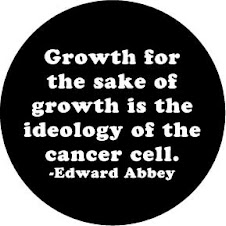
We still don’t get it do we? No-one wants to address the basics. Our economy is a sub system of the environmental/ecological system. Our system is dependent on limitless growth while the system it lies within is finite. That is unsustainable, as David Suzuki says “that is madness.”
I’ve recently watched the 11th Hour film and have pulled out some pertinent quotes. One of the most striking is from Ray Anderson, founder of Interface Carpets, who reckons our industrial economy needs to be re-invented,
“For every truckload of product...32 truckloads of waste are produced”
Our economy is a waste generating machine and now in our rush to consume our way to destruction we are drowning in it.
Nathan Gardels from the New Perspectives Quarterly states that consumer democracy has become the leading ideology of the planet. Even in China the state feels the need to allow it’s citizens to consume to distraction. I wholeheartedly agree with this recommendation from Mr. Gardels,
“We need to be slower and we need to be smarter. Slow movement means disengaging from consumerism as the main avenue of experience. It doesn’t reject any consumption but it says we’re not going to live our lives mediated by the marketplace or what’s being sold. We’re not going to make our identities and our meaning based on that. Instead of the long commute, the bigger car, the bigger house, let’s enjoy the local produce, have time to our selves, understand that things are thieves of time. Because the more things you have the more time you have to spend working, the more life is chained to a rhythm to get those things. The other element is the smart element and there I think we have to re-introduce the term, an old term from before the industrial revolution, frugality. Frugality does not mean poverty. Frugality means the wise use of resources. The meaning of the industrial revolution was that nature was turned into a resource and so was considered endlessly abundant. That’s not true.”
Paul Hawken, author of Blessed Unrest and The Ecology of Commerce, reminds us what is at stake,
“Every living system is in decline and the rate of decline is accelerating. There isn’t 1 peer reviewed scientific article in the past 20 years that’s been published that contradicts that statement”
That’s not a single living system, whether it be in the ocean, the boreal forests, the tropical rainforests, the atmosphere, or in your neighborhood, none of them are stable or improving.
Not to worry though. James Woolsey former head of the CIA, reminds us that from Pearl Harbor through to the beginning of demobilization after defeating Hitler and Imperial Japan took only 3 years and 8 months. America turned on a dime and got the job done. Quoting Winston Churchill
“Americans always do the right thing, unfortunately it’s only after they’ve exhausted all other possibilities”.
He thinks we’ve exhausted those possibilities and that maybe now we might be ready to get it right.
What do you think? What are we waiting for? Is it better technology? Don’t let anyone tell you we don’t yet have the technology. Kenny Ausubel, founder of the Bioneers, makes it clear,
“With existing technologies that we already have on the shelf or that we know we can develop in a rapid period of time we could reduce the human footprint on planet earth by 90%”
What we don’t yet have is the will to do the right thing.
Sandra Postel of the Global Water Policy Project,
“It’s not just going to be a matter of tweaking a policy here and there. It’s going to take a very broad societal mobilization. It’s going to take involvement at all levels, from the government through industry and on down to our communities and a welling up of involvement of citizens.’’
We just have to decide to do it.
Are we ready?
We still don’t get it do we? No-one wants to address the basics. Our economy is a sub system of the environmental/ecological system. Our system is dependent on limitless growth while the system it lies within is finite. That is unsustainable, as David Suzuki says “that is madness.”
I’ve recently watched the 11th Hour film and have pulled out some pertinent quotes. One of the most striking is from Ray Anderson, founder of Interface Carpets, who reckons our industrial economy needs to be re-invented,
“For every truckload of product...32 truckloads of waste are produced”
Our economy is a waste generating machine and now in our rush to consume our way to destruction we are drowning in it.
Nathan Gardels from the New Perspectives Quarterly states that consumer democracy has become the leading ideology of the planet. Even in China the state feels the need to allow it’s citizens to consume to distraction. I wholeheartedly agree with this recommendation from Mr. Gardels,
“We need to be slower and we need to be smarter. Slow movement means disengaging from consumerism as the main avenue of experience. It doesn’t reject any consumption but it says we’re not going to live our lives mediated by the marketplace or what’s being sold. We’re not going to make our identities and our meaning based on that. Instead of the long commute, the bigger car, the bigger house, let’s enjoy the local produce, have time to our selves, understand that things are thieves of time. Because the more things you have the more time you have to spend working, the more life is chained to a rhythm to get those things. The other element is the smart element and there I think we have to re-introduce the term, an old term from before the industrial revolution, frugality. Frugality does not mean poverty. Frugality means the wise use of resources. The meaning of the industrial revolution was that nature was turned into a resource and so was considered endlessly abundant. That’s not true.”
Paul Hawken, author of Blessed Unrest and The Ecology of Commerce, reminds us what is at stake,
“Every living system is in decline and the rate of decline is accelerating. There isn’t 1 peer reviewed scientific article in the past 20 years that’s been published that contradicts that statement”
That’s not a single living system, whether it be in the ocean, the boreal forests, the tropical rainforests, the atmosphere, or in your neighborhood, none of them are stable or improving.
Not to worry though. James Woolsey former head of the CIA, reminds us that from Pearl Harbor through to the beginning of demobilization after defeating Hitler and Imperial Japan took only 3 years and 8 months. America turned on a dime and got the job done. Quoting Winston Churchill
“Americans always do the right thing, unfortunately it’s only after they’ve exhausted all other possibilities”.
He thinks we’ve exhausted those possibilities and that maybe now we might be ready to get it right.
What do you think? What are we waiting for? Is it better technology? Don’t let anyone tell you we don’t yet have the technology. Kenny Ausubel, founder of the Bioneers, makes it clear,
“With existing technologies that we already have on the shelf or that we know we can develop in a rapid period of time we could reduce the human footprint on planet earth by 90%”
What we don’t yet have is the will to do the right thing.
Sandra Postel of the Global Water Policy Project,
“It’s not just going to be a matter of tweaking a policy here and there. It’s going to take a very broad societal mobilization. It’s going to take involvement at all levels, from the government through industry and on down to our communities and a welling up of involvement of citizens.’’
We just have to decide to do it.
Are we ready?
Subscribe to:
Posts (Atom)


 Posts
Posts


.jpg)