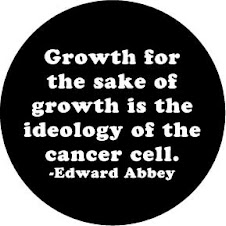
What have you done today to lower your impact?

We are washing away the foundations of our existence on every front. It is high time we move from crashing about on the planet like a bull in china shop and find a way to go forward with intent. We must find systems of living based on sustainability. The systems and tools exist, it is up to each of us to adopt them.

Showing posts with label pesticides. Show all posts

Sunday, 9 August 2009

Remember when soy was a "healthy" alternative to meat?

Back in the 80's I remember eating soy to get my protein instead of meat. I ate lots of tofu. To bad soy has become a toxic soup of gmo and hexane contamination. Read more in this article by Alexis Baden-Mayer, Esq. at Organic Consumers Association, here's an excerpt;

"GENETICALLY MODIFIED More than 90 percent of US soy is genetically modified. While genetic engineering is widely believed to be intended to increase yields, genetically modified soybeans, the world's most widely planted GM crop, have consistently lower yields than conventional soy.

SPRAYED WITH PESTICIDES Soy is genetically modified to withstand massive applications of Monsanto's RoundUp pesticide. According to the Center for Food Safety, U.S. government data reveal a huge 15-fold increase in the use of glyphosate on soybeans in the U.S. from 1994 to 2005, driven by the adoption of the Roundup Ready version of the crop. Increasing weed resistance to glyphosate has led to rising use of other toxic chemicals. In the U.S., the amount of 2,4-D (a component of the Vietnam War defoliant Agent Orange) applied to soybeans more than doubled from 2002 to 2006.

PROCESSED WITH HEXANE Before being added to food, soy processors, including Archer Daniels Midland and Solae, use a toxic petroleum-derived solvent called hexane to extract the oil and protein. When hexane is released to the environment it degrades to produce greenhouse gases that contribute to climate change. Hexane can cause dizziness and irritation and, with long-term exposure, nerve damage. It is regulated as a volatile organic compound, a class of compounds that contributes to smog problems."

Thursday, 25 June 2009

Having a bit of Thiabendazole with that apple?

Probably, Thiabendazole residue, a probable carcinogen, is found 87.9% of the time on non organic apples as determined by the USDA. The neurotoxin Azinphos methyl is found 31.8% of the time. Yummmmmm........ And you can't count on washing to remove these contaminants.

If you suspect that contamination somehow magically disappears during processing, check out peanut butter, Piperonyl butoxide, a suspected carcinogen and hormone disruptor, is found 26.9% of the time.

How about your cranberry juice? Chlorothalonil, a known carcinogen, is found in cranberries 56% of the time

DCPA, a suspected hormone disruptor, is found in Broccoli 50.3% of the time.

Boscalid a suspected carcinogen is found 64.8% of the time in cherries.

DDE p,p' a known carcinogen is found in Kale 41.7% of the time.

I could go on all day but the point is clear. Go Organic! for your own health and the health of the planet.

Find out what dangerous chemicals are on your produce over at What's on My Food a project of the Pesticide Action Network.


Thanks to the Organic Consumers Association for the heads up on this and for these factoids;

  • The average child gets 5+ servings of pesticides in their food and water each day.
  • The pesticide Atrazine is so toxic it is banned in Europe, but it is used so widely in the U.S., that it is found in 71% of the U.S. drinking water.
  • Currently, over 400 pesticides can be legally used in the U.S. For example, apples can be sprayed up to 16 times with 36 different pesticides. None of these chemicals are present in organic foods.
  • According to the US Department of Health and Human Services, organophosphate pesticides (OP) are now found in the blood of 95% of Americans tested, and the levels are twice as high in blood samples taken from children. Exposure to OPs is linked to hyperactivity, behavior disorders, learning disabilities, developmental delays and motor dysfunction.

Friday, 21 November 2008

Froggie in a pesticide mine

Amphibians are a bellweather species. Much like a canary in a coal mine they indicate the overall health of the environment.

When I lived in Bermuda I used to sit and watch the giant toads come out around sunset and snap up the giant cockroaches as they emerged from the septic tank vent pipe. I began to hear about the startling high numbers of these massive amphibians being found with extra legs, even extra heads. There are pesticides for sale in Bermuda which are made in the US but are illegal for use in the US. The pesticides for sale in the US are tested, minimally, for safety as individual chemicals, as if in a vacuum. Nothing in nature occurs in a vacuum. It has been suspected that the naturally resulting cocktail of chemicals derived from our love of poisons is far more dangerous both to the ecosystems upon which we depend and indeed directly upon ourselves than any chemical in isolation. Recent research bears this out. This is over on the Organic Consumers Association website where you will also find a link to the original research.

"PITTSBURGH, Nov. 13 (UPI) -- U.S. scientists studying 10 of the world's most popular approved pesticides say, when combined, the chemicals caused 99 percent mortality in tadpoles.

University of Pittsburgh researchers said the U.S. Environmental Protection Agency-approved pesticides, when mixed together, can decimate amphibian populations even if the concentration of the individual chemicals is within limits considered safe.

Such "cocktails of contaminants" are frequently detected in nature, the scientists said, noting their findings offer the first illustration of how a large mixture of pesticides can adversely impact the environment.

Associate Professor Rick Relyea, the study's lead author, exposed gray tree frog and leopard frog tadpoles to small amounts of the 10 pesticides -- insecticides carbaryl, chlorpyrifos, diazinon, endosulfan, and malathion, as well as five herbicides: acetochlor, atrazine, glyphosate, metolachlor, and 2,4-D.

He used each of the pesticides alone, the insecticides combined, a mix of the five herbicides, or all 10 of the poisons.

Relyea found a mixture of all 10 chemicals killed 99 percent of leopard frog tadpoles, as did the insecticide-only mixture."

Thursday, 28 August 2008

Like to eat? Then save the Bees!

Check out this article over at Organic Consumers Association regarding the US EPA's efforts to protect corporate interests, surprise surprise, at the cost of the environment. This time it involves a pesticide banned in Germany and France for years now due to it's danger to bees, those hard workers upon which "every third mouthful of food" we eat depends.

EPA is Hiding Colony Collapse Disorder Information


" 'This is a real mystery right now," said Dr. Gabriela Chavarria, director of NRDC's Science Center. "EPA needs to help shed some light so that researchers can get to work on this problem. This isn't just an issue for farmers -- this is an issue that concerns us all. Just try to imagine a pizza without the contribution of bees! No tomatoes. No cheese. No peppers. If you eat apples, cucumbers, broccoli, onions, squash, carrots, avocados, or cherries, you need to be concerned.' "

Wednesday, 9 July 2008

A quote from Vandana Shiva

Excerpted from an article at the Organic Consumers Association website:

"The $1.2 billion the World Bank says will solve the food crisis in Africa is a $1.2 billion subsidy to the chemical industry," said Vandana Shiva, an Indian physics professor and environmental activist speaking at the forum in Modena.


"Countries are made dependent on chemical fertilizers when their prices have tripled in the last year due to rising oil prices," she said. "I say to governments: spend a quarter of that on organic farming and you've solved your problems."


She said industrial farming was based on planting a single crop on vast surfaces and heavy use of chemical fertilizers, a process that used 10 times more energy than it produced.


"The rest turns into waste as greenhouse gases, chemical runoffs and pesticide residues in our food," she said.


In contrast, organic farms could increase output by 10 times by growing many different species of plants at the same time, which helped retain soil and water, she said. "In a one-acre farm in India they can grow 250 species of plants," she said.