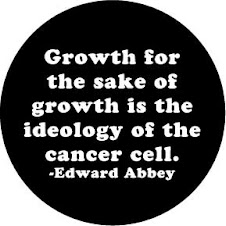
What have you done today to lower your impact?

We are washing away the foundations of our existence on every front. It is high time we move from crashing about on the planet like a bull in china shop and find a way to go forward with intent. We must find systems of living based on sustainability. The systems and tools exist, it is up to each of us to adopt them.

Saturday, 19 September 2009

Fancy a glass of manure tainted water? Lemon with that?


Not only are we loading our atmosphere with greenhouse gases due to our addiction to factory farmed meat, now these farms are poisoning their neighbors water supply. Read more at Scientific American. Here's an excerpt;

"Runoff from agriculture is the biggest polluter of the country's river and stream water, according to the U.S. Environmental Protection Agency (EPA), and it has been fingered for hypoxic dead zones and toxic red tide algae blooms.

But how much of that runoff makes it into people's drinking water closer to home? In agricultural areas, it can be enough to cause persistent health problems, including diarrhea and other infections, according to a report today in The New York Times.

"Sometimes it smells like a barn coming out of the faucet," Lisa Barnard, a Wisconsin resident told the Times. Barnard's well water tested positive for various contaminants and bacteria, including E. coli—which point not just to any runoff, but that coming from excess manure, according to the Times piece.

Beef and dairy farms often dispose of manure and other waste by shipping it out as fertilizer for crops, but "there just isn't enough land to absorb that much manure," said Bill Hafs, a Wisconsin county official who is angling for more stringent rules and enforcement, in an interview with the Times. When heavy rains or early spring melts come, excess waste can find its way into rivers and streams and also into groundwater—and into wells.

Brown County, where Hafs works, has about a quarter of a million people, according to the U.S. Census Bureau, and about 41,000 dairy cows, which is about six people per cow. And as Hafs noted, "one cow produces as much waste as 18 people." ...

"More than 30 percent of the wells in one town alone violated basic health standards," Hafs told the Times. "It's obvious we've got a problem." But he and others who have raised a stink about the contamination have been met with powerful agricultural lobbies. ... Dairy farms in Brown County create about a million gallons of waste a day, the Times reports. "

Thursday, 17 September 2009

The devastation wrought by dirty coal

There's resource war and then there is resource oppression; when a multinational company is allowed, by corrupt government, to ride roughshod over human rights to extract profits from the ground. Usually perpetrated upon powerless third world populations, now being practiced on the people of the first world as well.

Most of us have heard about the tragic injustices wrought by oil companies Shell, Chevron and Texaco in Ecuador and Nigeria, for profit rape and pillage of the local ecosystem leaving a poisoned dying populace in it's wake. We have learned about the crime that is the tar sands. But how many of us have heard about the same thing happening in the United States?

From West Virginia to Pennsylvania our insatiable hunger for energy has created toxic conditions choking whole valleys, destroying thousands of rivers and streams, and even the local's drinking water. Read more at Care2.com, here's and excerpt; from the post from Jennifer Mueller;

"This past weekend the New York Times covered the story of the Hall-Massey family near Charleston, West Virginia and the toxic chemicals pouring out of the water taps in the family's bathroom and kitchen. The Times reveals a common third-world condition - the lack of safe water for drinking and bathing - facing residents of one of the wealthiest nations in the world. The reporter outlines evidence of a massive failure by state and federal regulators to protect the community of Prenter, lax enforcement of water pollution laws, and yet another consequence of U.S. dependence on fossil fuels for energy.

Because what's polluting this community's water supply? Coal.

Coal Mining Pollution Threatens Drinking Water

Jennifer Hall-Massey and 264 of her neighbors are suing nearby coal mining companies for pumping toxic chemicals into the ground and contaminating their drinking water. "Everything that's in your sludge ponds is in my water, so how can it not be related?" Hall-Massey asks in a video on the Times web site.

Leaking sludge ponds is only one of many ways coal mining can pollute our water. Mountaintop removal mining, blowing the tops off mountains to reveal coal seams and dumping the debris - including numerous toxic heavy metals - into stream beds, is completely legal and common. According to the Sierra Club, more than 1,200 miles of mountain streams have been buried by such waste in Appalachia.

And the effect of underground mining isn't pretty either. Acid drainage from abandon mines pollute streams and groundwater with toxic metals and minerals. Acid drainage has contaminated some 3,000 miles of streams in Pennsylvania alone."

Video-Resource War-from Age of Stupid

War for Resources HD from Age of Stupid on Vimeo.

Arguably one of the best scenes in The Age of Stupid

Wednesday, 16 September 2009

Thermodynamics of Local Food

If there is any doubt that our current system of food production is inherently unsustainable then one need only check out this post over at the OilDrum by Jason Bradford. Here is an excerpt;

" The point I will make is that one can say with high confidence bordering on certainty that only a predominantly local food system will ever be sustainable.

What I mean by sustainable is the ability to endure. Quite simply and irrefutably I conclude that the current globalized food system is a flash in the frying pan because it doesn’t respect the first law of thermodynamics. Whatever other argument you might want to make against the global and for the local (and several legitimate ones come to mind) this fatal flaw is insurmountable. No quibbles, qualification or value judgments need to get in the way of this basic fact....

A sustainable system must be primarily local because of energetic and logistical constraints. What is removed from a plot of land needs to be returned. Okay, not the exact atoms, but roughly the same kinds atoms in the original quantities and proportions."

Relocalisation

As I listened to the BBC World Service this morning I heard a story about the Chinese economy and efforts to stimulate consumerism to keep the economy growing. Aside from the obvious futility of a continuing to rely on the infinite growth paradigm, a physical impossibility in a finite ecosystem, the commentator was discussing efforts to get the Chinese public to consume more locally produced goods thus double stimulating the economy. As western economies have tried to rebound from their self inflicted wounds which led to the recent recession, there have been repeated warnings about falling back into protectionism and abandoning globalization.

I'm no economist but it seems plain to me that globalisation is driven and dependent on consumerism and the infinite growth paradigm. Why should we continue to remain dependent upon what is clearly a failed paradigm. Remember the admonition of Gaylord Nelson, "The economy is a wholly owned subsidiary of the environment, not the other way around." The current economic model is predicated on it being the other way around, this is nonsensical. We are hearing everyday further evidence that the environment is at it's limits to support us and our profligate lifestyles. From peak oil, peak phospate, oceanic dead zones, collapsed fisheries, rising sea levels, worldwide droughts, do we need any more evidence that consumerism is doomed?

Even if we don't accept that the limits of the planet are being reached there is a strong moral argument for the cessation of consumerism. During the height of the famines in
Africa in the 80's while the local populace was starving, the shipment of vegetables to the UK never ceased. Local food production had been abandoned for production of cash crops. As usual the cash went mostly to the bosses while the country starved. Now there is a new report on evidence that consumerism is propped up by slave and child labor.

"According to the International Labor Organization, over 12 million people are enslaved, and about 218 million children work, with the majority subjected to hazardous conditions. Those most vulnerable to slave labor include women, migrants and indigenous peoples.

The Bureau of International Labor Affairs (ILAB) found 122 goods produced by slave or child labor in 58 countries.The most common goods include:
-Agriculture: cotton, sugarcane, tobacco, coffee, rice, cocoa
-Manufacturing: bricks, garments, carpet, footwear
-Mining: gold, coal

Slave and child labor stretches the globe, but some of the worst offenders are Bolivia, China, India, Nepal, Myanmar, Pakistan and North Korea. However it should be noted that although these specific countries have high levels of slave and child labor, the entire world is compliant. As long as corporations enable these conditions and consumers purchase goods, slave and child labor will continue. ...

The report notes that the global economic crisis has only exacerbated conditions. Those vulnerable to slave labor are typically the poorest and powerless. With rising food prices, the World Bank estimates that 100 million more people will be pushed into poverty this year." - Natasha G.

Read about it over at Care2.com.

The antidote to the abuses of globalization is relocalisation.

"The process by which a region, county, city, or even neighborhood frees itself from an overdependence on the global economy and invests its resources to produce a significant portion of the goods, services, food and energy it consumes from its local endowment of financial, natural, and human capital."- Talberth J. et. al.

I would extend that definition down to the household scale because that is where is starts. But clearly there is a role for governments and industry to play here. In India, a top fashion designer, Sabyasachi Mukherjee, is urging a return to the Gandhian principle of homespun.

"It's vital to him that the rural poor share India's growing economy - a Gandhian concept and one that puts India right at the centre of being Indian. In 2008 he set up cooperatives of rural craftswomen across India, starting with Rajasthan, Gujarat and Barasat in West Bengal. Inspired by the workers' co-operative models of the Nobel prize-winning Muhammad Yunus of Bangladesh, Mukherjee has aimed to cut out the middlemen.

Half of the money that the co-operatives earn they take home, and the other half is ploughed back into the community bank account for development....

He is insisting that to be well-dressed at Delhi and Mumbai's best cocktail parties, you have to be wearing not glittery Western-inspired tube dresses and leggings, but khadi - the simple homespun weave that was championed by Gandhi in the 1930s to boost the rural economy and give India a sense of nationalist pride during the fight for independence.

Apart from the beauty of the fabric, whose history in India goes back well over 5,000 years, Mukherjee's reasoning is simple. He finds it odd that Indian designers tend to steer clear of local hand-woven fabrics. Khadi, he says, is refined, sophisticated, eco-friendly and comfortable, and has too long been regarded as the poor man's fabric. To wear it is a sign of being well-dressed and cultured.

Best of all, in his view, it should help India's rural craftsmen and women to share in the country's growing wealth and economy." - Catriona Luke at the BBC

In the transition towns across the world, relocalisation is taking hold. This is not a shutting off from economy at large. But it is a effort to re-introduce resilience where it has been eroded by globalization. For instance, how many neighborhoods will have the wherewithal to produce their own computers and cell phones? Not many, I suspect, but they can practice re-use, reject planned obsolesence, and develop support networks to help each other troubleshoot older models. What every community can do is to grow food,;

"...food is the most sensible place to begin rebuilding community resilience, but building material, fabrics, timber, energy and currencies follow soon after." - Rob Hopkins, p69 "The Transition Handbook"

This is something we here is the west must begin to practice, the greater our dependence on the goods provided by globalization, and that includes food, the greater the hardship will be when that network begins to fail or is priced out of reach. A point made by Vandana Shiva in a speech to the Soil Association in 2007;

"The imperative here for you is of course to grow more food better, to grow it locally, organically and by doing that you avoid two kinds of harm to the food sovereignty and food independence of the South. The first is you contribute to the security of livelihoods by not adding to dumping. Of course organic farmers are not involved in dumping on the South – it’s too costly. Dumping means selling below the cost of production, technically, and since organic farmers aren’t subsidised they can’t afford to go around putting cotton on someone else’s market and putting corn on someone else’s market....

… By growing food locally you also prevent a second kind of exploitation and when that lettuce is growing in the land of the Masai and it’s diverting the water of the Masai’s you are actually displacing the Masai and exporting drought. You are actually contributing to displacement of local producers, pastoralists, as well as farmers." - Vandana Shiva "The Soil is our Liberator"

Resilience in both worlds is the goal so this is not a call to blanket localisation. We must find a new paradigm for trade, one that increases the well being of the local citizenry and supports their resilience as well.

Remember that peak oil will make relocalisation an imperative. It is up to us to decide when and how to develop it. The longer we wait the more difficult that transition will be.

Tuesday, 15 September 2009

Video - Greenwashing


Found on EcoTube

Hopeful signs but still missing the low hanging fruit.

While Senator Robert Byrd (D-WV) works with other senators from the coal states to get more money allocated to carbon capture and storage, a move that may save the Waxman Markey bill in the senate if all these senators beholden to dirty coal vote for the bill, and research by the New York University School of Law’s Institute for Policy Integrity shows that the bill will benefit the economy to the tune of $1.5 trillion between 2012 and 2050 while only costing $660 billion to implement, where is the debate surrounding population and it's effect on Climate Change?

A new study produced by the London School of Economics found that family planning is the most cost effective way to address CO2 emissions. As reported over at WorldChanging by Adam Stein,

"Specifically, the report claims that the world can spare 34 gigatons of CO2 emissions — the amount the entire U.S. produces in six years — over the next four decades at a cost of $7 per ton. According to the report, these reductions can be achieved simply by fulfilling the current “unmet need” for family planning, an ungainly phrase that refers to the population of couples who are married or “in union” and want contraception but lack access. Because unmarried people experience unwanted pregnancy as well, presumably demand for contraception is even greater than the study suggests.

If all this unmet need is filled, the projected population in 2050 drops from 9.1 billion to 8.7 billion. 8.7 billion, of course, still represents substantial growth from today’s level. That’s always been the problem with focusing overly much on population as the key driver of climate change: the number of people on the planet seems likely to hit roughly 9 billion no matter what we do, so ultimately clean energy and efficiency are going to be the primary way we solve the resource puzzle.

Nevertheless, 34 gigatons is a lot of gas, and $7 is a nice price, and providing family planning services to people who want them has meaningful humanitarian benefits, so this seems like a fruitful (ha!) area to explore. Of course, family planning is also an insanely fraught topic, so don’t expect much progress on this front anytime soon, at least in the U.S."

Monday, 14 September 2009

Video - Canvas Bags by Tim Minchin

Lest we take ourselves too seriously.
Another thanks to Dave Hampton for the heads up and to Dave Oxford for turning me on to Tim Minchin in the first place. I dedicate this post to my sister who has the most incredible collection of Canvas Bags I've ever seen and she uses them!

Paul Hawken Commencement Address May 2009

Thanks to Dave Hampton for reminding me of this.
In May of this year Paul Hawken delivered this address. It is inspiring and I really hope he doesn't mind me posting it here in it's entirety. I don't usually do that but it would be a shame to leave any of it out. So by way of apology I recommend that you go to his website, read his books, and follow his advice. The emphasis in bold is mine.

"The Commencement Address by Paul Hawken to the Class of 2009, University of
Portland, May 3, 2009

When I was invited to give this speech, I was asked if I could give a simple short talk that was “direct, naked, taut, honest, passionate, lean, shivering, startling, and graceful.” No pressure there.

Let’s begin with the startling part. Class of 2009: you are going to have to figure out what it means to be a human being on earth at a time when every living system is declining, and the rate of decline is accelerating. Kind of a mind-boggling situation... but not one peer-reviewed paper published in the last thirty years can refute that statement. Basically, civilization needs a new operating system, you are the programmers, and we need it within a few decades.

This planet came with a set of instructions, but we seem to have misplaced them. Important rules like don’t poison the water, soil, or air, don’t let the earth get overcrowded, and don’t touch the thermostat have been broken. Buckminster Fuller said that spaceship earth was so ingeniously designed that no one has a clue that we are on one, flying through the universe at a million miles per hour, with no need for seatbelts, lots of room in coach, and really good food—but all that is changing.

There is invisible writing on the back of the diploma you will receive, and in case you didn’t bring lemon juice to decode it, I can tell you what it says: You are Brilliant, and the Earth is Hiring. The earth couldn’t afford to send recruiters or limos to your school. It sent you rain, sunsets, ripe cherries, night blooming jasmine, and that unbelievably cute person you are dating. Take the hint. And here’s the deal: Forget that this task of planet-saving is not possible in the time required. Don’t be put off by people who know what is not possible. Do what needs to be done, and check to see if it was impossible only after you are done.

When asked if I am pessimistic or optimistic about the future, my answer is always the same: If you look at the science about what is happening on earth and aren’t pessimistic, you don’t understand the data. But if you meet the people who are working to restore this earth and the lives of the poor, and you aren’t optimistic, you haven’t got a pulse. What I see everywhere in the world are ordinary people willing to confront despair, power, and incalculable odds in order to restore some semblance of grace, justice, and beauty to this world. The poet Adrienne Rich wrote, “So much has been destroyed I have cast my lot with those who, age after age, perversely, with no extraordinary power, reconstitute the world.” There could be no better description. Humanity is coalescing. It is reconstituting the world, and the action is taking place in schoolrooms, farms, jungles, villages, campuses, companies, refuge camps, deserts, fisheries, and slums.

You join a multitude of caring people. No one knows how many groups and organizations are
working on the most salient issues of our day: climate change, poverty, deforestation, peace, water, hunger, conservation, human rights, and more. This is the largest movement the world has ever seen. Rather than control, it seeks connection. Rather than dominance, it strives to disperse concentrations of power. Like Mercy Corps, it works behind the scenes and gets the job done. Large as it is, no one knows the true size of this movement. It provides hope, support, and meaning to billions of people in the world. Its clout resides in idea, not in force. It is made up of teachers, children, peasants, businesspeople, rappers, organic farmers, nuns, artists, government workers, fisherfolk, engineers, students, incorrigible writers, weeping Muslims, concerned mothers, poets, doctors without borders, grieving Christians, street musicians, the President of the United States of America, and as the writer David James Duncan would say, the Creator, the One who loves us all in such a huge way.

There is a rabbinical teaching that says if the world is ending and the Messiah arrives, first plant a tree, and then see if the story is true. Inspiration is not garnered from the litanies of what may befall us; it resides in humanity’s willingness to restore, redress, reform, rebuild, recover, reimagine, and reconsider. “One day you finally knew what you had to do, and began, though the voices around you kept shouting their bad advice,” is Mary Oliver’s description of moving away from the profane toward a deep sense of connectedness to the living world.

Millions of people are working on behalf of strangers, even if the evening news is usually about the death of strangers. This kindness of strangers has religious, even mythic origins, and very specific eighteenth-century roots. Abolitionists were the first people to create a national and global movement to defend the rights of those they did not know. Until that time, no group had filed a grievance except on behalf of itself. The founders of this movement were largely unknown — Granville Sharp, Thomas Clarkson, Josiah Wedgwood — and their goal was ridiculous on the face of it: at that time three out of four people in the world were enslaved. Enslaving each other was what human beings had done for ages. And the abolitionist movement was greeted with incredulity. Conservative spokesmen ridiculed the abolitionists as liberals, progressives, do-gooders, meddlers, and activists. They were told they would ruin the economy and drive England into poverty. But for the first time in history a group of people organized themselves to help people they would never know, from whom they would never receive direct or indirect benefit. And today tens of millions of people do this every day. It is called the world of non-profits, civil society, schools, social entrepreneurship, non-governmental organizations, and companies who place social and environmental justice at the top of their strategic goals. The scope and scale of this effort is unparalleled in history.

The living world is not “out there” somewhere, but in your heart. What do we know about life? In the words of biologist Janine Benyus, life creates the conditions that are conducive to life. I can think of no better motto for a future economy. We have tens of thousands of abandoned homes without people and tens of thousands of abandoned people without homes. We have failed bankers advising failed regulators on how to save failed assets. We are the only species on the planet without full employment. Brilliant. We have an economy that tells us that it is cheaper to destroy earth in real time rather than renew, restore, and sustain it. You can print money to bail out a bank but you can’t print life to bail out a planet. At present we are stealing the future, selling it in the present, and calling it gross domestic product. We can just as easily have an economy that is based on healing the future instead of stealing it. We can either create assets for the future or take the assets of the future. One is called restoration and the other exploitation. And whenever we exploit the earth we exploit people and cause untold suffering. Working for the earth is not a way to get rich, it is a way to be rich.

The first living cell came into being nearly 40 million centuries ago, and its direct descendants are in all of our bloodstreams. Literally you are breathing molecules this very second that were inhaled by Moses, Mother Teresa, and Bono. We are vastly interconnected. Our fates are inseparable. We are here because the dream of every cell is to become two cells. And dreams come true. In each of you are one quadrillion cells, 90 percent of which are not human cells. Your body is a community, and without those other microorganisms you would perish in hours. Each human cell has 400 billion molecules conducting millions of processes between trillions of atoms. The total cellular activity in one human body is staggering: one septillion actions at any one moment, a one with twenty-four zeros after it. In a millisecond, our body has undergone ten times more processes than there are stars in the universe, which is exactly what Charles Darwin foretold when he said science would discover that each living creature was a “little universe, formed of a host of self-propagating organisms, inconceivably minute and as numerous as the stars of heaven.”

So I have two questions for you all: First, can you feel your body? Stop for a moment. Feel your
body. One septillion activities going on simultaneously, and your body does this so well you are
free to ignore it, and wonder instead when this speech will end. You can feel it. It is called life. This is who you are. Second question: who is in charge of your body? Who is managing those
molecules? Hopefully not a political party. Life is creating the conditions that are conducive to life inside you, just as in all of nature. Our innate nature is to create the conditions that are conducive to life. What I want you to imagine is that collectively humanity is evincing a deep innate wisdom in coming together to heal the wounds and insults of the past.

Ralph Waldo Emerson once asked what we would do if the stars only came out once every
thousand years. No one would sleep that night, of course. The world would create new religions overnight. We would be ecstatic, delirious, made rapturous by the glory of God. Instead, the stars come out every night and we watch television.

This extraordinary time when we are globally aware of each other and the multiple dangers that threaten civilization has never happened, not in a thousand years, not in ten thousand years. Each of us is as complex and beautiful as all the stars in the universe. We have done great things and we have gone way off course in terms of honoring creation. You are graduating to the most amazing, stupefying challenge ever bequeathed to any generation. The generations before you failed. They didn’t stay up all night. They got distracted and lost sight of the fact that life is a miracle every moment of your existence. Nature beckons you to be on her side. You couldn’t ask for a better boss. The most unrealistic person in the world is the cynic, not the dreamer. Hope only makes sense when it doesn’t make sense to be hopeful. This is your century. Take it and run as if your life depends on it.

……….

Paul Hawken is a renowned entrepreneur, visionary environmental activist, and author of many books, most recently Blessed Unrest: How the Largest Movement in the World Came into Being and Why No One Saw It Coming. He was presented with an honorary doctorate of humane letters by University president Father Bill Beauchamp, C.S.C., in May, when he delivered this superb speech.

Our thanks especially to Erica Linson for her help making that moment possible.


www.paulhawken.com "