Lately, It was starting to feel like I needed to be in a 12 step program for fossil fuel addiction. But at last, we spent two whole days at home, never cranked up the car. We worked on the gardens and workshop areas all day on Sunday and canned pumpkin on Monday. It felt good to be low energy, low fossil fuel anyway, for a couple of days.
However, the canning process certainly is energy intensive. Once we got through the prep work we had the stove going, sometimes all 4 burners for close to eight hours.We preheated some of the necessary hot water in the solar oven but since we started early we didn't get that much out of it. I do hope to set up a small biogas digester at some point to cut down on gas usage for all cooking.
We hope to remove the gas appliances and have it shut off. We already have plans to get most of our hot water from the sun but will switch to electric for backup. We'll change to an electric cooker as well which will be offset by the woodstove in the winter and the solar oven, once I solve a few problems, all year. We'll heat with the woodstove as well. The gas company charges us $10/month just to be hooked up. That $120/year could be better spent elsewhere. Of course we'll need to do the changeover on the cheap to make it worthwhile.
I'll build an improved version of my solar batch heater for the solar hot water bit and electric water heaters are cheap. We may be able to get an electric cooker from one of our rentals when it needs updating. We'll have the woodstove by this winter. We don't use a clothes dryer so the gas hookup for that won't be missed.
Today we were back in the car, we went over to one of our properties to mow the lawn.
Showing posts with label solar hot water heater. Show all posts
Showing posts with label solar hot water heater. Show all posts
Tuesday, 7 September 2010


Wednesday, 18 November 2009
Transition Bermuda solar batch heater wins an innovation award!

I spent most of the last 6 months in Bermuda volunteering with a group of locals to get a Transition Initiative going while my wife was working in the local schools doing supply work, substitute teaching. In February I built a solar batch heater from recycled materials and installed it at the guest house where we were staying. When I tested it, in October on a partly cloudy day, I discovered that it was reducing electricity demand for hot water by an average of 25%. With electricity approaching 50¢kWh on the island that represents a significant savings and means that the unit will pay for itself in under two years as the only costs were the plumbing supplies.
Recently, the local environmental group Greenrock, ran an innovation in sustainable construction competition as part of Global Entrepreneurship Week. We entered the unit as a Transition Bermuda project. Our hope being that at the very least it would help gain publicity for the initiative and might even win. In the final judging it was up against some stiff competition, several by professional architects; wood housing to reduce concrete use, prefab housing made from shipping containers, and a device that is used to determine site suitability for solar PV and microwind installations.
But we won! Last night my wife did the presentation at the final judging and it won $1500. The money will go to the initiative, hopefully to fund classes to teach folks how to build the units.
The design needs much refining but works as is.
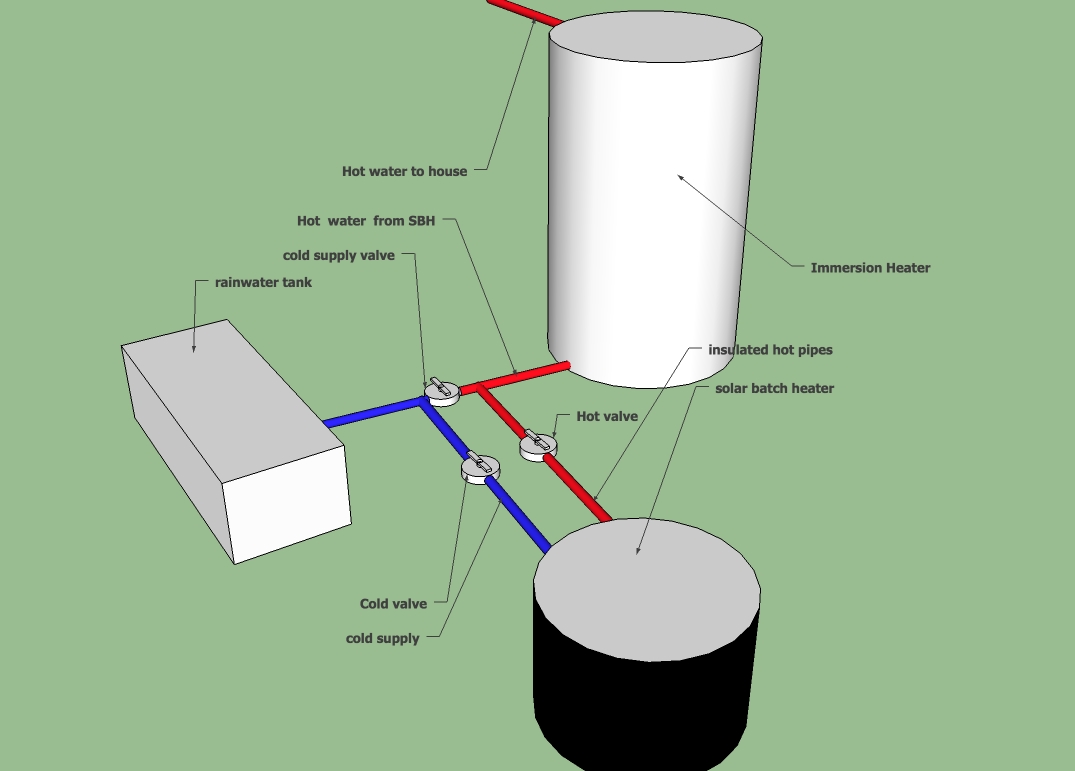
The plumbing diagram indicates that the unit is plumbed into the cold side of the immersion heater which sees hot water coming in so needs not come on as often. It is lower than the main tank as well which enables a thermal convection loop, circulating hot water out of the solar tank as it heats. This means the immersion heater stays warm longer as it doesn't rely exclusively on the main circulation pump for the system to deliver hot water to it.
Here is the text from the entry document with more details about the project.
A Greenrock Innovation Tournament 2009 entry
DIY Passive Solar Batch Heater made from recycled materials
A Transition Bermuda prototype project installed at:
Denevon Guest House #11 Woodbourne Crescent Pembroke
Transition Bermuda seeks to increase the resiliency of Bermuda by fostering and promoting a reduction in fossil fuel dependence, a return to local economy and self sufficiency, and the rebuilding of healthy community that comes with self reliance and local interdependance.
The prototype as built was designed according to the materials available at the time and tools available to be borrowed.
• How well does it respond to Bermuda’s unique building environment?
The salient point about Bermuda’s building environment that it is almost totally unsustainable. It does not use any significant amount of local materials. As buildings and appliances from buildings are replaced there is no significant recycling system for the materials. This valuable resource ends up in the land fill or up the incinerator stack. Built with very little mandated attention to efficiency, buildings here are completely reliant on imported energy. Additionally, construction labor is very expensive due to the high cost of living.
This project addresses all those issues, it reduces the reliance on imported energy by reducing electricity demand for hot water. It is constructed of recycled materials, thus reducing imports and waste to the dump. It is powered renewably and passively by the sun. It is easily built by anyone with a modicum of skill with tools thus reducing the cost of deploying renewables.
• How much does it contribute to energy savings?
Unit as built was measured to reduce electricity usage for hot water by 25% over 24 hrs on a partly cloudy day as compared to usage with solar batch heater out of the plumbing circuit. Water usage on both days was comparable relative to time of day and quantity used. Clearly on cloudy days performance suffers but this is more than offset by number of full sun days. I predict for the guest house where it was built, a savings of at least $115 per year thus paying for itself in 1.5 years.
Day one with SBH in circuit = 1.98 KWh used for hot water Day two with SBH out of circuit = 2.61 KWh used for hot water .63KWh x .50¢/KWH = 31.5¢ saved per day on average 31.5 x 365 = $115
• How broadly can the idea be applied?
There is no reason this type of solar batch heater could not be deployed on the majority of homes and businesses in Bermuda. The only limitation is the supply of old immersion heaters, glazing, lumber, and styrofoam packaging currently going to waste.
Monday, 8 June 2009
A simple recycled materials passive solar batch water heater, in Bermuda

 The 30 gallon water heater tank and mirrors came from a bathroom renovation and were headed for the dump, the double pane windows from an apartment renovation, the lumber from two separate home renovations, the insulation lining the bottom, top and sides came from various packaging materials destined for the dump. The only materials purchased, to the tune of about $200, are the screws used to assemble it, the plumbing supplies, sealant and paint, as yet uncompleted as you can see.
We plumbed it entirely on the cold supply side of the regular electric water heater, this water comes directly from the rainwater harvesting tank under the house. The hot water line from this tank to the electric tank is fully insulated. As hot water is pulled from the water heater it is replaced by preheated water from this little tank, thus causing the electric hot water heater to run less. Valves will allow the solar heater to be dropped out of the circuit without shutting off the water system.
I don't have figures yet but the simple things I did when I moved in, turned down the hot water heater and put an electric crisper on a timer, reduced usage by 60kwh/month. I'm expecting more from this project. I hope to get my Killawatt from the UK to measure usage at some point.
I should also say that I got two contractors to provide quotes for a solar thermal panel system. One was just over $10,000 for a single flat panel and an insulated water tank. This did not include the plumbing. A similar system in the UK would be less than half that. The second contractor never got back to me with a figure. Judy, my landlord, could not afford that size of investment. At that point I began collecting materials.
Subscribe to:
Posts (Atom)


 Posts