"The Lancet’s landmark Health Commission: “Climate change is the biggest global health threat of the 21st century”
- from Joe Romm over at Climate Progress
I see climate change as the greatest injustice humanity has perpetrated on itself and all other species. We are, to paraphrase Paul Hawken, stealing the future, selling it in the present and calling it GDP. By that reckoning, the behaviours that are leading to climate change are immoral. Do we not have a responsibility to our children and their children and theirs to cease and desist. Certainly, many of those behaviours are so trivial as to be inexcusable. Several come to mind; the consumption of bottled drinks, regular consumption of meat, using a clothes dryer, excessive automobile use, foreign vacations accessed by air, etc. These are practices that have a large impact and are very easily avoided. Knowing the trouble we are causing our offspring is it moral to continue them?
Many of us assuage our nagging guilt with recycling, turning off standby power devices, insulating our homes and other low hanging fruit of sustainability. These are laudable practices but they don’t in any way release us from the need to go further.
There are no moral offsets. The bible doesn’t say that as long as you don’t murder, a little coveting of your neighbours wife is OK. Similarly, if you are recycling, that doesn’t free you to drive an automobile indiscriminately, eat meat everyday, or buy your electricity from coal fired power plants. Surely, you might say, there is a continuum of morality when dealing with climate change. You could argue that by being connected to the grid you have no choice as to whether your power is from coal fired power plants, and in some cases this would be true. In the UK one can choose a renewable energy provider as your electric company. But if you are limited to coal fired power plants as your only choice of grid supplied electricity then what can be done? Much!
First, do everything you can to reduce your consumption of electricity.
Second, invest in sustainability. Go off grid with a standalone PV system to power your computer or your fridge, or both or more. Forget the simplistic paradigm of economic payback which plays into the business as usual solutions, accomplishes very little and not nearly soon enough. If payback is to be applied, then it should be applied universally, does that giant flatscreen TV have any chance of paying for itself? At least the PV system will do so at some point, and along the way you will have significantly reduced your carbon footprint. Going off grid has a multiplier effect, as you rely more and more on your standalone system you will begin to realize just how much electricity all your devices use. This will lead either to not purchasing more of them, the best option as this reduces the carbon costs and resource impacts of manufacture, or to relying on the most efficient option. A good example of this is shifting to a laptop rather than a desktop machine. In this way your investment in the system will payback in many ways, not just the in the grade school arithmetic of typical economics.
Third, work for change. Live it, do without a car if possible, and demonstrate that level of resilience. Plant a garden and share that technology with your neighbors. Show them how your PV system works and why. Give up meat except for special occasions. Campaign to bring a stop to the use of fossil fuel. Contact your government representatives about your views regarding dirty coal.
Fourth, give up the internal bargaining that you use to justify behaviours that are clearly risking the future health of the ecosystems that support us all and are guaranteeing a degraded planet as an inheritance from our generation.
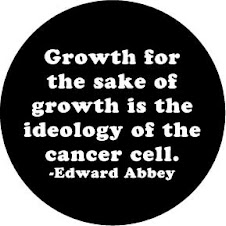
The real bottom line is that if you are participating in an aspect of the economy that perpetuates the dominant paradigm of growth at all costs, profit before morality, and consumerism then that activity is part of the problem instead of the solution and needs to stop.
Certainly, we all use the calculus of moral offsets to justify our behaviour. My father gave tens of thousands of dollars to environmental organizations, money he earned by investing in the stock market, in companies that were creating the very problems he was donating to solve. To me this did not make sense then and still doesn’t. I believe we must all find ways of earning an honest living without endangering future generations of all species.
Some work, like teaching, social services, cleaning, food preparation and such which are not necessarily directly helping to solve the problem, must be done. But with a litle effort they can be a part of the solution. Other work is clearly questionable. Do we need fast food or bottled drinks? Of course not. They are eroding our health and the waste stream is laying waste to the oceans and the atmosphere. Do we really need more internal combustion vehicles? Of course not. Does this mean we need to force all the auto workers into the unemployment line, no it does not. We should re-purpose those factories and workers to build the renewable energy equipment and infrastructure that the nation needs to transition off of fossil fuels. Do we need to perpetuate our reliance on industrial agriculture, so heavily dependent on dwindling petro chemicals and precious fossil water? No we don’t, we must begin to transition to a more resilient, diverse and sustainable agriculture. One that doesn’t create dead zones in our seas from massive over use of fertilizers and livestock waste runoff. One that doesn’t produce facsimiles of food to replace fresh seasonal organic food, the type of food we evolved to thrive on, and in the process correct much of the ill health we suffer from. Do we need to continue to pour precious financial and natural resources into offensive military capability? Clearly this policy causes more problems than it solves and leaves behind a legacy of toxic waste and toxic relations, worldwide. If it is so clear that these activities and many others besides are unsustainable and downright threatening to our survival, why do we continue to participate in them?
In short, if it is unsustainable, we should stop doing it, NOW!
Here are some facts from the Lancet report as listed at Climate Progress
- Even the most conservative estimates are profoundly disturbing and demand action. (p1697 col 1)
- The 12 warmest years on record within the past 150 years have been during the past 13 years. (p1698 col 1)
- Currently, a third of the world’s population lives within 60 miles of a shoreline and 13 of the world’s 20 largest cities are located on a coast. More than a billion people could be displaced in environmental mass migration. (p1699 col 1)
- Estimates show that small increases in the risk for climate-sensitive conditions, such as diarrhoea and malnutrition, could result in very large increases in the total disease burden. (p1701 col 1
- The carbon footprint of the poorest 1 billion people is around 3% of the world’s total footprint; yet, these communities are affected the most by climate change. (p1701 col 2)
- Malaria, tick-borne encephalitis, and dengue fever will become increasingly widespread. (p1702 col 2)
- Half of the world’s population could face severe food shortages by the end of the century because rising temperatures take their toll on farmers’ crops. (p1704 col 2)
- As people migrate away from areas deteriorated by gradual warming or destroyed by extreme weather events, they not only place substantial demands on the ecosystems and social infrastructures into which they migrate, but also carry illnesses that emerge from shifts in infectious-disease vectors. (p1719 col2)
- Extreme weather events are not always handled well by rich nations [i.e. Katrina]. (p1719 col 2)
- Farmers use about three-quarters of the world’s water supply: to grow 1kg of wheat requires around 1000L of water, whereas 1kg of beef takes as much as 15 000L. American or European diets require around 5000L of water per person every day, whereas African or Asian vegetarian diets use about 2000L per person every day. The social and political challenge of shifting dietary practices is enormous, especially as populations start to eat more meat as they climb out of poverty. (1720 col 2)
- Climate change will … have an effect on psychosocial health. Increased spending on appropriate counselling or sympathetic health promotion, and the initiation of such services in poor countries, could be as important as planning to reduce new disease vectors. (p1721 col 1)"


 Posts
Posts


.jpg)