I've been thinking recently about hubris. I don't mean the the petty everyday hubris we experience in our relationships and human contacts. I'm thinking about the hubris we have developed along with our big brains through the millenia of evolution. As we have refined our ability to change our environment, through fire, then agriculture and latterly industry, we seem to have become convinced that whatever we can imagine we have the right to do. So convinced are we that our ostensibly massive human intellect will solve all problems, even the ones we ourselves create, that we have completely lost touch with the intelligence that precedes and informs our own. We have forgotten the innate intelligence of nature.
This form of hubris is particularly dangerous in it's manifestation in reductionist western culture and value systems. It has led to what university of Texas professor Robert Jensen has called "the Delusion Revolution".
"It takes the hubris of folks such as biologist Richard Dawkins, who once wrote that “our brains … are big enough to see into the future and plot long-term consequences.” Such a statement is a reminder that human egos are typically larger than brains, which emphasizes the dramatic need for a drastic humility. I read that essay by Dawkins after hearing the sentence quoted by Wes Jackson, an important contemporary scientist and philosopher working at The Land Institute. Jackson’s work has most helped me recognize an obvious and important truth that is too often ignored: For all our cleverness, we human beings are far more ignorant than knowledgeable. Human accomplishments -- skyscrapers, the internet, the mapping of the human genome -- seduce us into believing the illusion that we can control a world that is complex beyond our ability to understand. Jackson suggests that we would be wise to recognize this and commit to “an ignorance-based worldview” that would anchor us in the intellectual humility we will need if we are to survive the often toxic effects of our own cleverness."
I'm not quite as hard on professor Dawkins as Jensen who believes Dawkins should be denounced for such views. I do however agree completely with Wes Jackson's assertion that we are tinkering with the systems of life we do not have the capacity to understand. Dawkins writes and speaks eloquently of the ability of evolution to bring into being the unimaginable complexities of this world while at the same time denouncing creator myths that deny evolution as scientific fact. I believe in the fact of evolution but am not willing to deny people faith in a creator, I don't see them as mutually exclusive. Indeed, the hubris I decry is even worse when compared to the hand of god. How can someone who believes in god the creator believes that it is OK to trash his/her creation.
The complexities of the natural world are the brain of the planet. As we seem intent on doing to our own brains, with toxic chemicals in our food, alcohol, drugs, pharmaceuticals, and polluted water and air, so we are doing to the planetary brain.
Rather than trust to the intelligence of evolution, or god, in our hubris we are killing it.
Showing posts with label balance. Show all posts
Showing posts with label balance. Show all posts
Tuesday, 23 September 2008


Sunday, 24 February 2008
The Eighth Deadly Sin by Dave
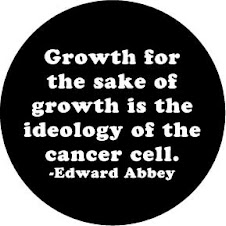
We've all heard the rhetoric of "growth". It is a word that carries heavy and sacred freight whenever uttered within financial institutions, or on the world's airwaves. It's fundamental to our concept of economic health. If a pundit should detect figures that indicate growth running at 1 or 2 percent, it would be labeled "anemic" and "worrisome". I'm no economist, but as far back as I can remember, I've been troubled by this convention, especially since the publication in 1970 of our first photo of the entire planet seen from space...it looks blue and round, beautiful but fragile, and emphatically finite. Yet 38 years later, we never hear economic experts question the illogic of endless growth within a finite system.
What can this wealth we speak of be, but the systematic mining of the world's resources? To improve our mining techniques doesn't change the equation, it only postpones the eventual reckoning...a reckoning the pioneer biologist Robert Malthus would recognize immediately; i.e. a smaller rabbit population leads to a smaller wolf population which leads to a larger rabbit population which leads...etc.
Can we be more logical than rabbits or even wolves? Can we project our destinies into the future based on all the self-evident data? Certainly we can. Our failure to do so is caused by mere unwillingness...by fear. Of course a paradigm shift of this magnitude makes people fearful- we've been growing exponentially for at least 250 years. But does the alternative have to be scary? I submit that it's less scary than "staying the course".
The alternative is "zero-growth", a state that has lasted a lot longer than 250 years. Equilibrium or balance need not be a frightening scenario. On the contrary, it could prove to be the restorative that our species needs most. "Balance", as any athlete will tell you, is the most basic attitude to adopt in order to acheive maximum physical proficiency...in any discipline. Our species has lived in balance before...we can do so again.
As we seek this sustainable equilibrium, we'll need to re-visit religious and moral concepts, rejecting some values, while re-emphasizing or inventing others. A starting place that comes to my mind are the infamous "seven deadly sins", sloth, gluttony, envy, lust (what are the other three? somebody help me out here...avarice?). I don't think I'd take anything off the list...they're all in synch with the ideal of sustainability, but I'd certainly add a new one...Waste.
The false ideal of endless growth has enabled the appearance, at least in the developed world, of the eighth deadly sin. Perhaps the most appropriate icon for this sin, both for it's revolting vividness and the universal sense of wrongness it engenders, would be the vision, in the late 19th century, of hundeds of thousands of buffalo carcasses rotting in the sun, stripped only of their hides and tongues. An act so morally bankrupt as to leave Native Americans paralyzed with the shock of it...what is this white man not capable of doing? How can the Great Spirit allow it?
As we move forward into an uncertain future of dwindling resources, we must all train ourselves to consume with the same level of awareness and balance practiced by the North American plains Indians....oh Great Spirit, deliver us from the eighth deadly sin.
What can this wealth we speak of be, but the systematic mining of the world's resources? To improve our mining techniques doesn't change the equation, it only postpones the eventual reckoning...a reckoning the pioneer biologist Robert Malthus would recognize immediately; i.e. a smaller rabbit population leads to a smaller wolf population which leads to a larger rabbit population which leads...etc.
Can we be more logical than rabbits or even wolves? Can we project our destinies into the future based on all the self-evident data? Certainly we can. Our failure to do so is caused by mere unwillingness...by fear. Of course a paradigm shift of this magnitude makes people fearful- we've been growing exponentially for at least 250 years. But does the alternative have to be scary? I submit that it's less scary than "staying the course".
The alternative is "zero-growth", a state that has lasted a lot longer than 250 years. Equilibrium or balance need not be a frightening scenario. On the contrary, it could prove to be the restorative that our species needs most. "Balance", as any athlete will tell you, is the most basic attitude to adopt in order to acheive maximum physical proficiency...in any discipline. Our species has lived in balance before...we can do so again.
As we seek this sustainable equilibrium, we'll need to re-visit religious and moral concepts, rejecting some values, while re-emphasizing or inventing others. A starting place that comes to my mind are the infamous "seven deadly sins", sloth, gluttony, envy, lust (what are the other three? somebody help me out here...avarice?). I don't think I'd take anything off the list...they're all in synch with the ideal of sustainability, but I'd certainly add a new one...Waste.
The false ideal of endless growth has enabled the appearance, at least in the developed world, of the eighth deadly sin. Perhaps the most appropriate icon for this sin, both for it's revolting vividness and the universal sense of wrongness it engenders, would be the vision, in the late 19th century, of hundeds of thousands of buffalo carcasses rotting in the sun, stripped only of their hides and tongues. An act so morally bankrupt as to leave Native Americans paralyzed with the shock of it...what is this white man not capable of doing? How can the Great Spirit allow it?
As we move forward into an uncertain future of dwindling resources, we must all train ourselves to consume with the same level of awareness and balance practiced by the North American plains Indians....oh Great Spirit, deliver us from the eighth deadly sin.
Subscribe to:
Posts (Atom)


 Posts
Posts


.jpg)