What have you done today to lower your impact?

We are washing away the foundations of our existence on every front. It is high time we move from crashing about on the planet like a bull in china shop and find a way to go forward with intent. We must find systems of living based on sustainability. The systems and tools exist, it is up to each of us to adopt them.

Showing posts with label sea level rise. Show all posts

Tuesday, 20 October 2009

Sea level rise and you

As the coast of North Carolina disappears beneath the waves the population of the area will need to relocate. Whether it be next year due to storm surge on top of sea level rise or 20 years down the line due to sea level rise itself there will be an ever increasing inevitable exodus from low lying coastal areas. My wife and I have purchased rental properties far inland just shy of the foothills of the Appalachians. We are counting on inland property values going up as the population shifts our direction, not to mention that all those folks will need somewhere to live. Do you think we are premature in this calculation? Consider this.

"... ocean levels are set to rise dramatically. According to UCLA scientists, the last time carbon dioxide levels were as high as they are today was 15 million years ago. At that time, the sea level was between 20 and 36 metres higher (75 to 120 feet), there was no permanent ice cap in the arctic, and very little ice in Antarctica or Greenland. That is where we are headed.", as reported over at Culture Change by Keith Farnish and Dmitry Orlov.

So the question is, how soon are we going to see significant sea level rise? Again from the Culture change article;

"There are two schools of thought, but they basically come down to when the temperature of Greenland increases by either 4°C or 8°C above the mean global average of the last 100 years.

Four degrees... haven’t we seen that first figure before? In fact, a global rise of 4 degrees corresponds to a considerably larger rise of Arctic temperatures: conventionally this is between 5 and 6 degrees, but if you look at the 2009 Hadley Centre forecasts, a global rise of 4 degrees actually corresponds to an 8 degree rise across much of Greenland. Pick any number you like, but Greenland is melting."

There is also the considerable mass of the Antarctic ice sheet to consider. As temperature increases are largest at the poles we can't leave Antarctica out of the equation.

"The WAIS (West Antarctic Ice Sheet) is largely below sea level, having over several million years pushed down and scoured out the bedrock beneath it, but because of its huge area, the part of it that is above water still manages to comprise around 10% of the total Antarctic ice volume. If this were to melt then the oceans would rise by another 5 metres, in addition to the thermal expansion of 1.4 metres, plus whatever has been sloughed off the Greenland ice sheet, giving us 13.6 metres, or close to 45 feet."

We've been hearing for years about the breakup of huge sea ice shelves in Antarctica and while these don't raise sea levels they have been serving as a plug on land ice movement to the sea. This means the land ice is accelerating towards it's watery doom, presaging the doom of our coastal cities.

But combining all the science which deals with one or another sea level raising effect is difficult and there is no consensus on an accurate forecast at this time. One researcher says .82 meters another 1.3 meters by 2100. But remember that scientists are conservative folk and their forecast reflect this, even more so when governments get their hands on them, as in the case of the IPCC. The eventual outcome is what's important.

"We know where we are going to end up eventually: at least 20 metres (65 feet) higher. The one thing we still do not know is how long it will take for us to get there.

We could keep waiting for the scientific community to settle on a consensus forecast, but this may take so long that it will have to be delivered through a snorkel. However, we can already observe that the doubling period of scientific climate forecasts is uncomfortably short, and, to provide for a margin of safety, we should at least double the latest estimates. If the latest forecast is for 2 metres this century, let us assume that we will see at least 4, and plan accordingly.

But do the exact forecasts even matter? We already know enough to say that there is a high probability that ocean levels will rise, significantly, within the lifetimes of most of the people alive today, disrupting the patterns of daily life for much of the world's population, which tends to be clustered along the coastlines and the navigable waterways. We also know that ocean levels will continue to rise far into the future, until they are 20 to 36 metres higher than they are today. We know that continuous coastal erosion and salt water inundation, coastal flooding and displacement of coastal populations, which number in the billions, toward higher ground, will be normal and expected. We also know that there is a high chance these changes will occur based on present carbon dioxide levels, regardless of what is being currently proposed by the governments of the world to reduce greenhouse gas emissions."

I personally believe that if I'm given a normal lifespan of 70 years or more I will see at least a meter of sea level rise. I'm hanging on to my investments in property ... far inland. What's your plan?

Wednesday, 11 March 2009

Do you own property near a coastline?

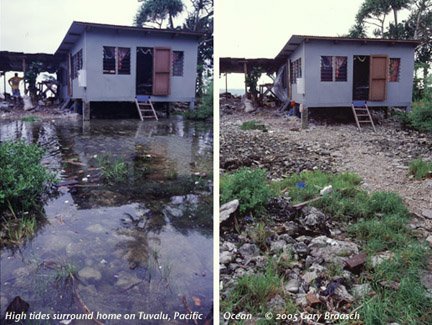
This image from World View of Global Warming is of a house in the island nation of Tuvalu.

My sister and I sold our family home which was about 18" above high tide mark a few years ago. I've posted before about the threats to coastal property, where you can find a link to the tool that lets you look at projected sea level rise in your neighborhood, and make no secret of my belief that I will live to see sea level rise of 1 meter or more. This isn't just a problem for far off nations like Tuvalu or Bangladesh so "out of sight, out of mind" ain't gonna cut it! Think, New York, Singapore, Hong Kong, London, Miami, Savannah, Charleston, Norfolk, Baltimore, etc, etc, ......

There are so many issues associated with sea level rise that make property values seem insignificant; pollution of the seas as they swamp industrial sites and garbage dumps, food shortages as coastal farms are drowned, disruption of commerce as ports become unusable and highways are swamped, environmental refugees as billions of people look for new places to live.

Assuredly this is not likely to be an event as portrayed in Day after Tomorrow, it will happen gradually, except in the case of storm surges as hurricanes become more severe. This gives us time to adapt. But will we?

When will we realize that coastal properties have no value? Insurance companies are already realizing it I think. How will you sell your home to finance your move inland if your home has no value? It may sound unethical or even callous but shouldn't you be thinking about selling that coastal property while it still has value? There are those who do not believe these levels of sea level rise are possible and are still willing to purchase that waterfront property. Buyer Beware!

Check out this post on the subject over at Worldchanging
Here's an excerpt from the post by Joe Romm,

" Coastal property values won't wait to (permanently) fall until sea levels have actually risen 4 or 5 feet, as they almost certainly will by the end this century on our current CO2 emissions path (see
Startling new sea level rise research: "Most likely" 0.8 to 2.0 meters by 2100 and Report from AGU meeting: One meter sea level rise by 2100 "very likely" even if warming stops?).

Coastal property values will crash when a large fraction of the financial community and of opinion-makers -- along with a smaller but substantial fraction of the public -- realize that it is too late for us to stop 4 to 5 feet of SLR. And remember, if we don't get on the sustainable sub-450-ppm path soon, then people will quickly come to understand that SLR won't stop in 2100. Seas will continue rising post-2100 perhaps 10 to 20 inches a decade (or more) for centuries until we are ice free and seas are 250 feet higher. And that makes protecting most coastal cities very, very difficult and expensive."

Monday, 23 February 2009

Yowza! Sounds like science fiction but it isn't

Check out this article over on celsias by Jeanne Roberts. It's starting to feel like a movie starring Kevin Costner.

Antarctic Ice Shelf "Hanging by a Thread", and What it Means to You


Here's an excerpt,

"Now, to make matters worse, geophysicists from the University of Toronto warn that the increasingly unstable West Antarctic Ice Sheet (WAIS) could lead to significantly higher sea level rises, and such changes will be highly variable as well, affecting primarily North American and nations in and along the southern Indian Ocean (Indonesia, the Maldives, and Madagascar).

Estimates suggest rises up to 16.5 feet, which is the value of the total volume of water locked up in the WAIS. However, warns study author and geophysicist Jerry X. Mitrovica, the estimate may fall shy because it ignores three significant effects: sea levels fall near a melting ice sheet, but rise progressively at greater distances; earth rebounds when an ice sheet melts, pushing more water into the ocean, and; melting of an ice sheet as large as the WAIS may cause the earth's rotational axis to shift, potentially as much as 1,640 feet from its present location - an alteration in the earth's geophysical plane that could shift water from the southern oceans to the Indian Ocean and northward toward North America."

Tuesday, 10 February 2009

While away the hours looking into the future

This is a projection, in red, of a 1 meter sea level rise on the coastal area I grew up in. The horseshoe shaped area just under and to the right of "Georgia" is where my family home is, though we no longer own it thankfully. I fully expect to see this amount of sea level rise in my lifetime.

I produced this at The University of Arizona Department of GeoSciences Environmental Studies Laboratory website. It is an interactive map with which you can see the effects of varying levels of sea level rise on coastal regions of the world. Find your favorite sea side vacation spot and watch it go under! Hmmm... now where will all those people go?

"Results indicate that the earth will be warm enough in less than 150 years (assuming no reduction in greenhouse gas emissions) to significantly melt the Greenland Ice Cap. This change could also lead to four to six meters of sea level rise at rates of up to two to five centimeters per year... 1 meter = 3.28 feet, 6 meters = 19.68 feet " - Architecture 2030


Sunday, 1 February 2009

British Columbia Coastline Faces Being Shaken and Swamped

Here's a link to an excellent article about a fascinating report.
Combining as it does the imminent threat of subsidence due to earthquake induced land slip and the more gradual threat of sea level rise due to a number of climate related changes, this report makes good reading.

I think the "probable", 11 to 50cm, is likely too conservative. The "possible" is more likely probable. Here is the "possible" from the report, 80 to 120cm. The report acknowledges that many researchers believe the figures for sea level rise from melting glalciers as projected in the IPCC 2007 are too conservative and that the rate of melting may increase substantially over the century. More recent science confirms this. Global warming is accelerating due to numerous positive feedback loops. I don't think scientists are sure enough about the severity of the effects, scientists are after all conservative beasts, to predict outcomes with any degree of certainty but I am willing to bet that we are in for a far rougher time of it than what governments and their panels of scientists and beaureaucrats are willing to let on.

Every day that we go about business as usual, applying palliative measures to salve our conscience in form of green consumerism, endless debate instead of action, we are, like lemmings, herding closer to the edge of climate catastrophe.

It will be interesting to see if based on this report the Canadian government is willing to put and end to the disastrous exploitation of the Alberta tar sands.

British Columbia Coastline Faces Being Shaken and Swamped

Download the report at

http://www.env.gov.bc.ca/epd/climate/pdfs/sea-level-changes-08.pdf