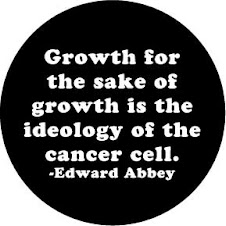
It has long mystified me that those with limited income to spend on food choose to spend it on junk food; soda's, processed foods, anything with high fructose corn syrup in it, white breads, and fast food. You would think investing in nutrition; fresh, seasonal, and organic food, makes more sense. You can purchase and eat less because the food you eat is so much more nutritious. The paradox is that the poor in America tend towards obesity and have high rates of diabetes due to these food choices. I believe this behaviour is down to intentionally deceptive media and poor nutrition education. Here is a story over at Organic Consumers Association about a couple that tried to exist on the government food stamp minimum while eating only SOLE food; that's sustainable, organic, local, or ethical food.
"Siobhan Phillips proves that eating sustainably and ethically can be done on a budget - even on a seriously limited budget. She and her husband embarked on an experiment to eat only SOLE foods - sustainable, organic, local or ethical foods - "on the government-defined, food-stamp minimum: $248 for two people in our hometown of New Haven, Conn." Even more courageously, the two started this experiment with bare cupboards!
No, Siobhan didn't go on an all-vegetarian diet - though she did have to pass on the grass-fed steak. "Instead, I bought a small free-range chicken for about $9 and a scant pound of local ground beef for about $6, knowing that this, along with some sustainable canned fish, was our allotment of animal flesh for four weeks." That meant she really, really had to stretch the chicken, not only using up every piece of meat but also saving the fat and boiling the bones for broth.
But by buying dry beans in bulk, baking her own basic bread, and discovering thrifty cookbooks and international cuisine, Siobhan got to have her Chinese fried rice and Italian risotto and spicy biryani and eat them too. She says it didn't take much more time than usual - and she didn't have to give up her morning cup of organic fair trade coffee or fair trade cocoa desserts either.
Siobhan says her method won't work for everyone: "I relied on the sort of reasonably flexible schedule that is a luxury in far too many households, and I started with some basic cooking knowledge." But they sure sound like they'd work for me - and many other MNN readers. Read her article for more details on her frugal and tasty ethical eating - which she says she plans to stick to - save for the occasional pepperoni pizza."
Thursday, 7 May 2009


The difference between just growing your own and doing it as part of Transition
Lots of folks are putting in veggie gardens these days, that's wonderful. So much more can be accomplished when that simple act is part of something larger, namely a Transition Initiative. An article over at the Daily Camera puts it thus;
"Last month, 18 people came together in Louisville to dig up a yard to become a vegetable plot.
"Last month, 18 people came together in Louisville to dig up a yard to become a vegetable plot.
That's not too unusual nowadays: Boulder County nurseries report a surge in interest in home vegetable gardening, and a revival of World War II-style Victory Gardens is a trend nationwide. What makes this particular patch of dirt different is that it's part of an effort called Transition -- whose members have a goal considerably more comprehensive than supplying local families with fresh produce. They envision nothing less than a community that has made the transition away from fossil fuels to a sustainable, locally based economy, able to largely feed itself and create local jobs.
The Transition movement, which got its start in the United Kingdom, is a model being implemented in 150 communities in various countries, including locations in the United States. Transition Boulder County was the first Transition initiative in the United States, getting its start in May of last year. It is an extension of Boulder County Going Local, a re-localization group that has been in existence since May 2005. What's different about Transition, says Michael Brownlee, who heads the Boulder County group, is that it offers a more comprehensive plan to accomplish its goals.
The plan includes 12 steps, such as forming an initiating group, raising awareness, networking with existing groups, staging a large community event called "The Great Unleashing" to draw in the wider population, forming working groups from that event and working in the community to create an "energy descent action plan."
While the model might sound a little vague and squishy to outsiders, it's purposely designed that way to let each community come up with a plan that includes as many people as possible.
"I think more people are open to the reality that really deep change is necessary now," Brownlee says. "These are not minor adjustments in lifestyle, but changes in commitment that our whole society begins to take on. ...
Changing behavior
Last year, when gas hit $4 a gallon, Transition folks were not surprised.
Many had been sounding the alarm about peak oil -- the point at which the world's oil supply reaches its high point, thereafter becoming increasingly expensive to extract. Many expect a "long emergency" in which the United States and other developed countries will be forced to make a wrenching adjustment to the end of the cheap fossil fuel on which much of their economic growth has been based.
After gas prices rose, however, they began to fall again as the global financial system, which was based on unsustainable credit, nearly collapsed, causing a deep recession. While the price of oil is lower, Americans have been left with a queasy feeling that their lifestyle may be in for a major readjustment.
"We thought peak oil would end the party," says Todd Siegel, initiator of Transition Boulder. "It's a lot more difficult to get the message out in a down economy. People are worried about trying to make their mortgage payment and put food on the table."
But, he says, "I believe it's all related and still as important as it ever was."
That's because the key idea behind Transition is building a sustainable community that is better able to insulate itself from globally driven shocks, whether they're caused by oil prices or problems in the financial markets. The Transition movement's advocates believe it can offer an orderly, community-based process to make the changes needed to live with fewer resources.
However, Siegel says, that doesn't have to mean a dreary, deprived life.
"I wouldn't say Transition is about transitioning to a spartan lifestyle," he says. "It's not about reverting to a more primitive state. It's about understanding the limits we face. If we preemptively decide to make the transition, we can take all the good stuff with us and move into the future that way."
By "good stuff" he means things like advanced medicine and technology, but probably not two-car, big-house families that gobble up huge amounts of precious energy. He envisions more multi-generational households with close community ties." - Cindy Sutter
Wednesday, 6 May 2009
Fear and loathing fighting Big Dirty Coal
For the sake of a few jobs are we really willing to sacrifice mountain communities and the very mountains the live on? Here's an update on the situation in West Virginia as reported by Ben Block over on World Changing.
Here's an excerpt;
Here's an excerpt;
"Maria Gunnoe raises her children in a small town in the Appalachian Mountains of West Virginia. Her grandfather toiled for 32 years in the coal mines to buy the property where she lives. She helped build the house that her son and daughter now call home.
Five years ago, a flood unlike anything her ancestors experienced nearly wiped Gunnoe's home off the map. A spring rain turned the docile Big Branch Creek that transects her yard into a barrage of black water. The flood ripped Gunnoe's Rottweiler from his collar and carried him downstream. Her family stayed indoors, praying the house would withstand the current.
"There is nothing more intimidating than a 60-foot-wide, 20-foot-tall wall of water coming at you," said Gunnoe, whose property has flooded seven times in the past nine years. She blames the 486 hectare (1,200-acre) mountaintop removal mine that has been leveling the ridge above her home.
Gunnoe, who was honored last month with the 2009 Goldman Environment Prize for North America, has become one of the most fearless opponents of mountaintop removal in her state. Her campaign against the powerful coal industry has helped attract international attention to the damaging mining practice. ... "The people of Appalachia are being sacrificed for energy in this country," said Gunnoe, a grassroots organizer with the Ohio Valley Environmental Coalition (OVEC). "The work I do with fighting mountaintop removal coal mining was inspired because I am a mother. I do not and will never support any aspect of the coal industry, simply because I've seen it kill people I care about."...
OVEC sued the Army Corps of Engineers in 2007 to stop any new mining at a mountaintop removal site near Gunnoe's home town of Bob White. Days before the hearing, Gunnoe gathered 20 local residents who were scheduled to join her in testifying against the mine site. But more than 60 coal miners also showed up at the community hall to harass the protestors to stay silent.
The day of the testimony, more than 100 people packed the courtroom, with a divided gallery split between miners and
environmentalists. Among the community witnesses, Gunnoe was the only resident willing to challenge the industry directly.
Her testimony helped sway U.S. District Judge Robert C. Chambers to rule in the coalition's favor. "Money can be earned, lost, and earned again," Chambers wrote. "But a valley once filled is gone forever."
The mining company involved in the lawsuit released a notice stating that the ruling could result in job losses for at least 39 miners at the site and another 180 at a related underground mine. Soon, Gunnoe found her face across her community on "wanted" posters labeled "Job Hater." A neighborhood store started collecting signatures for a petition against Gunnoe. Her daughter's dog was shot dead.
Friends heard rumors that Gunnoe too would be shot, and that her home would be burned with her children inside." - Ben Block
Monday, 4 May 2009
Sunday, 3 May 2009
Planted your garden yet?
The garden I helped get in the ground in Bermuda a month ago is already providing all the salad greens the household needs. The one I've helped put in here in North Carolina in the last month is already yielding fresh organic lettuce and swiss chard. The corn, onions and beans are 4 inches high, the turnips, carrots, and and cukes are well on their way. The blueberry bushes are several inches bigger. Have you planted your garden yet?
Our continued reliance on non local industrial agriculture is fraught with problems, from over reliance on climate destroying fossil fuels, destruction of carbon sequestering soil ecology, the extreme dependence on mining of fossil water to irrigate crops, the contamination of our ecosystem with genetically modified organisms, and the pollution of drinking water with pesticides, herbicides, and fungicides. This is all not to mention the health degrading effects of our diets so heavy with processed food substitutes, high fructose corn syrup, and the unknown (though getting less so) dangers of consuming genetically engineered organisms.
But our problems are as nothing compared to the damage our export of this pernicious form of agribusiness has had on the developing world. People are literally starving to death because they were convinced to give up their traditional sustainable modes of sustenance in favor of lining the pockets of corporate shareholders by growing cash crops for export. Their water sources are drying up, their farm workers are dying due to exposure to deadly chemicals, or committing suicide due to the burden of debt the have been pressured into by their governments in cahoots with the agribusiness giants. This situation represents a threat to civilization itself. If you doubt that, just look at Darfur and Somalia. Read more at Climate Progress;
"It’s not news that Lester Brown is warning about our unsustainable approach to feeding the planet. But it is news that Scientific American has run a major article by him on how “The biggest threat to global stability is the potential for food crises in poor countries to cause government collapse.”
Americans support regulating Greenhouse Gases
Recent polls have shown that Americans are in favor of dealing with Climate Change through the regulation of greenhouse gases. As reported at Worldchanging;
"the new Washington Post/ABC poll of 1,072 Americans (here) found: While majorities across the board support government regulation of greenhouse gases, it peaks among liberals (88%) and under 30s (80%), vs. 61% of conservatives and 64% of seniors. Support also ranges from 85% of Democrats, 65% “strongly,” to 64% of Republicans, 39% strongly. Concern about its cost is broader, and stronger, among those who’d presumably be hit hardest — lower-income adults. ... Americans appear to fully understand the worst-case consequences of what they are supporting. Imagine how the polling will ultimately turn out when President Obama and his team actually launches an all out messaging blitz on energy and climate action, with a tax cut for the poor and middle class, with aggressive strategies to lower their energy bills and create green clean energy jobs, and with a clear message of the cost to Americans of inaction." - Joe Romm
Thursday, 30 April 2009
The Idea of Geoengineering is Being Used Dishonestly - Joe Romm
It's another case of "Don't worry, technology will bail us out." Bullsh$@! I agree with this
post over at Climate Progress
Wednesday, 29 April 2009
US may never again need to build a new coal or nuclear power plant.
Thanks to OpenAlex for this tidbit.
"The chairman of the US Federal Energy Regulatory Commission has stated that the US may never again need to build a new coal or nuclear power plant. He argues that smarter grids along with better storage for renewables will make new conventional baseload capacity unnecessary. Many people have made the argument before. But its sure was a surprise to see it coming from such a highly placed official in the US government. " -Alex Aylett
read more
Scientist Warning of Health Hazards of Monsanto's Herbicide Receives Threats
Apparently we are not to be allowed to know about the dangers of using Roundup
As reported by Organic Consumers Association
"There are reports coming out of Argentina of attempts to intimidate the lead researcher of the study showing that Roundup - the glyphosate herbicide developed by Monsanto, could cause brain, intestinal and heart defects in fetuses. ... Dr. Carrasco has warned that the doses of herbicide used in his study "were much lower than the levels used in the fumigations," and so the situation "is much more serious" that the study suggests because "glyphosate does not degrade". ...
According to an article in the Argentine press, after news about the study broke, Dr. Carrasco was the victim of an act of intimidation, when four men arrived at his laboratory in the Faculty of Medicine and acted extremely aggressively.
Two of the men were said to be members of an agrochemical industry body but refused to give their names. The other two claimed to be a lawyer and notary. They apparently interrogated Dr. Carrasco and demanded to see details of the experiments. They left a card Basílico, Andrada & Santurio, attorneys on behalf of Felipe Alejandro Noël.
Dr. Carrasco also reports being subjected to offensive phone calls and there have been disparaging references to his research in newspapers with links to agribusiness. Dr. Carrasco however is resisting the intimidation, saying, "If I know something, I will not shut my mouth."
read more at OCA
Tuesday, 28 April 2009
Friday, 24 April 2009
BioChar and the wonders of the soil.
Look after the soil, keep it chemical free, and it will look after you.
Thanks to Replanting the Rainforest and EcoInteractive for the heads up on this fascinating video and the following excerpts.
 "What is Biochar? Biochar is charcoal that is created by heating biomass (plants) under low oxygen conditions, which sequesters the plants’ carbon, rather than releasing it into the atmosphere. When Biochar is used to amend soil, the resulting Terra Preta sequesters more carbon, increasing its own volume. The activity of friendly microorganisms, called arbuscular mycorrhizal fungi, increases as well. The fungi spread beyond the original carbon, fix additional carbon, stabilize the soil and assist in nutrient uptake by plants. Biochar also improves soil fertility, reducing the need for synthetic fertilizers. It conserves water, prevents erosion and acts as a natural carbon filter for water by removing chemicals from runoff.
Thanks to Replanting the Rainforest and EcoInteractive for the heads up on this fascinating video and the following excerpts.
"What is Biochar? Biochar is charcoal that is created by heating biomass (plants) under low oxygen conditions, which sequesters the plants’ carbon, rather than releasing it into the atmosphere. When Biochar is used to amend soil, the resulting Terra Preta sequesters more carbon, increasing its own volume. The activity of friendly microorganisms, called arbuscular mycorrhizal fungi, increases as well. The fungi spread beyond the original carbon, fix additional carbon, stabilize the soil and assist in nutrient uptake by plants. Biochar also improves soil fertility, reducing the need for synthetic fertilizers. It conserves water, prevents erosion and acts as a natural carbon filter for water by removing chemicals from runoff.
Biochar is inert and remains in the soil for thousands of years. It cannot be cut down, burned down, nor is it susceptible to erosion. It is self-renewing.
Biochar could be a solution for:
- Hunger and Food Insecurity
- Deforestation and Biodiversity Loss
- Excess Carbon Dioxide in the Atmosphere
- Methane and Nitrous Oxide emissions from soil
- Renewable Energy"
Subscribe to:
Posts (Atom)


 Posts