World Oil Production Forecast - Update November 2009
Posted using ShareThis
Sunday, 29 November 2009


Saturday, 28 November 2009
Video - Contraction and Convergence animation from "The Age of Stupid"
This animation from The Age of Stupid is a quick and concise explanation of the concept of Contraction and Convergence, a framework for the equitable powerdown from our disastrous oil dependence.
Here is the blurb from the Global Commons Institute website;
"Contraction and Convergence, C&C, is a scheme to provide a framework for a smooth transition to a low level of CO2 emissions from human activity. It can either follow or replace the Kyoto protocol. The first step in C&C, 'Contraction', is based on agreeing a safe target concentration level and the determination of global annual emissions levels into the which should take the atmosphere to that target. We assume that what is 'safe' would be determined by an international agreement, probably by the UNFCCC acting under guidance from the IPCC. A profile of plausible annual emissions levels can be set by GCI's CCOptions model. We project forward to 2200.
Having defined a global budget, the second step, 'convergence' defines allocations to each country. CCOptions assumes that each country is assigned annual allowances which vary, per capita, linearly, starting from actuals in 2000 and converging to a common level of per-capita emissions in a target year. This target year need not be the same as the contraction target year and is a likely topic for political negotiation.
A cap year can be set so that population growth after that year does not accrue additional emissions rights.
The C&C package is expected to be completed with an emissions-trading mechanism and with a governance framework including penalties for non-compliance."
Here is the blurb from the Global Commons Institute website;
"Contraction and Convergence, C&C, is a scheme to provide a framework for a smooth transition to a low level of CO2 emissions from human activity. It can either follow or replace the Kyoto protocol. The first step in C&C, 'Contraction', is based on agreeing a safe target concentration level and the determination of global annual emissions levels into the which should take the atmosphere to that target. We assume that what is 'safe' would be determined by an international agreement, probably by the UNFCCC acting under guidance from the IPCC. A profile of plausible annual emissions levels can be set by GCI's CCOptions model. We project forward to 2200.
Having defined a global budget, the second step, 'convergence' defines allocations to each country. CCOptions assumes that each country is assigned annual allowances which vary, per capita, linearly, starting from actuals in 2000 and converging to a common level of per-capita emissions in a target year. This target year need not be the same as the contraction target year and is a likely topic for political negotiation.
A cap year can be set so that population growth after that year does not accrue additional emissions rights.
The C&C package is expected to be completed with an emissions-trading mechanism and with a governance framework including penalties for non-compliance."
Wednesday, 25 November 2009
My permaculture education begins!
As most of my regular readers know, my wife and I are planning on setting up an off grid permaculture lifestyle with a attached community education project when we get to the states in the spring. This, of course, necessitates a thorough understanding of permaculture. I hope to take a permaculture design course, probably in Asheville, while my wife would like it if we could avoid that and rely on our own study. This necessitates owning the right books. So....
Since I got back to England I've been trolling the used book shops for books on Permaculture. I finally found one at my friend Brian's bookshop yesterday and what a find! "Permaculture: A Practical Guide for a Sustainable Future" by Bill Mollison, a tome, large hardbound 579 pages.
So my plan is to spend an hour every morning studying and keeping notes, particularly as they apply to our specific project. I will endeavour to post occasional updates on what I'm learning and the development of the plan.
Since I got back to England I've been trolling the used book shops for books on Permaculture. I finally found one at my friend Brian's bookshop yesterday and what a find! "Permaculture: A Practical Guide for a Sustainable Future" by Bill Mollison, a tome, large hardbound 579 pages.
So my plan is to spend an hour every morning studying and keeping notes, particularly as they apply to our specific project. I will endeavour to post occasional updates on what I'm learning and the development of the plan.
Tuesday, 24 November 2009
Video - Ted Talks - Rob Hopkins - Transition to a world without oil
"Rob Hopkins reminds us that the oil our world depends on is steadily running out. He proposes a unique solution to this problem -- the Transition response, where we prepare ourselves for life without oil and sacrifice our luxuries to build systems and communities that are completely independent of fossil fuels."
Saturday, 21 November 2009
Videos - Tim Jackson - Prosperity without growth
I remember a debate I had as a young man with a friend of mine who was making his living in the stock market. He advised me to invest in banks and to learn the ways of the trader. I admonished him for being involved in an industry that rewarded companies for firing people, for putting people out of work when they had families to feed, all in the interest of short term profits. I felt, as I still feel, that an economy that grows by reducing jobs was nonsensical, unethical and unsustainable. I wanted no part of it. For all the years in between, endless growth as an economic model has been gospel and any attempt to discuss the obvious fact that we live on a limited world of resources upon which our economy and our very survival is completely dependent was met with looks of disbelief. One never heard any mainstream discussion of this problem, until now.
Tim Jackson, Professor of Sustainable Development at University of Surrey and Economics Commissioner to the UK Sustainable Development Commission, (click here for bio) is advising the Labour Government, at their request, that we need to redefine what we call prosperity and find a new path there, one that doesn't involve consumerist materialistic growth! You can download his report here, the most downloaded report in the history of the Commission.
Meanwhile the fox still owns the henhouse in the US, the banksters remain firmly in control, steering the debate away from any serious discussion that the entire foundation of the economy is built on sand. Like Zombies in a Romero film, arms raised intoning "must protect the rich, must protect the rich...."
"Is our economy fit for purpose in a low carbon world? Can economic growth deliver us from the threat of catastrophic climate change, or is it the engine thats driving us relentlessly towards it?
Speaking today at a high-level debate in central London to mark the publication of his controversial new book Prosperity without Growth, Tim Jackson argues that building a new economic model fit for a low carbon world is the most urgent task of our times.
The current model isnt working, says Prof Jackson, a top sustainability adviser to the UKs four governments. Instead of delivering widespread prosperity, our economies are undermining wellbeing in the richest nations and failing those in the poorest. The prevailing system has already led us to the brink of economic collapse and if left unchecked it threatens a climate catastrophe.
Prosperity without Growth substantially updates Jacksons groundbreaking report for the Sustainable Development Commission. Launched earlier this year to great acclaim, the report rapidly became the most downloaded document in the Commissions nine year history and in recent weeks has contributed to a burgeoning debate about economic growth and its consequences for people and planet.
As world leaders prepare to meet in Copenhagen to forge a new climate deal, Jacksons analysis provides a salutary warning against complacency. Global carbon emissions have risen 40% since 1990 and will continue to rise inexorably unless action is taken urgently. By the year 2050, the carbon content of each dollar of economic activity will need to be a staggering 130 times lower than it is today, if we are to make room for much-needed development in the poorer nations and remain within a 2oC warming.
By the end of this century, well need an economy in which each and every dollar of economic activity is taking carbon out of the atmosphere, says Jackson. What does such an economy run on? What does it look like? What kind of economic activities take place in such a world? Nobody knows the answer to these questions. But its fanciful to suppose we can achieve such a transformation without seriously examining the dynamics of the growth-based model.
Jackson admits the task is not a trivial one. We are caught in a profound dilemma, he suggests. Economic growth is the default mechanism for achieving social stability. And at the same time it drives the scale of ecological damage. Whats needed now is an urgent commitment to building a different kind of economic system, one which puts people and planet at its heart, Jackson claims. For the advanced economies of the western world, prosperity without growth is no longer a utopian dream. It is a financial and ecological necessity.
Prosperity Without Growth: Economics for a Finite Planet (Earthscan, £12.99) is available from all good bookshops and www.earthscan.co.uk "
Tim Jackson, Professor of Sustainable Development at University of Surrey and Economics Commissioner to the UK Sustainable Development Commission, (click here for bio) is advising the Labour Government, at their request, that we need to redefine what we call prosperity and find a new path there, one that doesn't involve consumerist materialistic growth! You can download his report here, the most downloaded report in the history of the Commission.
Meanwhile the fox still owns the henhouse in the US, the banksters remain firmly in control, steering the debate away from any serious discussion that the entire foundation of the economy is built on sand. Like Zombies in a Romero film, arms raised intoning "must protect the rich, must protect the rich...."
"Is our economy fit for purpose in a low carbon world? Can economic growth deliver us from the threat of catastrophic climate change, or is it the engine thats driving us relentlessly towards it?
Speaking today at a high-level debate in central London to mark the publication of his controversial new book Prosperity without Growth, Tim Jackson argues that building a new economic model fit for a low carbon world is the most urgent task of our times.
The current model isnt working, says Prof Jackson, a top sustainability adviser to the UKs four governments. Instead of delivering widespread prosperity, our economies are undermining wellbeing in the richest nations and failing those in the poorest. The prevailing system has already led us to the brink of economic collapse and if left unchecked it threatens a climate catastrophe.
Prosperity without Growth substantially updates Jacksons groundbreaking report for the Sustainable Development Commission. Launched earlier this year to great acclaim, the report rapidly became the most downloaded document in the Commissions nine year history and in recent weeks has contributed to a burgeoning debate about economic growth and its consequences for people and planet.
As world leaders prepare to meet in Copenhagen to forge a new climate deal, Jacksons analysis provides a salutary warning against complacency. Global carbon emissions have risen 40% since 1990 and will continue to rise inexorably unless action is taken urgently. By the year 2050, the carbon content of each dollar of economic activity will need to be a staggering 130 times lower than it is today, if we are to make room for much-needed development in the poorer nations and remain within a 2oC warming.
By the end of this century, well need an economy in which each and every dollar of economic activity is taking carbon out of the atmosphere, says Jackson. What does such an economy run on? What does it look like? What kind of economic activities take place in such a world? Nobody knows the answer to these questions. But its fanciful to suppose we can achieve such a transformation without seriously examining the dynamics of the growth-based model.
Jackson admits the task is not a trivial one. We are caught in a profound dilemma, he suggests. Economic growth is the default mechanism for achieving social stability. And at the same time it drives the scale of ecological damage. Whats needed now is an urgent commitment to building a different kind of economic system, one which puts people and planet at its heart, Jackson claims. For the advanced economies of the western world, prosperity without growth is no longer a utopian dream. It is a financial and ecological necessity.
Prosperity Without Growth: Economics for a Finite Planet (Earthscan, £12.99) is available from all good bookshops and www.earthscan.co.uk "
Friday, 20 November 2009
Video - Ted - Rachel Pike: The science behind a climate headline
....36% (of Americans) say warming is occurring “mostly because of natural changes in the atmosphere.” ...(11%) say “there is no solid evidence that the earth is getting warmer.”
...84% of scientists say the earth is warming because of human activity. Scientists .... regard(ing) global warming as a very serious problem: 70% ... compared with 47% of the public. ."- Pew Research center for the people and the press
Why is that?
"In 4 minutes, atmospheric chemist Rachel Pike provides a glimpse of the massive scientific effort behind the bold headlines on climate change, with her team -- one of thousands who contributed -- taking a risky flight over the rainforest in pursuit of data on a key molecule."
...84% of scientists say the earth is warming because of human activity. Scientists .... regard(ing) global warming as a very serious problem: 70% ... compared with 47% of the public. ."- Pew Research center for the people and the press
Why is that?
"In 4 minutes, atmospheric chemist Rachel Pike provides a glimpse of the massive scientific effort behind the bold headlines on climate change, with her team -- one of thousands who contributed -- taking a risky flight over the rainforest in pursuit of data on a key molecule."
Video - FAIR FOOD: FIELD TO TABLE
"FARMWORKERS TODAY: Approximately 2-3 million farmworkers feed our nation every day, working under some of the harshest and most dangerous conditions found in any industry. This is a glimpse into the hard realities that a vast majority of these workers face on a day-to-day basis. For more information on the fair food movement in the US and to see other chapters of this project please visit: fairfoodproject.org. "
Who puts the food on your table? Take action on this issue over at Organic Consumers Association.
Who puts the food on your table? Take action on this issue over at Organic Consumers Association.
Thursday, 19 November 2009
The climate train has left the station.
A train loaded explosives and toxic chemicals pulls into a lonely country station outside a major metropolis. It is midnight. The engineer steps off to get a cup of tea, when he returns he sees that the train has started rolling down the line and is just going out of sight around a bend. Now he knows this stretch of track well. Up ahead, the grade continues to steepen, downward toward the sleeping metropolis. He knows that the train will continue to pick up speed unless it is derailed soon. He also knows that the longer he waits to do something the deeper into settlements it will get and therefore will cause much more damage and loss of life when it does finally crash. What should he do? What would you do?
Should he say, "not my problem" and just sit and quietly drink his tea? Should he walk to the station office and try to raise someone else to deal with it? Should he use his cell phone to call his superiors to determine the best course of action? Or should he immediately call emergency services and mobilize quick and decisive action to derail the train as soon as possible?
Now imagine you are one of the folks living near a sharp bend a few miles down the track at the bottom of the grade, comfortably snoozing away as the train hurtles your direction. What would you like him to do?
Of course, the train is the climate and we are watching it roll around the bend. The folks sleeping near the tracks are our children. What do we do? What will you do?
I can suggest several things you can do;
1. Contact your representatives in Washington, including president Obama, and vigorously support a binding and comprehensive climate agreement in Copnhagen. Sign this Petitition
2. Detach from consumerism, we are literally consuming the support systems upon which we all stand and the waste products are killing us as we fall.
3. Learn to live more sustainably, set an example for your neighbors. Reduce car driving, meat consumption, flying, use of palm oil, the human population. Increase local organic food consumption, how much food you grow, your production and conservation of energy, use of public transit or even better, human powered transport, the efficiency of your home.
4. Get involved in the climate change work being done in your community, start or join a transition initiative, write to your local paper, get active in preventing deforestation.
Thanks to Professor Richard Leakey for the train analogy. He used it in a lecture entitled "Climate Change and the Future of Life on Earth" delivered on May 30th 2009 at the Royal Ontario Museum and broadcast on Big Ideas.
Should he say, "not my problem" and just sit and quietly drink his tea? Should he walk to the station office and try to raise someone else to deal with it? Should he use his cell phone to call his superiors to determine the best course of action? Or should he immediately call emergency services and mobilize quick and decisive action to derail the train as soon as possible?
Now imagine you are one of the folks living near a sharp bend a few miles down the track at the bottom of the grade, comfortably snoozing away as the train hurtles your direction. What would you like him to do?
Of course, the train is the climate and we are watching it roll around the bend. The folks sleeping near the tracks are our children. What do we do? What will you do?
I can suggest several things you can do;
1. Contact your representatives in Washington, including president Obama, and vigorously support a binding and comprehensive climate agreement in Copnhagen. Sign this Petitition
2. Detach from consumerism, we are literally consuming the support systems upon which we all stand and the waste products are killing us as we fall.
3. Learn to live more sustainably, set an example for your neighbors. Reduce car driving, meat consumption, flying, use of palm oil, the human population. Increase local organic food consumption, how much food you grow, your production and conservation of energy, use of public transit or even better, human powered transport, the efficiency of your home.
4. Get involved in the climate change work being done in your community, start or join a transition initiative, write to your local paper, get active in preventing deforestation.
Thanks to Professor Richard Leakey for the train analogy. He used it in a lecture entitled "Climate Change and the Future of Life on Earth" delivered on May 30th 2009 at the Royal Ontario Museum and broadcast on Big Ideas.
Video - Princes Rainforest Project - Prepare for Crash Landing!
"This clip explains what is happening to the planet as a result of rainforest deforestation. Using images and graphics this film explains the importance of the forests and why we must stop destroying them before its too late. "
Wednesday, 18 November 2009
Video - California could dry up and blow away
Thanks to Climate Progress for the heads up on this video. Click on the link for more detail from Mr. Romm
"A July 2009 study, “Impacts of climate change from 2000 to 2050 on wildfire activity and carbonaceous aerosol concentrations in the western United States” finds a staggering increase in “wildfire activity and carbonaceous aerosol concentrations in the western United States” by mid-century under a moderate warming scenario: We show that increases in temperature cause annual mean area burned in the western United States to increase by 54% by the 2050s relative to the present-day … with the forests of the Pacific Northwest and Rocky Mountains experiencing the greatest increases of 78% and 175% respectively. Increased area burned results in near doubling of wildfire carbonaceous aerosol emissions by mid-century." - Joe Romm
"A July 2009 study, “Impacts of climate change from 2000 to 2050 on wildfire activity and carbonaceous aerosol concentrations in the western United States” finds a staggering increase in “wildfire activity and carbonaceous aerosol concentrations in the western United States” by mid-century under a moderate warming scenario: We show that increases in temperature cause annual mean area burned in the western United States to increase by 54% by the 2050s relative to the present-day … with the forests of the Pacific Northwest and Rocky Mountains experiencing the greatest increases of 78% and 175% respectively. Increased area burned results in near doubling of wildfire carbonaceous aerosol emissions by mid-century." - Joe Romm
Transition Bermuda solar batch heater wins an innovation award!

I spent most of the last 6 months in Bermuda volunteering with a group of locals to get a Transition Initiative going while my wife was working in the local schools doing supply work, substitute teaching. In February I built a solar batch heater from recycled materials and installed it at the guest house where we were staying. When I tested it, in October on a partly cloudy day, I discovered that it was reducing electricity demand for hot water by an average of 25%. With electricity approaching 50¢kWh on the island that represents a significant savings and means that the unit will pay for itself in under two years as the only costs were the plumbing supplies.
Recently, the local environmental group Greenrock, ran an innovation in sustainable construction competition as part of Global Entrepreneurship Week. We entered the unit as a Transition Bermuda project. Our hope being that at the very least it would help gain publicity for the initiative and might even win. In the final judging it was up against some stiff competition, several by professional architects; wood housing to reduce concrete use, prefab housing made from shipping containers, and a device that is used to determine site suitability for solar PV and microwind installations.
But we won! Last night my wife did the presentation at the final judging and it won $1500. The money will go to the initiative, hopefully to fund classes to teach folks how to build the units.
The design needs much refining but works as is.
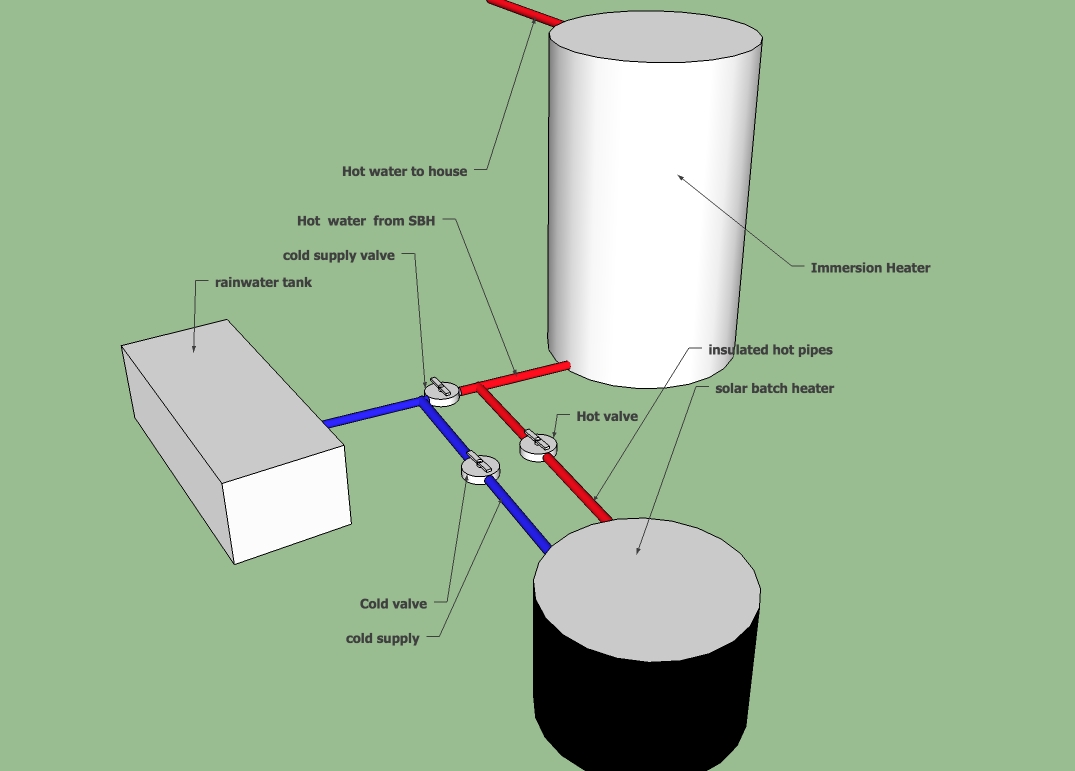
The plumbing diagram indicates that the unit is plumbed into the cold side of the immersion heater which sees hot water coming in so needs not come on as often. It is lower than the main tank as well which enables a thermal convection loop, circulating hot water out of the solar tank as it heats. This means the immersion heater stays warm longer as it doesn't rely exclusively on the main circulation pump for the system to deliver hot water to it.
Here is the text from the entry document with more details about the project.
A Greenrock Innovation Tournament 2009 entry
DIY Passive Solar Batch Heater made from recycled materials
A Transition Bermuda prototype project installed at:
Denevon Guest House #11 Woodbourne Crescent Pembroke
Transition Bermuda seeks to increase the resiliency of Bermuda by fostering and promoting a reduction in fossil fuel dependence, a return to local economy and self sufficiency, and the rebuilding of healthy community that comes with self reliance and local interdependance.
The prototype as built was designed according to the materials available at the time and tools available to be borrowed.
• How well does it respond to Bermuda’s unique building environment?
The salient point about Bermuda’s building environment that it is almost totally unsustainable. It does not use any significant amount of local materials. As buildings and appliances from buildings are replaced there is no significant recycling system for the materials. This valuable resource ends up in the land fill or up the incinerator stack. Built with very little mandated attention to efficiency, buildings here are completely reliant on imported energy. Additionally, construction labor is very expensive due to the high cost of living.
This project addresses all those issues, it reduces the reliance on imported energy by reducing electricity demand for hot water. It is constructed of recycled materials, thus reducing imports and waste to the dump. It is powered renewably and passively by the sun. It is easily built by anyone with a modicum of skill with tools thus reducing the cost of deploying renewables.
• How much does it contribute to energy savings?
Unit as built was measured to reduce electricity usage for hot water by 25% over 24 hrs on a partly cloudy day as compared to usage with solar batch heater out of the plumbing circuit. Water usage on both days was comparable relative to time of day and quantity used. Clearly on cloudy days performance suffers but this is more than offset by number of full sun days. I predict for the guest house where it was built, a savings of at least $115 per year thus paying for itself in 1.5 years.
Day one with SBH in circuit = 1.98 KWh used for hot water Day two with SBH out of circuit = 2.61 KWh used for hot water .63KWh x .50¢/KWH = 31.5¢ saved per day on average 31.5 x 365 = $115
• How broadly can the idea be applied?
There is no reason this type of solar batch heater could not be deployed on the majority of homes and businesses in Bermuda. The only limitation is the supply of old immersion heaters, glazing, lumber, and styrofoam packaging currently going to waste.
Sunday, 15 November 2009
Video - Cole's Carbon Credit Clearing House
a satirical look at the burgeoning business of carbon credits, as sold by Biff Blingsley, star of this local TV commercial
Subscribe to:
Posts (Atom)


 Posts
Posts


.jpg)