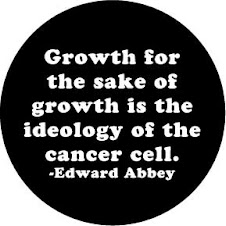
What have you done today to lower your impact?

We are washing away the foundations of our existence on every front. It is high time we move from crashing about on the planet like a bull in china shop and find a way to go forward with intent. We must find systems of living based on sustainability. The systems and tools exist, it is up to each of us to adopt them.

Friday, 31 October 2008

James H Kuntsler


James H Kuntsler wrote a book called "The Long Emergency", among others, in which he lays out the rather grim future before us if we don't get our act together. He also pretty well predicted the current financial fiasco we find ourselves in. I really like his no bullshit approach. He doesn't waste time promoting half measures but lays out the depth of change necessary to stave off the worst effects of the calamities coming down the pike. In this article over at Organic Consumers Association he offers a typically hard hitting analysis of the current corporate scam called the bailout.

"...we are witnessing the two stages of a tsunami. The current disappearance of wealth in the form of debts repudiated, bets welshed on, contracts cancelled, and Lehman Brothers-style sob stories played out is like the withdrawal of the sea. The poor curious little monkey-humans stand on the beach transfixed by the strangeness of the event as the water recedes and the sea floor is exposed and all kinds of exotic creatures are seen thrashing in the mud, while the skeletons of historic wrecks are exposed to view, and a great stench of organic decay wafts toward the strand. Then comes the second stage, the tidal wave itself -- which in this case will be horrific monetary inflation -- roaring back over the mud flats toward the land mass, crashing over the beach, and ripping apart all the hotels and houses and infrastructure there while it drowns the poor curious monkey-humans who were too enthralled by the weird spectacle to make for higher ground. The killer tidal wave washes away all the things they have labored to build for decades, all their poignant little effects and chattels, and the survivors are left keening amidst the wreckage as the sea once again returns to normal in its eternal cradle."

Whenever I need some no nonsense take no prisoners analysis of our current survival experiment I turn to either Mr. Kuntsler or Alex Smith over at Radio Ecoshock.

School food and family farms


In another excellent article over at Organic Consumers Association, Diane Raymond points out that the US credit crunch and resultant necessary belt tightening have led some schools, 8700 so far, to source healthy fresh local food from from family farms. In my opinion the National School Lunch Program has become a vehicle for elimination of surplus agribusiness commodity food products and has led to a rising epidemic of obesity in school children.

"Nearly half of the children in the U.S. who attend private and public schools participate in the NSLP, a federally assisted meal program that dates back to 1946. While the NSLP does provide a low-cost (and in some cases, free) means of delivering lunch through subsidies to schools, the program has been widely criticized in recent years for contributing to America's obesity epidemic. According to the Sustainable Table, a non-profit organization dedicated to educating the public about the problems with our food supply, our children are not meeting the RDA of vitamins and nutrients under the current NSLP guidelines. Couple that with the skyrocketing price of food, which extends beyond the family table to the school cafeterias as well. Forced to consider lower-priced alternatives to fresh foods, many schools have no alternative but to rely on the cheaper, less healthy fare. A number of districts across the country are taking matters into their own hands and breaking the mold. Instead of doling out sodium and fat-laden chicken nuggets for lunch, they are opting to assist local farmers and provide healthier, locally grown foods to students."

Ms. Raymond also gives a list of steps to follow if you want to start a farm to school program in your community. Check it out. Organic Consumers Association

Thursday, 30 October 2008

Apologies from Robb

Hello all,
We've moved to a boarding school up near Pontefract. My web access is limited and as a result I have had to resort to posting exclusively through "share this" buttons on other sites. Normally I would include some explaination with these but am unable to at the moment. Sorry to post this way but I wanted to keep up a steady flow of relevant content and that is currently my only method. I will try to post when we are back in Sheffield but will be limited by time for the next 6-8 weeks. Please bear with me until the new year when I hope to get back to normal posting. If you are in the US, please don't forget to vote!
Thanks
Robb

Climate-proofing the World\'s Food Supply | Use Celsias.com - reduce global °Celsius

Climate-proofing the World's Food Supply | Use Celsias.com - reduce global °Celsius

Posted using ShareThis

John McCain: We know you by now ... | Use Celsias.com - reduce global °Celsius

John McCain: We know you by now ... | Use Celsias.com - reduce global °Celsius

Posted using ShareThis

Wednesday, 29 October 2008

9 Ways To Go Local

Locavore, locally sourced, local, we've heard it all....now here's 10 reasons going local is the way to go, or eat rather:

1. Food tastes better! It's newer and fresher!

2. Science says it's better for you, nutrients are lost over time, so the quicker it gets from farm to table the more nutrients are retained

3. It's safer, hopefully. Local farms are held more accountable because of their size, their names really do mean everything to them

4. Local food supports local farms and their families. The amount of traditional farmers in this country has dropped drastically and we've gotta get them back working the land! We don't want machines doing everything do we?

5. Local food builds your community spirit, you are aware of your actions and their impact

6. The more you support local farms, the more farm land will be preserved from being paved over.

7. Local food supports the environment by keeping fuel usage down for example

8. Supporting local farms is like investing in your future and the future of your community. By ensuring your local farms maintain their business against bigger, more machine driven farms.

9. Local farms sell to many places, but the most obvious is your local farmer's market! It's so meaningful buying directly from the farmer, they make more money by dealing with their consumers directly, they cut down on fuel, and like shouting I CARE ABOUT MY FOOD FUTURE to the world!

Support Local Farmers!

Posted using ShareThis

California, America\'s ‘Leader of the Pack\', to Address Factory Farming | celsias°

California, America's ‘Leader of the Pack', to Address Factory Farming | celsias°

Posted using ShareThis

No Child Left Inside: Why We Need to Get Kids Outside | celsias°

No Child Left Inside: Why We Need to Get Kids Outside | celsias°

Posted using ShareThis

Sunday, 26 October 2008

Debt, usury, and plunder of the commons

$10, 533,580,803,241,82
That's the US debt as of 26 Oct 2008 at 08:35:16 AM GMT.
Thanks to the US National Debt Clock.

While Cheney and Bush laugh all the way to the bank, watching their 11th hour efforts to completely privatize all aspects of life succeed in a big way, the people on your street are losing their homes, their jobs, their schools, their health care.

Naomi Klein, in a lecture, over on Radio Ecoshock, drawn from her book "The Shock Doctrine, the Rise of Disaster Capitalism" maintains that this recent plundering of the commons by corporate raiders is not only a transfer of wealth to the elites but also an attempt by the right to insure that the next president does not have the resources necessary to transition the US economy away from exploitative, extractive, and war mongering industries towards a greener sustainable foundation. They will maintain that we cannot afford it due to so called "economic and financial realities" as defined by the very thieving industries that create these harsh realities. Sound far fetched?

Klein says we've seen it before. President Clinton abandoned his attempts to reform NAFTA towards social justice and fight for his universal health care plans on the advice of treasury secretary Robert Rubin that he accept "economic realities".

Guess what, Robert Rubin is one of Obama's top economic advisors. The fox is not only in the hen house he has set up shop and is raising the chickens for his own personal slaughter.

Friday, 24 October 2008

Bye Bye Buzz?

There really is no substitute for honeybees. Whether it's the gazillion tonnes of pesticides we pollute our food, land and water with every year, an Israeli virus, extreme lack of diversity through our insane enslavement to monoculture, or genetically modified plants, the honey bees are dying at an alarming rate. They are a vital part of the ecosystem which provides us with food, and everything else we really need for that matter. What can you do about it? Make your yard Bee Friendly for a start. Honey Gal, a teacher of bee stewardship and a contributor to the forum over at the Organic Consumers Association, has these suggestions;


"Plant a flowering herb garden. Bees use herbs medicinally and your plants can help make a difference. I suggest rosemary, sage, THYME (lots of it), marjoram, chives, basil, all the mints and other herbs with flowers. Bees will find them. To do more, plant native flowering bushes, too. In our area (WA) spirea and goldenrod are bee magnets. Try to have flowers in bloom through into fall.


Put out a big shallow dish of water with sticks or moss in it (so they don't fall in) and keep it moist. If you can get seaweed, bees are particularly fond of the minerals so I keep a little pile of seaweed in the "bee pond." All these small actions add up and make it a little easier on your local bees."


You can also support your local organic family farmer by buying his/her produce directly or in locally owned non chain shops.
Learn more;

Spikenard Farm

Organic Consumers Association forum

Monday, 20 October 2008

Whew! At last an "energy expert" VP! - By Robb

Boy am I relieved. Now that John McCain has an "energy expert" as a VP candidate I can sleep better at night knowing that the US energy future is secure.

What with 45 new Nuclear power plants providing 3 QBtu's by 2030 and all that wonderful offshore oil he wants to drill for providing .5 QBtu's by 2030 I'm sure we will be just fine. After all, projections indicate that with business/growth/lack of foresight as usual the US will need a mere 118 QBtu's by 2030.

So, hmmm, that's 2.5% from 45 nuclear plants at the cost of how many billions per plant, $4.9 billion per reactor or there abouts. Not to mention the unknown costs of decommissioning and waste storage, two things we don't even know how to do safely yet. And let's not forget that the fuel is set to get really scarce in about 40 years which will drive up the costs considerably.


Thankfully if we allow the oil industry, those trustworthy fellows who have taken such good care of us up to now, to despoil our coastlines we'll get a staggering .42% of our needs there. And goodness knows if McCain follows GW's lead, which McCain reminds us he has done 90% of the time up till now, he won't even make his oil buddies pay any royalties not to mention the billions of corporate welfare those cash strapped good ole boy American oil prospectors deserve and demand from the taxpayers of America.

Yessirree I feel loads better knowing he's got an "energy expert" helping him draft his bold new energy plan.

To find out more and to see a plan that could really deliver us from all evil, at least some of the evils that have been foisted upon us up until now by the Republicans, check out;

Architecture 2030

Thanks to Architecture 2030 for the graphics and figures for this post.

Soil, organics, and Co2 - by Robb

I've discussed the threats from modern industrial agriculture to one of our most valuable resources, our soil, in past posts.

Here are a few stats from my Soil Erosion post back in February of this year.

* The United States is losing soil 10 times faster -- and China and India are losing soil 30 to 40 times faster -- than the natural replenishment rate.
* The economic impact of soil erosion in the United States costs the nation about $37.6 billion each year in productivity losses. Damage from soil erosion worldwide is estimated to be $400 billion per year.
* As a result of erosion over the past 40 years, 30 percent of the world's arable land has become unproductive.
(http://www.news.cornell.edu/stories/March06/soil.erosion.threat.ssl.html Feb 2008)

This is the type of vital ecosystem service George Monbiot discusses in the article I linked to in my recent post,

Externalities?


Now I'd like to discuss some of the benefits of proper maintenance of that precious resource, our soil, through organic agriculture. Rodale Institute has published some research cataloging the potential effects proper soil husbandry can have on global warming. Much of the information and graphics for this post is drawn from the report.

Aside from the obvious benefits of growing food, providing a base for vegetation that prevents erosion, acting as a sponge to mitigate the effects of flooding, reducing pollution from agricultural runoff, the soil offers other less well known services. If treated properly soil sequesters carbon, it actually locks up more carbon than the vegetation growing on it.

"On a global scale, soils hold more than twice as much carbon (an estimated 1.74 trillion US tons) as does terrestrial vegetation (672 trillion US tons)."

This is accomplished through the buildup of humic substances, soil organic matter or SOM, in the soil that allow long term carbon storage. This SOM, which is primarily made up of carbon, is the heart and soul of organic agriculture. SOM is almost completely avoided in industrial agriculture which uses petrochemicals to replace the nutrients otherwise provided.

The naturally developed grassland soils that much of the American corn and soy crop grows in was originally comprised of 6-10% SOM. These soils have been degraded to typically 1-3% by industrial agricultural methods. Indeed, Rodales research over 27 years indicates that organic systems increased soil carbon by 30% while their similar petrochemically managed fields showed no increase in carbon.

This effect is largely down to a beneficial environment for fungi which is fostered by organic methods. No only does fungi assist in the processes necessary for carbon sequestration but,

"Mycorrhizal fungi structures enhance the ability of plant roots to access soil moisture and nutrients, produce stable compounds to sequester carbon dioxide as soil carbon, and slow decay of soil organic compounds."

Fungi is most amazing stuff. For more on that check out the work by Paul Stamets at Fungi.com.


Additionally the practices of organic fertilization and cropping diversity stimulates carbon sequestration whereas petroleum based practices and mono cropping stimulates quick decay of SOM thus releasing carbon into the atmosphere.

Organic practices like cover crops and composting have direct benefits to the atmosphere in that they use 33% less fossil fuel in the farming practices themselves compared to petroleum fertilizer based practices. Further Rodale research has shown that,


"the use of composted manure with crop rotation in organic systems can result in carbon sequestration of up to 2000 lbs/ac/yr. By contrast, fields under standard tillage relying on chemical fertilizers lost almost 300 pounds of carbon per acre per year."

If all 43 million acres of cropland in the US were to use these methods 1.6 billion tons/yr would be sequestered, around 25% of the total US fossil fuel emissions.

Here are some more facts about Organic agriculture from the Organic Consumers Association,

  • If organic farming methods were practiced on all the planet's food-growing land, it would be like taking more than 1.5 billion cars off the road.
  • You can increase your antioxidant intake by 30 percent by choosing organic.
  • The average child in America is exposed to five pesticides daily in their food and drinking water.
  • The U.S. water system is regularly contaminated above safe limits immediately following chemical fertilizer applications to farm fields.
  • Farms in developing countries that use organic techniques produce an average of 79% more than farms that don't.
So it seems clear that organic agriculture produces healthier food, more food, is far less damaging to the soil and surrounding ecosystem, and can help mitigate global warming and climate change. It looks like the sustainable choice to me.

Thanks to Rodale Institute for the report from which most of this post is drawn and the Organic Consumers Association for pointing me in that direction and for additional facts.