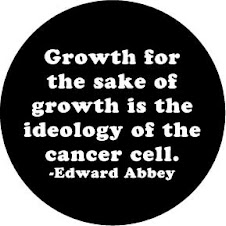
What have you done today to lower your impact?

We are washing away the foundations of our existence on every front. It is high time we move from crashing about on the planet like a bull in china shop and find a way to go forward with intent. We must find systems of living based on sustainability. The systems and tools exist, it is up to each of us to adopt them.

Tuesday, 16 June 2009

Mediocrity is unacceptable.


Over on another site where I publish a blog, AltGlobe, I have recently been held up as a model of sustainable living. While flattered I must point out the danger in accepting this accolade. We must guard against the tendency to settle for the lowest common denominator when it comes to cutting greenhouse gas emissions, we simply do not have that luxury!

Do you think I'm kidding? Take a look at this post over on Climate Progress detailing the hellish future we face if we don't radically cut emissions. It deals with a new NOAA report assessing the likely impacts of business as usual. Here is an excerpt.

"The thermometer in this landmark U.S. government report puts warming at 9 to 11°F over the vast majority of the inland U.S. — and that is only the average around 2090 (compared to 1961-1979 baseline). On this emissions path, the IPCC’s A2 scenario, most of the inland United States will be warming about 1°F a decade by century’s end. Worse, we are on pace to exceed the A2 scenario (which is “only” about 850 ppm in 2100): See U.S. media largely ignores latest warning from climate scientists: “Recent observations confirm … the worst-case IPCC scenario trajectories (or even worse) are being realised” — 1000 ppm.... Much of the southern United States is projected to have more than twice as many days per year above 90°F by the end of this century."

We need to decrease our emissions by over 90%. My meagre efforts don't even come close, nor do the outcomes of the current climate bill in front of Congress. Of the facets of my lifestyle that I have direct control over there are still many that are unacceptable if I intend to cut my personal emissions by 90% or more.

I still use electricity generated from fossil fuel, unacceptable.

I still utilize air travel, even if never for holidays, unacceptable.

I still eat substantial quantities of imported food, unacceptable.

I still occasionally ride in a fossil fuel powered vehicle, unacceptable.

I still occasionally eat meat, unacceptable.

There are those who have foresworn all of these activities if not completely then to a much greater degree than I. They are the models not I.

I will continue to report on my efforts to improve my carbon footprint. Plans are afoot to do just that. Meanwhile I urge you to do the same and to lobby congress for ever more aggressive legislation to cut greenhouse gas emissions!

Mediocrity is unacceptable.

Sunday, 14 June 2009

The tyranny of the lawn

Just what is up with this obsession with that most unnatural of monocrop desecrations, the suburban lawn? What could be less green than a lawn? An oil refinery or chemical plant perhaps? probably but not by much as lawns are responsible for huge quantities poison being dumped on the earth and fouling our water ways. A NASCAR race track? Probably but very similar as each and every lawn seems to be responsible for an army of two stroke highly polluting machines wielded by poorly paid workers at least once/week leaving a cloud of toxic gas and many ringing ears from the cacophony.

Read more at The Future is Green about the travesty of the modern lawn.

Re-use in action, the High Line project


Thanks to the High Line website for the image. Go there for many more pictures of the project.

This is an excellent example of re-use of existing Manhattan infrastructure rather than allowing it to be torn down for new construction, "sustainable" or otherwise. Conversion of this derelict elevated railway into a green public space prevents needless further building, preserves access to sunlight by surrounding buildings, and gives the citizens a lovely gathering space high above the congested streets.

thanks to Worldchanging for the heads up on this.

Some thoughts about water

Growing up in the US I never saw a house without a water meter, unless there was no water supply. This was the case where I lived in New Mexico where all the water I used, though free, had to be carried up the hill in 5 gallon containers. While carrying 85 pounds of water up a hill was good physical conditioning this was a particularly strong incentive to conserve. Some of the first permaculture principles I ever saw put into action were on that land. My roommate built swales to halt rainwater runoff and direct it the pinion pines.

The western US has a long and interesting relationship with water. Personal rainwater harvesting was illegal until recently in the state of Colorado, where hundred year old water rights and laws are still in effect. It still is illegal in the state of Washington. The idea being that by interrupting the flow of water from my roof to the watershed I would be “stealing” water from the rightful owner, whoever held the rights to that watershed. Nevermind that I would be using it very efficiently and the rightful owner, probably a farmer or mining operation might be wasting it extravagantly. This is an unfortunate situation because simply by using water where it falls from the sky the carbon footprint is lower than using water that has to be purified, and pumped through miles of leaky water pipes. This is especially true in the UK where about a third of the water in the system is lost through leaky mains. (Harris and Borer 2005 p.279)

When I first moved to the UK I was astounded to discover that most homes don’t even have water meters. While this could be seen as a convenience it removes incentive to conserve. To borrow a concept from business management, you can’t manage what you don’t measure! Installing a meter, which should be free from your water company, will provide a incentive to conserve and will allow you to pay only for what you use. Typically a household that installs a meter will see a 30% reduction in water use. (Harris and Borer 2005 p.279)

As the UK sees more water restrictions due to changing weather patterns brought on by climate change there will be increased impetus to conserve. Mains water supply uses significant amounts of electricity to purify and pump and using pure water to flush toilets is wasteful. The trick is to find ways to cut usage without investment in expensive equipment that counteracts the savings. In subsequent posts I’ll discuss simple methods for doing just that.

References:
Harris, C. and Borer, P. 1998 - The Whole House Book; Ecological Building Design and Materials 2nd edition,

Still relevant - RFK challenges GDP

Wisdom from 40 years ago, a lesson still to be learned.
Thanks to Joe Romm over at Climate Progress for the heads up on this.

Thursday, 11 June 2009

Doctors call for a moratorium on GM Foods

As reported over at Organic Consumers Association

"The American Academy of Environmental Medicine was founded in 1965, and is an international association of physicians and other professionals interested in the clinical aspects of humans and their environment. The Academy is interested in expanding the knowledge of interactions between human individuals and their environment, as these may be demonstrated to be reflected in their total health. The AAEM provides research and education in the recognition, treatment and prevention of illnesses induced by exposures to biological and chemical agents encountered in air, food and water. .... Wichita, KS - The American Academy of Environmental Medicine (AAEM) today released its position paper on Genetically Modified foods stating that "GM foods pose a serious health risk" and calling for a moratorium on GM foods. Citing several animal studies, the AAEM concludes "there is more than a casual association between GM foods and adverse health effects" and that "GM foods pose a serious health risk in the areas of toxicology, allergy and immune function, reproductive health, and metabolic, physiologic and genetic health." The AAEM calls for:

* A moratorium on GM food, implementation of immediate long term safety testing and labeling of GM food.
* Physicians to educate their patients, the medical community and the public to avoid GM foods.
* Physicians to consider the role of GM foods in their patients' disease processes.
* More independent long term scientific studies to begin gathering data to investigate the role of GM foods on human health.

"Multiple animal studies have shown that GM foods cause damage to various organ systems in the body. With this mounting evidence, it is imperative to have a moratorium on GM foods for the safety of our patients' and the public's health," said Dr. Amy Dean, PR chair and Board Member of AAEM. "Physicians are probably seeing the effects in their patients, but need to know how to ask the right questions," said Dr. Jennifer Armstrong, President of AAEM. "The most common foods in North America which are consumed that are GMO are corn, soy, canola, and cottonseed oil." The AAEM's position paper on Genetically Modified foods can be found at http:aaemonline.org/gmopost.html. AAEM is an international association of physicians and other professionals dedicated to addressing the clinical aspects of environmental health. More information is available at www.aaemonline.org."

Wednesday, 10 June 2009

A sure fire route to happiness; reduce dependence on consumer goods

No debt, lower carbon footprint, reduced pollution, and more time for enjoying life because I can spend less time working for someone else just to pay for all the stuff, 99% of which ends up in the landfill within 6 months, see the video below.

In the case of items I have decided to own I work towards the least energy use I can, I use a pre-owned laptop instead of a desktop computer, when I've owned and operated an automobile I have only owned used models that achieve good levels of efficiency (though I strive to do without whenever possible), I address efficiency in the houses I live in. Energy efficiency is the lowest of low hanging fruit.

As Amory Lovins has said " We've found a Saudi Arabia under Detroit." By implementing lightweight materials in autos we can save "8.5 million barrels of oil a day...and it's a whole lot easier to find that oil than under 10,000 feet of water". Here Mr. Lovins is referring to the much touted "new" technology of drilling in deep water. The light materials he is referring to are available now.

As reported by Joe Romm over at Climate Progress "The energy efficiency provisions in the House energy and climate bill (H.R. 2454) could save $750 per household by 2020 and $3,900 per household by 2030, according to an analysis by the American Council for an Energy-Efficient Economy (ACEEE). "

Not only do these provisions pick the lowest hanging fruit in the battle against needless consumption which causes climate change but they also create jobs, "An ACEEE news release notes that not only will efficiency reduce the costs to consumers and businesses of cutting carbon pollution:

ACEEE estimates that approximately 250,000 jobs will be created by the energy efficiency provisions in H.R. 2454 by 2020, with a total of 650,000 jobs generated by 2030."


It is just common sense, why pay for something you are just wasting?

Monday, 8 June 2009

A simple recycled materials passive solar batch water heater, in Bermuda


The 30 gallon water heater tank and mirrors came from a bathroom renovation and were headed for the dump, the double pane windows from an apartment renovation, the lumber from two separate home renovations, the insulation lining the bottom, top and sides came from various packaging materials destined for the dump. The only materials purchased, to the tune of about $200, are the screws used to assemble it, the plumbing supplies, sealant and paint, as yet uncompleted as you can see.


We plumbed it entirely on the cold supply side of the regular electric water heater, this water comes directly from the rainwater harvesting tank under the house. The hot water line from this tank to the electric tank is fully insulated. As hot water is pulled from the water heater it is replaced by preheated water from this little tank, thus causing the electric hot water heater to run less. Valves will allow the solar heater to be dropped out of the circuit without shutting off the water system.

I don't have figures yet but the simple things I did when I moved in, turned down the hot water heater and put an electric crisper on a timer, reduced usage by 60kwh/month. I'm expecting more from this project. I hope to get my Killawatt from the UK to measure usage at some point.

I should also say that I got two contractors to provide quotes for a solar thermal panel system. One was just over $10,000 for a single flat panel and an insulated water tank. This did not include the plumbing. A similar system in the UK would be less than half that. The second contractor never got back to me with a figure. Judy, my landlord, could not afford that size of investment. At that point I began collecting materials.

Friday, 5 June 2009

Stop Monsanto's Genetically Engineered Wheat

I recently learned that chicken producers in the UK are complaining that sourcing feed with a minimum of GM ingredients, less than .9% as required by supermarkets, is getting harder and harder as Monsanto and their corporate bully ilk are tightening their control on frankenfood corn and soy production (as reported on Farming Today on the BBC ). Meanwhile the corporate profiteers are gearing up to re-invigorate the fight to frankenstein our wheat supply. You can join in the fight to keep this most traditional and basic of food staples a safe edible product by reading this article at Organic Consumers Association and follow the links to send a message of dissapproval.

Here is an excerpt from the newsletter;

"Stop Monsanto's Genetically Engineered Wheat

Monsanto and the biotech bullies are once again moving to tighten their grip on the world's food supply. Genetically engineered (GE) varieties now account for 70-90% of all conventional (non-organic) corn, soybeans, cotton, and canola grown in the U.S. Joining the growing menu of unlabeled and untested gene-spliced Frankenfoods, genetically engineered sugar (derived from GE sugar beets) hit store shelves in 2008. Now it appears that the most controversial crop of them all, Monsanto's GE wheat, is not far behind, at least if industry gets its way. Given that wheat is such a major global crop and essential ingredient in bread, breakfast cereals, pasta and other everyday foods, the force-feeding of unlabeled GE wheat on the public would represent a major conquest for Monsanto and the biotech industry.

Although Monsanto withdrew their applications to the U.S. and Canadian governments for approval of genetically engineered wheat in 2004 because of tremendous pressure from the OCA and hundreds of our allied public interest groups and farmers (as well as pressure from large food companies such as General Mills), it looks like we're in for another round of battle.

Wheat industry groups in the United States, Canada and Australia announced on May 14, 2009, they would work toward the objective of "synchronized commercialization of biotech traits in the wheat crop." For the sake of the Earth and public health, we must stop them."

Wednesday, 3 June 2009

OCA Web Video of the Week: The Genetic Conspiracy - Are Genetically Engineered Foods Dangerous?

Check out the Organic Consumers Association 3 part web video

The Genetic Conspiracy - Are Genetically Engineered Foods Dangerous?

What's wrong with genetic engineering the food supply?

I found this interview over at Organic Consumers Association

Arpad Pusztai and the Risks of Genetic Engineering

To Subscribe to the Non-GMO Report call 1-800-854-0586 or visit http://www.non-gmoreport.com/

Arpad Pusztai was one of the first scientists to raise concerns about the safety of genetically modified foods. In the late 1990s, Pusztai, a respected molecular biologist, conducted research on GM potatoes for the Rowett Institute in Scotland. The potatoes were genetically altered to produce lectins, natural insecticides, to protect them against aphids. Pusztai conducted feeding studies on rats and found that the potatoes damaged the animals' gut, other organs, and immune system. In 1998, Pusztai expressed his concerns about GM foods on a British television program and was promptly suspended and forced to retire from his position. Dr. Pusztai's research was later peer reviewed and published in The Lancet, a leading British medical journal.

You were initially supportive of genetically modified foods, is that correct?

Yes, I thought at the time on the basis of rather poor understanding of genetic modification that it was a good idea. As we progressed with our experimental work we found all the snags and I had to re-assess my ideas.

What negative impacts did you find with GM potatoes you were developing?

The first problem that we encountered was when we tried to correlate the protection of the potato plant leaves against aphid attack with the transgene expression level. We found there was very little or no correlation at all. That is a major flaw, sufficient to question the validity of the whole idea. The next was that the transgenically expressed insecticidal protein did not only damage the aphid pests but also their natural enemies, such as the ladybugs. What was particularly damaging for the validity of genetic modification was when we found that diets based on GM potatoes affected the growth, organ development, and immune reactivity of young rapidly growing rats. The final straw was when we showed that the damage originated not from the transgene and its expressed product but from the damage caused by the insertion of the transgene, probably due to insertional mutagenesis.

Why is genetic engineering a risky technology?

Gene insertion is a major problem. You cannot direct where the splicing of the genetic construct will happen. It is well known that when you insert a genetic construct into the DNA network of a plant, you create changes in that network. As a result, you will get changes in the functionality of the plant's own genes. They may become more active or silent. The effects will be unpredictable and uncontrollable. It can sometimes cause irreparable damage to the genome. This is insertional mutagenesis.

The biotechnology industry simply overrides this concern. They say we don't have to worry about it, and if you raise your voice, you are called a Luddite.

Fundamentally the science of genetic engineering is crap. One gene expressing one protein is the basis of genetic engineering, but the Human Genome Project discovered 23,000 genes, and there are 200,000 proteins in every cell. With this discovery, genetic engineering should have disappeared into the dustbin, but the biotechnology industry is so strong. Genetic engineering is a product driven technology. If you have enough money to throw at it, you can do many things. But the industry won't waste money on safety assessment.

What are some of the studies you are aware of showing negative health impacts of GM foods?

In addition to the organ ultrastructural studies showing up significant changes, the most important studies are ones that showed alterations in the immune system. The Australian study (showing that GM peas caused immune damage in mice), the recent Italian study (showing immune disturbances in mice fed GM corn), and the reproduction studies of Irina Ermakova and more recently the Austrian study (showing reduced fertility in mice fed GM corn).

Although the significance of these studies is questioned by the biotech industry and regulatory agencies, in scientific terms the writing is on the wall for the present genetic modification technique.

What type of safety testing do you think should be done on GM foods?

We could do more targeted safety testing using proper nutritional/toxicological, metabolic, cancer, immunological and reproductive studies to reassure ourselves that the major dangers have been eliminated. Most of the methodologies for these exist and have been used with new non-GM food protein sources in the past. Why are these not used?

GM food advocates try to discredit studies showing negative health or environmental impacts of GM foods and scientists who conduct the studies. You were forced to resign from the Rowett Institute. Why are GM food advocates so hostile to such research and what can be done to ensure that independent research on GM food safety is conducted?

The reason is simple: GM advocates' main reason for denying money and facilities for proper safety assessment is that they financially and socially benefit from the existence of GM products. We have to make society to understand that they and the state will have to pay for independent research.

Why are such limited funds available for research looking at health effects of GM foods?

It is not in the interest of the biotech companies, or most of the governments, to dig up data that could question the safety of GM products. For the industry GM is just another product and, if it is not acutely poisonous, their job is to sell as much as possible of it.

Do you believe that scientific research will conclusively show that GM foods pose significant health risks?

Yes.

10 Tips for Eating Healthier from the Good Guide

I like these guidelines from the Good Guide. Many of these suggestions will also improve the sustainability of your diet. For instance, meat and the production of it has been linked to vast amounts of fossil fuel use and methane emissions. It is recommended that one consume meat once or week or less to reduce greenhouse gas emissions.

Clearly, processing uses additional inputs of energy, as does industrial agriculture. Therefore, clean, organic, unprocessed foods are not only healthier but better for the planet. If you are concerned about sustainability as well, I would add; eat locally produced food where possible and research your fish choices very carefully as many fish, while healthy are under immense strain from over fishing.

1. Keep it Simple

Eat fewer processed foods. Heavy processing often decreases the nutritional value of foods, adds calories, and usually includes added sodium and chemical additives.

2.Think Small

Eat smaller portion sizes. Americans in general are eating more calories, more protein, and more fat than they really need. An average adult should eat 2000-2400 calories per day. With GoodGuide you can immediately spot the high-calorie items, like this pizza.

3. Eat Low/Eat High

Eat less sodium.
Find low-sodium products.

Avoid added sugar.
Find low-sugar products.

Eat more high fiber and whole grain foods.

Eat more fruits and vegetables.

4. Avoid Bad Fats

Eat less saturated fats and in particular trans fats. Trans fats have been correlated to coronary heart disease. Look for products that have zero trans fat or low saturated fats. When you can, choose low-fat dairy products and lean meats.

Beware: even products that say “0 trans fat” can still have trans fats because of some FDA labeling loopholes — look for partially hydrogenated oils in the list of ingredients.

5. Read the Fine Print

Always read the product health claims on food packaging with a grain of salt, or sometimes a heaping serving of skepticism!
Look for products that are labeled on whether they contain genetically modified organisms.

6. Eat Low on the Food Chain

Eat less red meat, which has a big environmental impact.

When you do eat meat, avoid the ones that were given hormones and antibiotics. Look for beef that is organic or grass fed. If you eat chicken, look for pastured chicken. If you drink milk, look for milk without growth hormones (rBGH or rBST). And as much as possible, eat lean meats and low-fat dairy products.

And, don't be fooled by packaging and marketing, you might be surprised by what‘s on the ingredient lists and in the nutritional facts.

7. Think Organic

When possible, eat organic meat, milk, cheese, baby food, and the fruits and vegetables that are likely to be high in pesticides.

Check out our list of the top foods to eat organic.

And always wash your fruits and vegetables.

8. Beware of Color

Avoid certain food additives, such as food colors currently being reviewed for bans (such as Yellow #5, Red #3, and Red #40).

See our list of colors that are being reviewed for elimination in Europe.

9. Go Fish

Try to eat one to two servings of healthy fish each week.
This means avoiding fish that are likely to be high in methyl mercury (such as Shark, Swordfish, King Mackerel, Tilefish, and Albacore Tuna) and fish high in PCBs (such as farm-raised Salmon and Catfish, Bluefish, and Striped Bass).

10. Let it Stick

To decrease your exposure to certain chemicals, cook your food in non-Teflon pans, fry at lower temperatures, and never microwave your foods in plastic containers (such as Tupperware) or covered in plastic wrap.