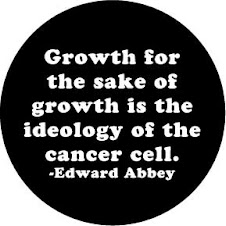
What have you done today to lower your impact?

We are washing away the foundations of our existence on every front. It is high time we move from crashing about on the planet like a bull in china shop and find a way to go forward with intent. We must find systems of living based on sustainability. The systems and tools exist, it is up to each of us to adopt them.

Friday, 5 June 2009

Stop Monsanto's Genetically Engineered Wheat

I recently learned that chicken producers in the UK are complaining that sourcing feed with a minimum of GM ingredients, less than .9% as required by supermarkets, is getting harder and harder as Monsanto and their corporate bully ilk are tightening their control on frankenfood corn and soy production (as reported on Farming Today on the BBC ). Meanwhile the corporate profiteers are gearing up to re-invigorate the fight to frankenstein our wheat supply. You can join in the fight to keep this most traditional and basic of food staples a safe edible product by reading this article at Organic Consumers Association and follow the links to send a message of dissapproval.

Here is an excerpt from the newsletter;

"Stop Monsanto's Genetically Engineered Wheat

Monsanto and the biotech bullies are once again moving to tighten their grip on the world's food supply. Genetically engineered (GE) varieties now account for 70-90% of all conventional (non-organic) corn, soybeans, cotton, and canola grown in the U.S. Joining the growing menu of unlabeled and untested gene-spliced Frankenfoods, genetically engineered sugar (derived from GE sugar beets) hit store shelves in 2008. Now it appears that the most controversial crop of them all, Monsanto's GE wheat, is not far behind, at least if industry gets its way. Given that wheat is such a major global crop and essential ingredient in bread, breakfast cereals, pasta and other everyday foods, the force-feeding of unlabeled GE wheat on the public would represent a major conquest for Monsanto and the biotech industry.

Although Monsanto withdrew their applications to the U.S. and Canadian governments for approval of genetically engineered wheat in 2004 because of tremendous pressure from the OCA and hundreds of our allied public interest groups and farmers (as well as pressure from large food companies such as General Mills), it looks like we're in for another round of battle.

Wheat industry groups in the United States, Canada and Australia announced on May 14, 2009, they would work toward the objective of "synchronized commercialization of biotech traits in the wheat crop." For the sake of the Earth and public health, we must stop them."

Wednesday, 3 June 2009

OCA Web Video of the Week: The Genetic Conspiracy - Are Genetically Engineered Foods Dangerous?

Check out the Organic Consumers Association 3 part web video

The Genetic Conspiracy - Are Genetically Engineered Foods Dangerous?

What's wrong with genetic engineering the food supply?

I found this interview over at Organic Consumers Association

Arpad Pusztai and the Risks of Genetic Engineering

To Subscribe to the Non-GMO Report call 1-800-854-0586 or visit http://www.non-gmoreport.com/

Arpad Pusztai was one of the first scientists to raise concerns about the safety of genetically modified foods. In the late 1990s, Pusztai, a respected molecular biologist, conducted research on GM potatoes for the Rowett Institute in Scotland. The potatoes were genetically altered to produce lectins, natural insecticides, to protect them against aphids. Pusztai conducted feeding studies on rats and found that the potatoes damaged the animals' gut, other organs, and immune system. In 1998, Pusztai expressed his concerns about GM foods on a British television program and was promptly suspended and forced to retire from his position. Dr. Pusztai's research was later peer reviewed and published in The Lancet, a leading British medical journal.

You were initially supportive of genetically modified foods, is that correct?

Yes, I thought at the time on the basis of rather poor understanding of genetic modification that it was a good idea. As we progressed with our experimental work we found all the snags and I had to re-assess my ideas.

What negative impacts did you find with GM potatoes you were developing?

The first problem that we encountered was when we tried to correlate the protection of the potato plant leaves against aphid attack with the transgene expression level. We found there was very little or no correlation at all. That is a major flaw, sufficient to question the validity of the whole idea. The next was that the transgenically expressed insecticidal protein did not only damage the aphid pests but also their natural enemies, such as the ladybugs. What was particularly damaging for the validity of genetic modification was when we found that diets based on GM potatoes affected the growth, organ development, and immune reactivity of young rapidly growing rats. The final straw was when we showed that the damage originated not from the transgene and its expressed product but from the damage caused by the insertion of the transgene, probably due to insertional mutagenesis.

Why is genetic engineering a risky technology?

Gene insertion is a major problem. You cannot direct where the splicing of the genetic construct will happen. It is well known that when you insert a genetic construct into the DNA network of a plant, you create changes in that network. As a result, you will get changes in the functionality of the plant's own genes. They may become more active or silent. The effects will be unpredictable and uncontrollable. It can sometimes cause irreparable damage to the genome. This is insertional mutagenesis.

The biotechnology industry simply overrides this concern. They say we don't have to worry about it, and if you raise your voice, you are called a Luddite.

Fundamentally the science of genetic engineering is crap. One gene expressing one protein is the basis of genetic engineering, but the Human Genome Project discovered 23,000 genes, and there are 200,000 proteins in every cell. With this discovery, genetic engineering should have disappeared into the dustbin, but the biotechnology industry is so strong. Genetic engineering is a product driven technology. If you have enough money to throw at it, you can do many things. But the industry won't waste money on safety assessment.

What are some of the studies you are aware of showing negative health impacts of GM foods?

In addition to the organ ultrastructural studies showing up significant changes, the most important studies are ones that showed alterations in the immune system. The Australian study (showing that GM peas caused immune damage in mice), the recent Italian study (showing immune disturbances in mice fed GM corn), and the reproduction studies of Irina Ermakova and more recently the Austrian study (showing reduced fertility in mice fed GM corn).

Although the significance of these studies is questioned by the biotech industry and regulatory agencies, in scientific terms the writing is on the wall for the present genetic modification technique.

What type of safety testing do you think should be done on GM foods?

We could do more targeted safety testing using proper nutritional/toxicological, metabolic, cancer, immunological and reproductive studies to reassure ourselves that the major dangers have been eliminated. Most of the methodologies for these exist and have been used with new non-GM food protein sources in the past. Why are these not used?

GM food advocates try to discredit studies showing negative health or environmental impacts of GM foods and scientists who conduct the studies. You were forced to resign from the Rowett Institute. Why are GM food advocates so hostile to such research and what can be done to ensure that independent research on GM food safety is conducted?

The reason is simple: GM advocates' main reason for denying money and facilities for proper safety assessment is that they financially and socially benefit from the existence of GM products. We have to make society to understand that they and the state will have to pay for independent research.

Why are such limited funds available for research looking at health effects of GM foods?

It is not in the interest of the biotech companies, or most of the governments, to dig up data that could question the safety of GM products. For the industry GM is just another product and, if it is not acutely poisonous, their job is to sell as much as possible of it.

Do you believe that scientific research will conclusively show that GM foods pose significant health risks?

Yes.

10 Tips for Eating Healthier from the Good Guide

I like these guidelines from the Good Guide. Many of these suggestions will also improve the sustainability of your diet. For instance, meat and the production of it has been linked to vast amounts of fossil fuel use and methane emissions. It is recommended that one consume meat once or week or less to reduce greenhouse gas emissions.

Clearly, processing uses additional inputs of energy, as does industrial agriculture. Therefore, clean, organic, unprocessed foods are not only healthier but better for the planet. If you are concerned about sustainability as well, I would add; eat locally produced food where possible and research your fish choices very carefully as many fish, while healthy are under immense strain from over fishing.

1. Keep it Simple

Eat fewer processed foods. Heavy processing often decreases the nutritional value of foods, adds calories, and usually includes added sodium and chemical additives.

2.Think Small

Eat smaller portion sizes. Americans in general are eating more calories, more protein, and more fat than they really need. An average adult should eat 2000-2400 calories per day. With GoodGuide you can immediately spot the high-calorie items, like this pizza.

3. Eat Low/Eat High

Eat less sodium.
Find low-sodium products.

Avoid added sugar.
Find low-sugar products.

Eat more high fiber and whole grain foods.

Eat more fruits and vegetables.

4. Avoid Bad Fats

Eat less saturated fats and in particular trans fats. Trans fats have been correlated to coronary heart disease. Look for products that have zero trans fat or low saturated fats. When you can, choose low-fat dairy products and lean meats.

Beware: even products that say “0 trans fat” can still have trans fats because of some FDA labeling loopholes — look for partially hydrogenated oils in the list of ingredients.

5. Read the Fine Print

Always read the product health claims on food packaging with a grain of salt, or sometimes a heaping serving of skepticism!
Look for products that are labeled on whether they contain genetically modified organisms.

6. Eat Low on the Food Chain

Eat less red meat, which has a big environmental impact.

When you do eat meat, avoid the ones that were given hormones and antibiotics. Look for beef that is organic or grass fed. If you eat chicken, look for pastured chicken. If you drink milk, look for milk without growth hormones (rBGH or rBST). And as much as possible, eat lean meats and low-fat dairy products.

And, don't be fooled by packaging and marketing, you might be surprised by what‘s on the ingredient lists and in the nutritional facts.

7. Think Organic

When possible, eat organic meat, milk, cheese, baby food, and the fruits and vegetables that are likely to be high in pesticides.

Check out our list of the top foods to eat organic.

And always wash your fruits and vegetables.

8. Beware of Color

Avoid certain food additives, such as food colors currently being reviewed for bans (such as Yellow #5, Red #3, and Red #40).

See our list of colors that are being reviewed for elimination in Europe.

9. Go Fish

Try to eat one to two servings of healthy fish each week.
This means avoiding fish that are likely to be high in methyl mercury (such as Shark, Swordfish, King Mackerel, Tilefish, and Albacore Tuna) and fish high in PCBs (such as farm-raised Salmon and Catfish, Bluefish, and Striped Bass).

10. Let it Stick

To decrease your exposure to certain chemicals, cook your food in non-Teflon pans, fry at lower temperatures, and never microwave your foods in plastic containers (such as Tupperware) or covered in plastic wrap.

Saturday, 30 May 2009

Peak Oil explained in video

Organic Consumers Association has posted a series of video's that very effectively explain peak oil and the situation we as planet find ourselves in as a result. One of my favorite points is that in 1985 when OPEC began basing its production quota's on stated reserves, all members raised their reserves overnight by 2X sometimes 3X! And the numbers haven't changed much, after all these years of production. The fact is that even the International Energy agency predicts the peak in worldwide production as early as 2015 and there is growing evidence that production peaked in 2008.

For more detail about Oil, our dependence on it, our willingness to wage war over it, and our unwillingness to deal with it's depletion in a meaningful way watch the videos over at OCA.

Friday, 29 May 2009

Foraging in Bermuda - Surinam Cherry


thanks to scentofgreenbananas for the image.

About the size of a bing cherry but not as sweet, these cherries don't really taste like a bing cherry. They are slightly astringent. More of a shrub or bush than a tree, they are found quite often growing as hedge along the road or railway trail. As usual I never pick fruit growing along roads, I don't really want to consume any more hydrocarbons than I already do.

When we were putting in a raised bed garden out at the east end of the island my friend Emily presented us with some surinam cherry juice mixed with a bit of lemon. I suggested that it would be really good with some Black Seal, the local dark rum. With a little sweetener, stevia or agave syrup, this concoction makes a delicious and refreshing drink.

Emily harvests the cherries and squeezes out the ample juice by hand, simultaneously removing the bitter skins and seeds.

This plant is considered invasive by some in south Florida.

You can read more about this delicious fruit at Dave's Garden. Here is an excerpt from a comment by foodiesleuth;

"We have two large shrubs in our yard - they are about 10' tall and about the same size in span. They are covered in fruit at this time and usually fruit twice a year.
I do not notice too many volunteer plants underneath. The birds don't seem to bother them and we have no squirrels.

The taste is sweet with a slightly tart undertone. I like making flavored vinegars with it. Wonderful in mixed fresh green salads, with some crumbled feta and chopped toasted macadamia nuts.

3 cups cherries
3/4 cup distilled vinegar
3/4 cup sugar
3/4 cup water

Cook until cherries are soft and mushy. Pass through a fine sieve, pushing as much of the pulp as you can through it. Beautiful ruby red color. Makes great gifts.

UPDATE RE: LARVAE:
I have never noticed any larvae on the fruit. We have had a huge crop of them this year and I have been making many different preserves and vinegars.....Made a wonderful trifle with the jam, vanilla pudding and angel food cake."