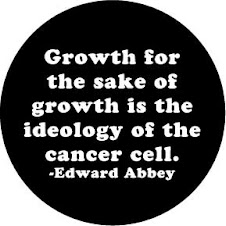
What have you done today to lower your impact?

We are washing away the foundations of our existence on every front. It is high time we move from crashing about on the planet like a bull in china shop and find a way to go forward with intent. We must find systems of living based on sustainability. The systems and tools exist, it is up to each of us to adopt them.

Tuesday, 26 May 2009

Sustainability or Resilience?

I recently went to a few lectures of a course the Bermuda Aquarium is hosting on the local ecology, sustainability and human economics.

In most cases the use of the term "sustainable development" seemed to be about finding a way to maintain an unsustainable level of development in a sustainable way. If this seems like an oxymoron to you, it did to me as well. This is certainly not unique to Bermuda. Helping businesses to find a way to do as little as possible to get a "green" label has become an industry in the US and the UK. But Bermuda is like a microcosm of the planet, isolated, with limited almost completely exhausted resources.

Bermuda is a high density island that lives an extremely high energy, as in fossil fuels, lifestyle. While driving small cars at mostly low speeds, practicing rainwater harvesting island wide and in some cases relying on the wisdom of their ancestors passive solar design knowledge, Bermudians are completely reliant on imports for almost everything. They generate electricity with imported oil, they exist on imported food and consumer goods (they do have some marvelous organic farms and a wonderful farmers market however), and they, much like Americans, are addicted to electronics, shopping, and high living. There is precious little open space, agricultural land is disappearing under condo developments, and what is left for growing food is often unused.

They do have an effective, well thought out, reliable and inexpensive mass transit system consisting of buses and ferries. It has reduced automobile traffic and increased opportunity for the citizens of the country to save money on auto related expenses. This system is an example of "sustainable development", one of the few on the island and stands as a model for many an American city.

So in this context, I pondered "sustainable development". In one instance the term was used by a planning officer who moments before admitted that the islands' lifestyle was already unsustainable.

There is a great deal of difference between "sustainable development" and developing sustainability. I believe the first, more often than not is impossible and represents a type of greenwash. A way to get projects approved as "sustainable" when the development can no longer come anywhere close to improving sustainability.

As David Fleming pointed out at the recent transition conference in the UK;

"... I asked him if he could explain why he sees resilience as being a better concept than sustainability. Sustainability, he said, is like the idea of an unsinkable ship, a nice idea, but completely unachievable, like, he added, a spouse that would always be completely faithful. The market economy depends on growth, and sustainability argues that we can grown AND sustain our ecology. The concept of sustainability allows us to grow economically and polish our haloes at the same time, to have our cake and eat it." - Rob Hopkins at Transition Culture


Perhaps it is time to shift to a new term, Resilience.

Here is an article on the subject by David Fleming from Transition Culture;

"**The Transition to Sustainable Resilience.**

**by David Fleming and Lawrence Woodward.**

Very big shocks are on the way. They include energy, climate, water and food, social fracture, displaced populations and pollution from unstable waste, especially nuclear waste. Sustainable development is not an adequate response to serial crisis. It is time now to move on to sustainable resilience. That means a political economy which can cope with shocks. It will need to be decentralised into relatively small-scale localised communities, so that:

• If one part is destroyed, the shock will not ripple through the whole system.
• There is wide diversity of character and solutions developed creatively in response to local circumstances.
• It can meet its needs despite the substantial absence of travel and transport.
• The other big infrastructures and bureaucracies of the intermediate economy are replaced by fit-for-purpose local alternatives at drastically reduced cost.

And that in turn opens up some new possibilities:

• Local closed systems conserving fertility and materials will become feasible.
• Local energy production, distribution and storage can be established, linked by local grids.
• Local social capital and culture can be rebuilt as a necessary condition for the cooperation and reciprocities needed to achieve the transition.

There are several degrees of sanity in this model. It is the only coherent response to the coming shocks. It is a realistic outcome of local initiatives. And such places will be good to live in, benefiting from the latest in technology, but not suffering from the latest in congestion and alienation. It has a chance of achieving the critical property of intelligent design: it is fit for the task. A large-scale economy which crashes very shortly after experiencing the first few outages in the supply of oil is not an intelligent design. Decentralised energy-efficient political economies, by contrast, have at least a chance. We need them now. We had better be quick about it

Being quick about it does not just mean starting soon; it means taking a route that can get there quickly. What matters now is to find the point of leverage – the point at which it is possible to steer the whole system by making it want to go the way you want it to go. The heart of the matter is energy. If we can find a way of moving down a steep energy descent, learning to get by with less and less energy, then we have the link to every other part of the system. It is like the child’s “cat’s cradle”: pull one string and all the rest come together. The low-energy economy has to be the localised economy; and localisation here includes a very substantial local contribution to the supply of food. It will not be possible to live within the energy constraint in any other way.

So, how to you make energy descent happen? By using Tradable Energy Quotas. Here are their main features:

• Every energy-user in the economy is included.
• The currency of the scheme consists of electronically-traded “TEQs units”, defined to represent specific quantities of energy, such as a litre of fuel; the definition may be based on (a) the global warming potential of the carbon released on combustion by that quantity of fuel, or on (b) actual quantities of the scarce fuels.
• All adults get a free and unconditional Entitlement to TEQs units. They can sell any surplus and top up their supply if they need to.
• All other users (e.g. businesses and public bodies) buy their units through a weekly Tender.
• There is a (rolling) 20-year TEQs Budget which reduces step by step, while clearly announcing the quantity of units that will be available in 20 years’ time.

>Individual carbon trading is also attractive because it appears to reach aspects of human behaviour which seem to be immune to other policies and programmes. It can both enforce and incentivise individual responsibility amongst a population which has so far appeared unable and/or unwilling to constrain its collective urge to drive, fly, and consume more electricity. And by explicitly involving the entire population in reducing carbon emissions, it maximises the collective intelligence and imagination applied to the task.
Simon Roberts and Joshua Thumim, Centre for Sustainable Energy – Report to DEFRA “A Rough Guide to Individual Carbon Trading” (Nov 2006)

TEQs guarantee that the Energy Descent will be achieved. They are equitable, since everyone gets the same Entitlement. They are efficient, because they are based on an efficient market, and they give everyone 20 years’ notice to cope with the structural changes that will transform our whole concept of the supply and use of energy (see Appendix 1).

Planned transition is a key process. It requires:

• A view of where you have to get to.
• A timescale.
• A way of involving everyone.

The model that at present we are calling “transition towns” cannot at present fulfil these criteria. It is hard for them really to commit themselves to the deeply unfamiliar vision of the low-energy/local-food (lo-lo) economy which the coming climacteric of peak oil and climate change will demand, or to commit themselves to the timescale set by the oil peak. It is impossible for them to include everybody: it will be an achievement if as many as one household in ten becomes seriously involved. And they are working in the context of a dominant and mature market economy, so they do not have the advantage of being able to go with the flow of a consensus about a deep change in the way we live, move, work and think: people with expensive families and flourishing careers are simply going to carry on for as long as they can.

And yet, the educative process in planning transition towns, the cooperative networks that are formed, and their experimental and practical results, are important. The people who are actually doing it are pioneers. They are taking ideas off the page and starting to work out how to make them stand up on the ground. And they have the crucial and rare insights that a liveable future will look sharply different from our present understanding of what “sustainable” means, and that it will take some time to build a future that works.

The twenty years of the TEQs Budget is about the time needed to develop Lean Energy far enough to begin to cope with the deep reductions in oil and gas that are on the way. The task for transition towns would be made much easier, and the whole concept would be seriously effective, if a TEQs scheme were up and running. It would then be possible for them to focus on how to achieve the transition to which everyone had already become committed, rather than how to commit people to it in the first place. Twenty years is slow, given the imminence of the problems, but it is quick, given the scale of the change that is needed. If an actual energy descent in the form of a binding TEQs budget within which we all had to live were in place, transition towns could get things moving locally and, by example, they could massively help things along in other places, too.

And while we are thinking about speed, it is worth giving a thought to what would happen if the outages that can be expected around the time of the oil peak, and increasingly after it, occurred before any substantial progress had been made in reducing the energy dependence of food production – and in some areas at least, reducing it dramatically. The immediate sequel would be food scarcities, mainly because of the lack of transport. Food would not get onto supermarket shelves in towns in sufficient quantities to feed urban populations. If food does not get in, the people living in towns will come out to get it. It could be hard for orderly transition towns to keep their crops, and indeed many of their other possessions, intact.

There would have to be a response by the Government: a “law-and-order” response which could be fierce, but also, in many ways, welcome. The effect of the Government’s longer-term policy, in the form of intervention in agriculture, may be less welcome. During the World War II, the War Agricultural Committees (“War Ags”) had draconian powers over farmers. They could order them to grow certain crops in certain ways, and if the farmers refused, the committees had the power to sequester their farms.

There could, in the future, be a stand-off between local organic farmers who used little energy to grow for their local customers, and the officially sanctioned methods of farming for unconditional maximum yield: agriculture will undoubtedly have priority for the use of whatever energy is available, and Government will use the leverage this gives them over farmers. Government insistence on intensive, large-scale, GM farming as part of a corporately run food distribution system, backed with the full power of the state, is a prospect we must try to avoid.

We need now to move fast. A mechanism, such as TEQs, for providing the framework and incentive structure for the transition needs to be put in place. Local initiatives that engage people, as transition towns are doing, are indispensable. In fact, “transition” itself is a little bit misleading. Things are not going to be as leisurely as that. The time for waiting is past. The oil peak and the climate are waiting for no-one. The shift from sustainable development to sustainable resilience is profound. It will be one of the big new story-lines in history. There have been four so far. This will be the fifth.

***************************************************************

David Fleming is Director of the Lean Economy Connection and originator of Tradable Energy Quotas. fleming@theleaneconomyconnection.net
Lawrence Woodward is Director of the Organic Research Centre (Elm Farm) lawrence.w@efrc.com.

Appendix 1. **Lean Energy.**
The three elements of Lean Energy are:
1. Energy efficiency: to achieve the decisive improvements in the efficiency of energy-services – and corresponding reductions in the demand for energy – made possible by the conservation and energy-saving technologies.
2. Structural reform: to develop the potential for local provision of energy, goods and services, according to the “Proximity Principle”. This major advance, which is difficult but necessary, and achievable only incrementally, will build local competence across the whole range of economics and culture. Deep reductions in travel and transport can be expected to come about rapidly and brutally as the oil market breaks down; adapting to them – and crucially, preparing for them before the event – will take longer.
3. Renewable energy: to design and build renewable energy systems to match the needs and resources of the particular place and site. Renewable energy programmes should not be started until (1) and (2) have been planned, at least in outline."

Monday, 25 May 2009

Not every barrel of oil is alike.

The impact of a barrel of oil varies greatly depending on where is comes from. Clearly, the eco-cide of the tar sands exploitation has a far greater impact than a barrel pumped from the ground in Texas. In fact a barrel of oil from the tar sands of Alberta generates five times more greenhouse gases in it's production. Unfortunately,as we feel more and more of the effects of peak oil the market for the tar sands oil will improve. All the more reason to wean ourselves off of fossil fuels as much as is humanly possible.

Just as barrels of oil differ in their impact so to do different companies. Apparently Shell wins the prize for the worst offender when it comes to producing the highest impact oil.

Read more about the differing impacts of oil depending on where it is sourced and what company produces it over at GreenPepper. Here is an excerpt;

"Shell tops the list for three reasons:
  • Its reliance on Nigerian crude oil, which is associated with huge levels of wasteful gas flaring
  • Its investments in highly energy intensive liquefied natural gas
  • Its massive gamble on Canada’s oil-bearing tar sands, for which the extraction process is so energy intensive that it produces up to five times more greenhouse gases than conventional oil

The bad news for Shell shareholders is that 30% of its total resources are now in tar sands. As the US moves to introduce carbon control legislation, and the world looks towards December’s Copenhagen summit for action to limit climate change, Shell is fighting a determined rearguard action - taking a lead in industry lobbying against similar measures being proposed by the Eurpean Union."

Sunday, 24 May 2009

Zero Carbon Britain

Zero Carbon Britain from Zero Carbon Britain on Vimeo.

Wales, the greenest country on earth?

Wales has made legally binding commitments to become energy self sufficient in 20 years through reliance on renewable energy. It will also reduce it's waste stream to zero by 2050. This plan truly embodies the term "sustainable development". While many countries and companies are attempting to brand their efforts as such, for the most part it is business as ususal with a slight nod to increasing efficiency where it can be profitable. There is a big difference between sustainable development and developing sustainability. Wales looks to be an exception to that rule.

Wales is fertile ground for such commitments to take root. Here are a few reasons I believe that is true.

• Wales has had a tradition of establishing it's differences from England, sometimes violently, for a long time. In the 70's they had a vigorous nationalist movement which expressed it's displeasure with negative effects of the increasing numbers of English holiday homes, rising house prices and erosion of communities, by burning some down. Devolution has allowed this urge to become legitimate and increased Wales' capacity for leadership. They have also kept their ancient and beautiful language alive.

• Much of the coal that the UK used to depend on was mined in Wales and when Maggie Thatcher shut down the industry in favor of North Sea oil and gas the economy was hard hit. Many of the methods developed at that time for increasing resilience did not die out due to some later economic boom, which never really occurred country wide.

• Over 30 years ago The Center for Alternative Technology, just outside of Machynlleth Wales, presented the UK with an energy plan that would move the nation towards sustainability and energy independence. They have now published a 30 year update called Zero Carbon Britain,
and are working on a plan for Europe. CAT is now offering fully accredited masters degrees relating to sustainability in the built environment and renewable energy technologies. I've just finished one of those.

• Due to this legacy of leadership Wales has a high proportion of citizens either actively working for sustainability or are at least sympathetic to it. The area around CAT is a particular magnet for open minded and progressive folks.

• Much of Wales is still rural and doesn't suffer from the degree of NIMBYism that England does. This has allowed it to benefit from alternative energy installations at every scale. Folks have been powering their cars with vegetable oil since the 70's, microhydro, solar hot water and PV are not uncommon, biomass boilers are increasing in number, and wind generation from microwind to wind farms are in evidence.

Over at Worldchanging you can read more about Wales' commitments. Here is an excerpt;

"We intend to reduce by 80-90% our use of carbon-based energy, resulting in a similar reduction in our greenhouse gas generation," said Jane Davidson, the Welsh environment minister, launching the sustainable development scheme at the Guardian's Hay festival. "We are committed to making annual 3% cuts in greenhouse gas emissions from 2011," she added.

"This is about living within our resources while improving people's well being. It will require radical changes in Welsh society," said Rhodri Morgan, first minister for Wales, which is currently celebrating 10 years of devolution.

The report sets out a series of ambitious goals:
• to produce more electricity from renewables than the nation consumes within 20 years
• increase recycling rates from 36% today to over 70% by 2025
• send just 5% of Welsh waste to landfill sites by 2025
• phasing out free plastic bags
• developing new marine and biomass energy plants

"Waste will be taboo. Heavy industry and power generation will greatly improve their energy efficiency," says the report, "there will be a consistent drop in energy and water demand."

Jonathan Porritt, the chair of the UK Sustainable development commission, said: "Wales will set an example for the rest of the world to follow. [Its] government is showing a serious commitment to making Wales a truly sustainable country."

Communities in south Wales will become part of one of Europe's few "low carbon regions", with 40,000 social housing homes equipped with solar, wind and heat-saving equipment.

Davidson said that £623m was expected to be spent in the next three years on improving energy efficiency in homes in Wales, which has some of the highest rates of fuel poverty rates. Most of the money will come from energy companies." - John Vidal

Friday, 22 May 2009

Get Former Monsanto Lobbyist off of the Food safety working group

"Agri-Pulse reported that former Monsanto lobbyist Michael Taylor, who has been serving on President Obama's Department of Agriculture Transition Team, was "the leading candidate to staff the White House [food safety] working group." Michael Taylor, who now promotes himself as a food safety expert, is a lawyer whose accomplishments include shepherding Monsanto's genetically engineered bovine growth hormone (rBGH) through Clinton's FDA as the Deputy Administrator for Policy." - OCA

Go to the Organic Consumers Association to send a message to Secretary Vilsack. Remove Michael Taylor from our nations' Food safety working group.

Peak Oil update


"World oil production (EIA Monthly) for crude oil + NGL. The median forecast is calculated from 14 models that are predicting a peak before 2020 (Bakhtiari, Smith, Staniford, Loglets, Shock model, GBM, ASPO-[70,58,45], Robelius Low/High, HSM). 95% of the predictions sees a production peak between 2008 and 2010 at 77.5 - 85.0 mbpd (The 95% forecast variability area in yellow is computed using a bootstrap technique)."

I found this chart over at the Oil Drum. It clearly shows the prediction that we are probably enjoying the peak right about now. Could it be that the rising oil prices we are currently experiencing, even though the economy is apparently still in the dustbin, are the first harbingers of far worse to come?

Sorry about the two grim posts from yesterday and today but every now and again I feel it is good policy to remind myself about what we are up against. While we luxuriate on the sofa, eating grapes. The Hydrocarbon Twins, climate change and peak oil, are moving their seige engines against the city gate!

Thursday, 21 May 2009

Expecting Grandchildren?


For those of you with children in the house you can probably expect to bounce a grandchild on your knee at some point in the next 20 years. That grandchild, if it survives the repeatedly forecast flu pandemic, or the red level threat from terrorists, or the dire effects of lack of credit, will likely live to see the next century. Now, ignoring the fabricated threats the media wants you to be afraid of, take a look at the threats predicted by cold hard science.

" Results of the studies are depicted online in MIT’s “Greenhouse Gamble” exercise that conveys the “range of probability of potential global warming” via roulette wheel graphics (shown above). The modeling output showed that under both a “no policy” scenario and one in which nations took action beginning in the next few years to reduce greenhouse gas emissions, the odds have shifted in favor of larger temperature increases.

For the no policy scenario, the researchers concluded that there is now a nine percent chance (about one in 11 odds) that the global average surface temperature would increase by more than 7°C (12.6°F) by the end of this century, compared with only a less than one percent chance (one in 100 odds) that warming would be limited to below 3°C (5.4°F).

To repeat, on our current emissions path, we have a 9% chance of an incomprehensibly catastrophic warming of 7°C by century’s end, but less than a 1% chance of under 3°C warming."

Should we not act decisively RIGHT NOW we can kiss the greenland ice sheet goodbye, raising sea levels approximately 20 feet, and a good portion of the antarctic ice sheet, raising them perhaps another 50 or more, agriculture worldwide will collapse, water shortages will be severe. I'll leave it up to your imagination to project the social upheavals that will follow.

Please contact your representative in Washington and express your support for the Waxman Markey climate bill. It is a small but necessary first step. After you have done that, plan a diet that reduces your family intake of meat, plan a schedule that reduces your automobile use, plan a renovation that enables you to stop using air conditioning, build a solar hot water heater, get some solar PV panels. If we don't lead, who will follow? Do it for your grandkids.

Read more about the MIT research at Climate Progress.

The Powerdown Show

Here is a taster of a series of videos called the "Powerdown Show" produced by Cultivate Dublin as an educational set for communities embarking on a Transition initiative. Thanks to Rob Hopkins over at Transition Culture for this.

The Powerdown Show - Transition Towns and Energy Descent Pathways from Rob Carr on Vimeo.

Can Genetically modified crops feed the World?

Here is the text of the daily audio from the Scientific American 60 Second Earth podcast by David Biello

"Humans have been genetically modifying crops for millenia the old-fashioned way—selective breeding. But new techniques that insert foreign genetic material, say bacterial genes to produce insecticide in a corn plant, have raised health and environmental concerns. And that has prompted European countries, most recently Germany, to ban genetically modified, or GM, crops.

Proponents argue that GM crops can help feed the world. And given ever increasing demands for food, animal feed, fiber and now even biofuels, the world needs all the help it can get.

Unfortunately, it looks like GM corn and soybeans won't help, after all.

A study from the Union of Concerned Scientists shows that genetically engineered crops do not produce larger harvests. Crop yield increases in recent years have almost entirely been due to improved farming or traditional plant breeding, despite more than 3,000 field trials of GM crops.

Of course, farmers have typically planted, say, GM corn, because it can tolerate high doses of weed-killer. And the Biotechnology Industry Organization argues that GM crops can boost yields in developing countries where there are limited resources for pesticides.

But it appears that, to date, traditional plant breeding boosts crop yields better than genetic modification. Those old farmers were on to something."—David Biello

Tuesday, 19 May 2009

Energy Payback on Solar Panels

Let's put this one to rest shall we? People keep asking me if solar panels don't actually take more energy to manufacture than they will ever produce. NO, NO, NO!

A new life cycle assessment adds yet another scientifically sound voice to that point. Read more in this article by Jeremy Faludi over at WorldChanging. Here is an excerpt;

" A recent life-cycle analysis published at the Institute of Science in Society (ISIS) showed that in a nice sunny place like Spain, PV panels reach energy payback (when they've saved as much fossil fuel as it took to make them) in about one to three years, depending on the type of panel. Interestingly, the new thin-film chemistry cadmium telluride (CdTe) fared best at 1.1 year despite having the lowest efficiency (9%), while monocrystalline silicon fared worst at 2.7 years despite having the highest efficiency (14%). This may seem counterintuitive, but the explanation is simple: it takes a lot less energy to make CdTe film....If your climate is less sunny than Spain, there will obviously be a longer payback time; but most of the continental US gets as much solar radiation as the location in the study. (It got 1,700 kWh/m^2/year, which is 4.7 kWh/m^2/day...."

I must say however that PV observers have been predicting the dominance of thin film over cyrstalline panels for close to 20 years and it never seems to happen. I hope Mr. Faludi is right but this next bit is worth taking with a grain of salt.

"Though thin-film PV panels have been in the market for more than a decade, the new chemistries that are coming to maturity (mostly CdTe and copper indium gallium selenide, "CIGS") are fundamentally changing the game. They are still not as efficient, but they are good enough, and they are far cheaper (up to 1/3 the cost per watt), even before reaching true economies of scale from mass-manufacturing. Now we see that they are environmentally preferable as well, since they have faster energy payback times. In the years ahead, crystalline silicon will become relegated to satellites, mobile systems, and other applications where compactness is king, while thin-film PV will be the default style. Crystalline prices will stay high, but thin-film prices will continue to drop steadily until they hit grid parity (arguably they have already), at which point they will plummet because manufacturing will ramp up massively. CdTe and CIGS will ultimately be price-limited by the rarity of their ingredients; the next wave after them will be dye-sensitized solar cells, made from common titanium dioxide and organic dyes. It'll be probably ten years or more before those dominate, though, and in that much time, who knows what other chemistries will come along? In any case, keep an eye out for it: the future of PV is thin."

Non GMO when buying dairy

Here's a list of Dairy products, alternative dairy products and infant formula indicating it's GMO status.

"DAIRY PRODUCTS &
ALTERNATIVE DAIRY PRODUCTS
Some U.S. dairy farms inject the genetically engineered hor-
mone rbGH, also called rbST, into their cows to boost milk
production—so be sure to purchase products with a label that
indicates cows free of rbGH or rbST. Many alternative dairy prod-
ucts are made from soybeans and may contain GM materials.
Dairy Products: Non-GMO
Certified Organic
Alta Dena Organics
Butterworks Farm
Harmony Hills Dairy
Horizon Organic
Morningland Dairy
Natural by Nature
Organic Valley
Radiance Dairy
Safeway Organic Brand
Seven Stars Farm
Straus Family Creamery
Stonyfield Farm
Wisconsin Organics

Produced Without rbGH

National
Alta Dena
Ben & Jerry’s Ice Cream
Brown Cow Farm
Crowley Cheese of Vermont
Franklin County Cheese
Grafton Village Cheese
Great Hill Dairy
Lifetime Dairy

West Coast

Alpenrose Dairy
Berkeley Farms
Clover Stornetta Farms
Joseph Farms Cheese
Sunshine Dairy Foods
Tillamook Cheese
Wilcox Family Farms
Midwest and Gulf States
Chippewa Valley Cheese
Erivan Dairy Yogurt
Promised Land Dairy
Westby Cooperative Creamery

East Coast

Blythedale Farm Cheese
Crescent Creamery
Derle Farms (milk with “no rbST” label only)
Erivan Dairy Yogurt
Farmland Dairies
Oakhurst Dairy
Wilcox Dairy (rbST-free dairy line only)


May contain GMO ingredients
Colombo (General Mills)
Dannon
Kemps (aside from
“Select” brand)
Land O’ Lakes
Parmalat
Sorrento
Yoplait (General Mills)

Alternative Dairy Products
Non-GMO
Belsoy
EdenSoy
Imagine Foods/Soy Dream
Nancy’s Cultured Soy
Pacific Soy
Silk
Soy Delicious
Sun Soy
Stonyfield Farm O’Soy
Tofutti
VitaSoy/Nasoya
WestSoy
WholeSoy
Yves The Good Slice
Zen Don

May contain GMO ingredients

8th Continent
BABY FOODS & INFANT FORMULA
Milk or soy protein is the basis of most infant formulas. The
secret ingredients in these products are often soy or milk from
cows injected with rbGH. Many brands also add GMO-derived
corn syrup, corn syrup solids, or soy lecithin.

Non-GMO

Baby’s Only
(certified organic products)
Earth’s Best
Gerber products
HAPPYBABY
Mom Made Meals
Organic Baby
Plum Organics

May contain GMO ingredients

Beech-Nut
Enfamil
Good Start
Nestlé
Similac/Isomil " - copied from the NON GMO Shopping Guide from The Center for Food Safety which you can download here at realfoodmedia.com

Monday, 18 May 2009

The Story of Stuff

This nice little educational video has been called anti-capitalist and leftist. I guess dealing honestly with the impacts of consumerism, understanding how what we use has a stream of waste behind it, and the potential of continuing to treat the planet as infinite is somehow a leftist practice. Does that mean that delusion, denial, and intentional misrepresentation of the facts is a right wing practice. Does capitalism have to be practiced in such a way as to doom itself? I guess I never thought that understanding how the world works was either left or right, just good ole common sense.