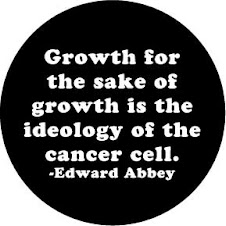
What have you done today to lower your impact?

We are washing away the foundations of our existence on every front. It is high time we move from crashing about on the planet like a bull in china shop and find a way to go forward with intent. We must find systems of living based on sustainability. The systems and tools exist, it is up to each of us to adopt them.

Thursday, 8 January 2009

You're eating WHAT?!

Currently Americans are not given the right of knowing what they are eating. The biotech companies have successfully controlled the regulatory process and prevented the labelling of Frankenfood, even though 90% of those surveyed said they would avoid this non food if they only knew. As a result 90% of Americans regularly consume frankenfood even though the evidence is mounting that it is poison!

Check it out over at Organic Consumers Association.

"here are some quick tips to help you avoid GMO ingredients and "Frankenfoods."


1) Look for products that voluntarily label themselves as GMO or GE-free.

2) Buy Organic: Products certified as "Organic" are not allowed to contain genetically modified ingredients.

3) Avoid non-organic products that contain the most common genetically engineered ingredients: corn (corn syrup, corn meal, corn oil, etc.), fructose, dextrose, glucose, modified food starch, ingredients including the word "soy" (soy flour, soy lecithin, etc.), vegetable oil, vegetable protein, canola oil (also called rapeseed oil), cottonseed oil, and sugar from sugar beets." (OCA)


Thanks to www.berghuis.co.nz/abiator/weird/bigrooster.html for the image

Lord Stern interview on the BBC


Lord Stern was one of the first of prominent people to prominently draw a link between climate and the economy. Hear a recent short interview from Jarvis Cocker with Lord Stern on how the current financial debacle offers us an opportunity to commit to meaningful action on climate change. Check it out on the BBC.

Dirty Coal strikes! Here and Now!

"On December 22 ... , over 1 billion gallons of toxic coal sludge came cascading through Eastern Tennessee. The tidal wave of sludge toppled houses and dirtied rivers and streams. This toxic coal ash has been stored in an open 40-acre pond next to the 50-year-old power plant. According to State authorities, after the spill there are 54,000 people with contaminated water in Roane County alone, and many more outside the county may also have tainted drinking water." (Gillian Caldwell at Huffington post january 7 2008)

This is appalling. It's not like it wasn't predicted, it was. It's not like we didn't know dirty coal was endangering not only our future here on this planet but mountain communities here and now, we did. The question is, what is being done about it? What are you doing about it?

Here are some things you can do;

take action over at 1Sky

reduce your electrical demand NOW!

contact your electrical supplier and demand that they cease sourcing mountaintop removal coal

get involved

Thanks to the Oildrum for the image

Wednesday, 7 January 2009

Give Coal the Boot!

Greenpeace - Kick start a green energy future

Give coal the boot! We must move beyond business as usual solutions!

C Robb

Fair Trade?

Are you a conscious consumer or even better a mindful citizen? Is Fair Trade a means to that end or not? Personally, I look for local organic, if that is not available I look for organic, then local, and then fair trade. I suppose one of the reasons I don't buy more Fair Trade is because I tend to avoid buying stuff from far flung locales, for example, I don't drink coffee, and I don't buy banana's. My weakness is dark chocolate and I usually end up with fair trade organic Divine chocolate available here in the UK.
Here's a link to an excellent discussion on Fair Trade over on AltGlobe.Link

Tuesday, 6 January 2009

Ancient Carbon Sequestration technology discovered!

Plant Trees and Create Healthy Soil, that's it, that's all there is to it.
Of course this means we'll have to stop treating forests and soil like they are just there to be wasted. That can't be too hard .... can it?

Lester Brown, the guru behind Plan B at the Earth Island Institute, lays it out for you over at celsias.

Here's an excerpt,

"A successful deforestation ban may require a ban on the construction of additional biodiesel refineries and ethanol distilleries. Against this backdrop of growing concern about the forest-climate relationship, a leading Swedish energy firm, Vattenfall, has examined the large-scale potential for foresting wasteland to sequester carbon dioxide. They begin by noting that there are 1.86 billion hectares of degraded land in the world--land that was once forestland, cropland, or grassland--and that half of this, or 930 million hectares, has a decent chance of being profitably reclaimed. Some 840 million hectares of this total are in the tropical regions, where reclamation would mean much higher rates of carbon sequestration.

Vattenfall estimates that the maximum technical potential of these 930 million hectares is to absorb roughly 21.6 billion tons of CO2 per year. If, as part of a global climate stabilization strategy, carbon sequestration were valued at $210 per ton of carbon, the company believes that 18 percent of this technical potential could be realized. If so, this would mean planting 171 million hectares of land to trees.

This area--larger than that planted to grain in India--would sequester 3.5 billion tons of CO2 per year, or over 950 million tons of carbon. The total cost of sequestering carbon at $210 per ton would be $200 billion. Spread over a decade, this would mean investing $20 billion a year to give climate stabilization a large and potentially decisive boost. This global forestation plan to remove atmospheric CO2, most of it put there by industrial countries, would be funded by them. An independent body would be set up to administer, fund, and monitor the vast tree planting initiative. Aside from the Vattenfall forestation idea, there are already many tree planting initiatives under way that are driven by a range of concerns, from climate change to desert expansion, to soil conservation, to making cities more habitable. ...

A number of agricultural practices can also increase the carbon stored as organic matter in soils. Farming practices that reduce soil erosion and raise cropland productivity usually also lead to higher carbon content in the soil. Among these are shifting from conventional tillage to minimum-till and no-till, the more extensive use of cover crops, the return of all livestock and poultry manure to the land, expansion of irrigated area, a return to more mixed crop-livestock farming, and the forestation of marginal farmlands.

Rattan Lal, a Senior Agronomist with the Carbon Management and Sequestration Center at Ohio State University, has calculated the range of potential carbon sequestration for each of many practices, such as those just cited. For example, expanding the use of cover crops to protect soil during the off-season can store from 68 million to 338 million tons of carbon worldwide each year. Calculating the total carbon sequestration for the practices he cites shows a potential for sequestering 400 million tons of carbon each year at the low end, and 1.2 billion tons of carbon per year at the more optimistic high end."

Once again the "technology" we need is right there in front of us, not 20 years off like the myth of clean coal. It's the technology of lifting our eyelids, a radical process of opening our eyes and our minds at the same time. Let's shift the $200billion out of the rich man's bailout program currently under way in Washington and Wall Street and pay for something truly worthwhile, a genuine investment in the future, the planet's future.


Monday, 5 January 2009

Bill Moyers interviews Michael Pollan

I recently read "Omnivore's Dilemma" and "In Defense of Food". Both excellent and both by Michael Pollan. If you are at all concerned about your food supply I highly recommend them.

Check out Bill Moyers interview with Michael Pollan at Bill Moyers Journal.

Thanks to city farmer for the image where you will find an article about Mr. Pollan as well as lots of other information about food and growing your own.

Saturday, 3 January 2009

Sunday, 21 December 2008

It´s Official, Peak Oil is soon!

The International Energy Agency has produced a report revising it´s projections for the onset of Peak Oil. Read George Monbiot´s assessment of the report compared to the IEA´s previous position over at celsias or at his own site along with his other articles.

Saturday, 20 December 2008

Sail assisted cruise ship

I caught a program on TV while hanging out in southern Spain about a couple cruising the Med in a small sailboat. In the background I saw this amazing craft. Check it out at the Professional Travel Guide site which is where I found the image.

Wind assisted shipping


Here´s an interesting post over on Roland Piquepaille´s Technology Trends
which is also where I found the excellent graphic. Thanks Roland.

"German designers, who tested a prototype last year, estimate that such a hybrid sailing ship would see a 50 percent reduction of its fuel consumption. Danish and Japanese companies are also designing wind-assisted ships."

The rest of the post is very interesting and is well worth a visit to the site.

Monday, 15 December 2008

Sailing

Hello all,
I´m back on dry land, caught up on my sleep and fresh produce consumption and am looking forward to getting back to the blog. We are still in Spain and have internet access only at the local internet cafe so I´m limited in what I can do at the moment. I´ve got lots of thoughts about increasing the use of sail for shipping and want to do a series of posts on it at some point. It will have to wait until I get more done on my thesis though as it will require some research.

For now suffice it to say that I don´t think a return to square rigged ships is the way forward as they are quite limited in their ability to go upwind and this affects their ability to sail to a schedule. Also the amounts of manpower required on a traditionally rigged brig is quite high. So much to think about. I believe some ships are using kites to increase fuel economy downwind. I hope to look into this at some point.

Thanks for sticking with us during my break and I hope to provide you with lots of content in the months to come.

Robb