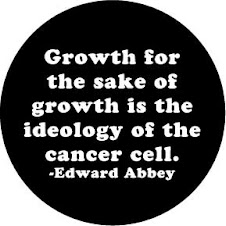
What have you done today to lower your impact?

We are washing away the foundations of our existence on every front. It is high time we move from crashing about on the planet like a bull in china shop and find a way to go forward with intent. We must find systems of living based on sustainability. The systems and tools exist, it is up to each of us to adopt them.

Thursday, 6 March 2008

Food part 2 - Meat - by Robb

I was vegetarian for over 20 years. Getting enough protein in your diet without meat is possible if careful attention is paid to proper food combining. I personally found that I was not focused and disciplined enough and began to suffer from problems related to deficits of protein in my diet. I could probably do better now but have grown used to eating meat again. We are very careful in our household to purchase free range chickens, from a farm just a pleasant 2 mile walk away, and sausage, from the local butchers shop. We would prefer organic chickens but have chosen local free range instead because of the food miles and packaging involved. We have meat as an entree 2 or 3 times a week. I cook two chickens together on the weekend and we eat from it till it’s gone and make soup and stock from the bones. On weeks we don’t have chickens we have sausages. We could increase our sustainability by making reductions.

My plan is to reduce our chicken consumption down to one per week for the 3 of us thus halving the impact from our chicken consumption, aside from the energy to cook it as it will take nearly as much time to cook one as two. We also eat 1 or 2 dozen eggs/week, free range, as well as organic cheese and milk for myself and my mother in law. My wife eats very few diary products. Dairy products have less of an impact than livestock raised for meat. Free range animals live a healthier and more natural life whereas organically raised livestock are also fed a much healthier diet with no chemicals involved.

Livestock husbandry requires tremendous input of energy, water, feed, and land. Livestock contributes to soil erosion, water pollution, and are themselves emitters of greenhouse gases. Zero Carbon Britain calls for a 66% reduction in British meat consumption as part of a sweeping plan to bring Britain to a zero carbon future. ZCB recommends that meat become a special occasion food as it once was as well as a flavoring agent for other meals rather than as a main course. Those who support a vegan diet claim that seriously addressing climate change is impossible without a large scale shift to veganism.

‘A report commissioned by the United Nations Food and Agriculture Organisation (FAO), the US Agency for International Development (USAID) and the World Bank concluded that factory farming, "acts directly on land, water, air and biodiversity through the emission of animal waste, use of fossil fuels and substitution of animal genetic resources. In addition, it affects the global land base indirectly through its effect on the arable land needed to satisfy its feed concentrate requirements. Ammonia emissions from manure storage and application lead to localized acid rain and ailing forests.’”
(Vegan Society)

While 25,000 people die every die from hunger related conditions the US feeds it’s livestock 60% of the grain harvest. A recent study in Canada suggests that beef raised on feedlots convert 2.5% of the gross feed energy, human edible grains, into usable food for human consumption while in the most efficient operations dairy cattle convert between 55 and 67% of their gross feed energy to human food. Meat heavy diets are especially damaging as they often rely on developing nations to devote land directly to livestock production or feed for export rather to feeding their own populations. With more and more arable land being lost to soil erosion how we use the remaining bit becomes increasingly important.

Land use per kg of food:
beef requires 20.9 m2/kg
pork requires 8.9 m2/kg
eggs require 3.5 m2/kg
milk requires 1.2 m2/kg
fruit requires 0.5 m2/kg
vegetables require 0.3 m2/kg
potatoes require 0.2 m2/kg

Additionally, growth hormones used in the meat industry are having dire consequences on the ecosystem as well as the health of consumers. Non organic livestock are typically fed with GM feed stock, with all the implications that brings, not the least of which is corporate control of food and loss of diversity in seed stock.

So can a sustainable lifestyle include consumption of meat? Surely if you produce your own meat or eggs, or even source them locally, provided they are organic and do not involve the importation of foreign grain for feed stocks then I’d say yes. But even then one has to consider the resources devoted to that production and do ones best to minimize consumption and impacts. I still have a ways to go on this one.

Thanks to the Vegan Society website http://www.vegansociety.com/html/environment/ for content.Link

Monday, 3 March 2008

A brief aside - by Robb

When I've had all the research, writing, and listening about sustainability I can stand I go for a walk. I put my iPod, purchased used, in my pocket and listen to some great science fiction. My podcast of choice is Escape Pod, well written and read science fiction with very thoughtful and thought provoking commentary. I highly recommend it

http://escapepod.org/

Science fiction is related my interest in sustainability because I find it an expression of the possible. The two interests intersect because quite often science fiction is set in some possible future, one where humans have risen above, or haven't, the challenges we face. This can be very reassuring, whether to my hope that we are capable of rising above or to my belief that the challenges are almost insurmountable.
I don't seem to be the only one who feels this way. Check this out

http://www.grist.org/feature/2008/02/21/bacigalupi/index.html

A very interesting interview about the intersection of environmentalism and science fiction.

Friday, 29 February 2008

Video - Vesco Back from Exhaustion Part 4

Video - Vesco Back from Exhaustion Part Two

Food part 1 - Soil erosion - by Robb

There are many issues surrounding food, it’s production, transportation, and consumption. I’ve already touched on some issues relating to corn production in the previous post. I’d like to go right back to the basic ingredients for production of healthy food; clean water, clean air and rich healthy soil. I’ll deal with more with clean water in later posts and clean air will require many posts as well. For now I’d like to start with soil.

Our entire civilization depends on our soil!


“Around the world, soil is being swept and washed away 10 to 40 times faster than it is being replenished, destroying cropland the size of Indiana every year....” reports a Cornell University study by ecologist David Pimental.

The same Cornell report points out that 99.7 percent of human food comes from cropland. Cropland is shrinking by almost 37,000 square miles a year due to soil erosion.

"Erosion is one of those problems that nickels and dimes you to death: One rainstorm can wash away 1 mm (.04 inches) of dirt. It doesn't sound like much, but when you consider a hectare (2.5 acres), it would take 13 tons of topsoil -- or 20 years if left to natural processes -- to replace that loss," Pimentel said.

If that isn’t enough to scare you here are some more stats from that report:
* The United States is losing soil 10 times faster -- and China and India are losing soil 30 to 40 times faster -- than the natural replenishment rate.
* The economic impact of soil erosion in the United States costs the nation about $37.6 billion each year in productivity losses. Damage from soil erosion worldwide is estimated to be $400 billion per year.
* As a result of erosion over the past 40 years, 30 percent of the world's arable land has become unproductive.
(http://www.news.cornell.edu/stories/March06/soil.erosion.threat.ssl.html Feb 2008)

So what’s going on? It seems clear we need to look carefully at farming methods. It is well known that tropical rainforests exist over very poor soils due to their amazing ability to very quickly recycle nutrients. So when these forests are cleared for farming or livestock the soil can only support a few years of crops before erosion washes it away. Stopping the clearing of tropical rainforests make sense on so many levels that it is frankly unbelievable that it continues.

Industrial farming methods are equally to blame. At every planting season the earth is laid bare to dry out and blow away. It is already weakened through overfarming and chemical usage and lack of organic matter to bind it together and hold moisture. According to Pimental in just one winter almost 2 inches per hectare (2.5 acres) of soil blew away from cropland in Kansas, the equivalent of 650 tons of topsoil per hectare. There is new evidence suggesting that the increasing dustiness of the US west has gotten much worse in the last 200 years and is due largely to intensive livestock grazing and railroad building. (http://www.livescience.com/environment/080225-west-dustier.html March 2008)

Low or no tillage farming is proving to substantially reduce erosion. Avoiding the plough and leaving mulch in the soil, even if only 20%, reduces erosion by 70% to 80% according to conservation agriculture trials monitored by the Catholic University of Leuven in Belgium. (http://news.bbc.co.uk/2/hi/europe/5274100.stm Feb 2008)

So what can an individual do about this? As with most efforts to live in a sustainable manner one begins with detailed examination of personal consumption. Where does your food come from? Does it contribute to irresponsible farming practices? Are all the calories you are consuming full of quality nutrition? The easiest solution is to grow your own food and drastically reduce meat consumption. By growing as much food as you can, organically, you can offset the food with unknown origination with food you know everything about. But if you can’t grow it, buy it. Organically grown food is much kinder to the soil as it depends on healthy soil for it’s production rather than on chemical fertilizers, herbicides, and pesticides. Buy supporting organic farming you will be encouraging conservation of the soil and getting healthier food in the bargain, a much more sustainable choice.

Video - Vesco Back from Exhaustion Part 1

The Epiphany of Enough by Dave

The populations of the developed world generally and the United States particularly are choosing more and enjoying it less. That's the basic premise of a book entitled, "The Paradox of Choice" by Barry Schwartz. This book is a great resource for reinforcing our commitment to living a balanced, sustainable life.
Schwartz examines the apparently contrary fact that, although people today have a veritable cornucopia of options to choose from...an array that has increased exponentially since the 60's, we also see a corresponding decrease in well being. Since 1960 in the U.S., the divorce rate has doubled,the teen suicide rate has tripled,the recorded violent crime rate has quadrupled,the prison population has quintupled, and the percentage of babies born to unwed parents has sextupled. Also, and perhaps the most telling of all, the rate of serious clinical depression has more than tripled over the last two generations, and increased by a factor of 10 from 1900 to 2000. Why all this in a culture that assures us that being in control of your needs and wants...the freedom of choosing...is the key to a happy, fulfilled life?
The author's conclusions lend new resonance to Orwell's anti-mantra, "Freedom is Slavery". This freedom we celebrate as a birthright comes with a curse: what economist Fred Hirsch called "the tyranny of small decisions". The many field studies Schwartz cites show that choice, in the modern age, has become burdensome, not liberating. A study in a hospital asked patients if they would prefer to choose their own mode of treatment should they contract cancer...65% said yes. However, when patients who actually got the cancer were asked, 88% said they would prefer that the professionals made that choice.
Other data presented showed that accumulations of wealth (i.e. more choices) did not always translate into increased happiness. People in wealthy nations are generally happier than people in poor nations,yes...money matters. But, once subsistence needs are met, surveys show that further increases in wealth don't seem to matter much.
Another interesting element is the discovery that the things that seem to make people the most happy, are the things that limit choices . Marriage for instance, and closer, more committed ties to family and religious institutions.....the kind of things that can't be easily opted out of. That part reminded me of a discovery I made when working in the theatre, building scenery. When I built sets on a tight budget, I had to get more creative about problem-solving, and the rewards for success were richer than later in my career when I could just throw money at the problem. The limitations became the reward.
So the dynamics of choice are seen to vary from a sense of helplessness at the extreme where a person has no choice at all, to a sense of empty ennui and depression at the other end.
Choosing when to choose is one corrective. Some control over choice is certainly rewarding.We don't want to give up on choosing altogether, like the somnambulent Eloi in H.G. Wells' "Time Machine", just waiting around listlessly to die, but neither do we want to invest too much in the expectation that mere choosing will enrich our lives and make us happy.
Schwartz encourages us to cultivate an "attitude of gratitude", and substitute an elusive and ultimately disappointing search for the "best", with a calm acceptance of the concept of "good enough".
I found all this to be yet more evidence that sustainable living is not a discipline that we need to shrink from as onerous, but an ideal to pursue for our own, and the planet's enhanced well-being.

Research tidbit - Lake Mead


Researchers at San Diego's Scripps Institution of Oceanography suggest that Lake Mead faces a 50% chance of drying up by 2021 if the drought continues and water use keeps rising. By 2017 Lake Mead will likely not be able to produce hydropower any longer. Lake Mead and Lake Powell are both half full. 25 million people in seven states rely on these lakes for water management.
Thanks to the National geographic website for the picture. Please click on the post title "Research tidbit - Lake Mead" to go to a more detailed discussion of this research.

Monday, 25 February 2008

Corn ethanol and Water in the US Part 5 - by Robb

In this discussion on living sustainably I have already mentioned food as a basic need. My next post will begin to look at food in more detail but for now let me wrap up this thread on corn ethanol with a move from it’s water implications to it’s impacts on food production.


Corn is Food

Of the total 93 million acres planted in corn in 2007, approximately 23 million acres were devoted to ethanol. (Food and Water Watch2007) 70 million acres of corn were used directly or indirectly for food production. The 2006 US output of ethanol was 6.5 billion gallons. (Platts 2007) The Congressional Research Service has stated:

“barring drastic realignment of US field crop production patterns, corn based ethanol’s potential as a petroleum import substitute appears to be limited by a crop area constraint.”

Tell the Bush administration because the US Dept of Energy and the US Dept of Agriculture have decided that the US has the land resources capable of producing 1.3 billion tons of biomass/yr by 2030 and that only 1 billion tons would be needed to displace 30% of the country’s oil use based on 2004 rates. Even the NRDC has gotten on board. The Natural Resources Defense Council reckons that biofuels could offset 25% of projected US transport oil consumption by 2050. (Food and Water Watch2007)

But what will be the effect on food prices? Ethanol production already has a deleterious effect on the poor who rely on the corn crop as a staple. Corn prices in Mexico rose 400% just 3 months resulting in civil unrest in Mexico in early 2007. (Jerome Taylor in “The World” 2007)

“David Pimentel,... has calculated that powering the average U.S. automobile for one year on ethanol (blended with gasoline) derived from corn would require 11 acres of farmland, the same space needed to grow a year's supply of food for seven people.” (Roger Segelken 2008)

It should be noted that Mr. Pimentel’s work on this issue has been called into question due to his research associate, Tad Patzek’s connections with the oil industry. More recent research is supporting his conclusions however.

Conclusions

The profligacy of the US extends beyond their driving habits; water use in the US is the highest in the world. According to the WWF report “Rich Countries, Poor Water”:

“In the USA, large areas are already using substantially more water than can be naturally replenished. This situation will only be further exacerbated by climate change scenarios of lower rainfall, increased evaporation and changed snow-melt patterns. Salinity threatens important irrigation areas and there is increasing anxiety over the level of contamination with chemicals and pathogens in water sources and water supplies.”

Ground and surface water pollution has resulted in an ecological catastrophe in the Gulf of Mexico and poisoned drinking water across the corn belt. The environment of the US cannot support a large scale expansion of the corn industry; indeed if anything it should be scaled back to a level that is achievable through sustainable and ecologically sound practices. There is not enough water, not enough arable land, and not enough GHG emissions reduction to be gained from an expanded corn to ethanol industry. If the subsidies currently going to support corn ethanol production, $7 billion in 2007, were instead shifted to the auto industry to help them rapidly achieve at least a doubling in CAFE standards, a much more substantive reduction in GHG emissions could be realized.

Committing to a large scale shift to corn based ethanol as a fuel for transportation in the US is a business as usual solution that threatens water quality and availability as well as making food even more unaffordable for the worlds poor. Further, cultivation of food crops for fuel means that more land will have to be converted into food crop production, whether it be rainforest, temperate wildlife habitat, or drained swampland. There is mounting evidence that this process has grave implications on GHG emissions as mature diverse wild lands tend to sequester carbon and their conversion to crop lands releases huge quantities of carbon into the atmosphere as well as methane.

I think we face a choice, would we rather eat, drink, and breath or drive an SUV?

Sunday, 24 February 2008

Video - Joanna Macy on The Great Turning

The Eighth Deadly Sin by Dave

We've all heard the rhetoric of "growth". It is a word that carries heavy and sacred freight whenever uttered within financial institutions, or on the world's airwaves. It's fundamental to our concept of economic health. If a pundit should detect figures that indicate growth running at 1 or 2 percent, it would be labeled "anemic" and "worrisome". I'm no economist, but as far back as I can remember, I've been troubled by this convention, especially since the publication in 1970 of our first photo of the entire planet seen from space...it looks blue and round, beautiful but fragile, and emphatically finite. Yet 38 years later, we never hear economic experts question the illogic of endless growth within a finite system.
What can this wealth we speak of be, but the systematic mining of the world's resources? To improve our mining techniques doesn't change the equation, it only postpones the eventual reckoning...a reckoning the pioneer biologist Robert Malthus would recognize immediately; i.e. a smaller rabbit population leads to a smaller wolf population which leads to a larger rabbit population which leads...etc.
Can we be more logical than rabbits or even wolves? Can we project our destinies into the future based on all the self-evident data? Certainly we can. Our failure to do so is caused by mere unwillingness...by fear. Of course a paradigm shift of this magnitude makes people fearful- we've been growing exponentially for at least 250 years. But does the alternative have to be scary? I submit that it's less scary than "staying the course".
The alternative is "zero-growth", a state that has lasted a lot longer than 250 years. Equilibrium or balance need not be a frightening scenario. On the contrary, it could prove to be the restorative that our species needs most. "Balance", as any athlete will tell you, is the most basic attitude to adopt in order to acheive maximum physical proficiency...in any discipline. Our species has lived in balance before...we can do so again.
As we seek this sustainable equilibrium, we'll need to re-visit religious and moral concepts, rejecting some values, while re-emphasizing or inventing others. A starting place that comes to my mind are the infamous "seven deadly sins", sloth, gluttony, envy, lust (what are the other three? somebody help me out here...avarice?). I don't think I'd take anything off the list...they're all in synch with the ideal of sustainability, but I'd certainly add a new one...Waste.
The false ideal of endless growth has enabled the appearance, at least in the developed world, of the eighth deadly sin. Perhaps the most appropriate icon for this sin, both for it's revolting vividness and the universal sense of wrongness it engenders, would be the vision, in the late 19th century, of hundeds of thousands of buffalo carcasses rotting in the sun, stripped only of their hides and tongues. An act so morally bankrupt as to leave Native Americans paralyzed with the shock of it...what is this white man not capable of doing? How can the Great Spirit allow it?
As we move forward into an uncertain future of dwindling resources, we must all train ourselves to consume with the same level of awareness and balance practiced by the North American plains Indians....oh Great Spirit, deliver us from the eighth deadly sin.

Corn ethanol and Water in the US Part 4 - by Robb

Efficiency and emissions in personal transport in the US

In the US, petroleum is primarily used in the transportation sector, 14 million barrels per day of the 20.6 mb/day consumed in 2006. In 2005 average fuel economy for all passenger cars was 22.9mpg, up from the 1990 average of 20.3mpg, for other 2-axle 4 tire vehicles, SUV’s, light trucks, vans and the like it was 16.2mpg, up from the 1990 average of 16.1mpg! 15 years of virtually no progress.

If we use a figure of 20mpg, roughly midway between the two figures above, for all light vehicles and the average distance travelled by the typical household of 24,800 miles multiplied by 104,700,000 households, we can calculate the average fuel used to be 1,240 gallons/household with a total for all households of 129,828 million gallons which breaks down to 3,091 million barrels of transportation fuel/year or 8.5 million barrels/day. (Rutledge 2006)

A standard of 40 mpg, easily achieved with current technology, would half that figure to 4.25 million barrels/day. That would be a reduction of GHG emissions of 50% from this sector which accounts for 20% of US GHG emissions, a total US GHG emissions reduction of 10%.

Ethanol, Energy, and Emissions

Corn grain ethanol only reduces GHG’s by 12% compared to gasoline with a meager 25% net energy gain, one of the lowest ratios of all biofuels. (Food and Water Watch 2007) In addition, ethanol has a more negative effect on air, water and soil quality compared to biodiesel. A study based on the 2005 crop from two institutions based in the heart of the corn belt, University of Minnesota and St. Olaf College, determined:

“In 2005, 14.3% of the US corn harvest was processed to produce 1.48x10¹⁰ liters of ethanol energetically equivalent to 1.72% of US gasoline usage...... Devoting all 2005 US corn and soybean production to ethanol and biodiesel would have offset 12% and 6% of US gasoline and diesel demand, respectively. However, because of the fossil energy required to produce ethanol and biodiesel, this change would provide a net energy gain equivalent to just 2.4% and 2.9% of US gasoline and diesel consumption, respectively.”

So referring back to the gasoline use figures mentioned earlier, and applying the 12% offset
.12 offset x 129,828,000,000 gallons = 15,579,360,000 gallons x .024 net energy gain = 373,905,000 gallons x .12 emissions reduction = 44,869,000 gallons

So for giving up the entire 2005 crop to ethanol the emissions from just 44,869,000 gallons of gasoline would have been offset, .035% of total usage in the sector which is responsible for 20% of overall GHG emissions resulting in a total reduction of .7%

There is much dissension on this issue. A 1995 USDA study found corn ethanol to have a net energy value 3X that found by ethanol dissenter, David Pimentel, and also compared many other studies. Results for net energy values of corn ethanol ranged from a low of -33,517 btu/gal (Pimentel) up to a high of +25,653 btu/gal.

The Pew Center on Global Climate Change estimates corn ethanol reduces emissions 20 to 30% compared to gasoline. If the more optimistic figure were used in the formula, using the same net energy gain, emissions reductions comparable to cutting 112,172,000 gallons of gasoline would result. This is .086% of total usage which would result in an overall US GHG reduction of 1.72% This is still a very small improvement in the GHG emissions situation in the US compared to improvements to be gained from higher fuel efficiency standards.